Exhuma, Explained: The Iron Stake and the Records We Could Open
From the research behind Pause the Drama.
In Exhuma (파묘, 2024), the geomancer insists on procedure. Kim Sang-deok (김상덕) is a jigwan (지관, 地官) — a specialist who reads whether a burial site is good or bad — and when a client asks him to simply dig up the coffin and move it, he walks the man through the order of things: report to the district office, open the coffin, let a funeral director collect the remains, and only then move or cremate. Touching the ground has a sequence. The Korean title names that act: 파묘 (破墓) means breaking open a grave, which gives the English title Exhuma.
And then this same procedural man stands in front of one particular grave and says he has spent forty years at this work and cannot read this place at all.
The film was a large commercial success in Korea in 2024. We give no admissions or chart figures here: we could not open a source to check them against, and this piece’s argument does not rest on the size of the audience. Still: why did a story about digging up one grave reach that far?
Late in the film, what comes out of that ground is no ordinary reburial. A coffin, the presence of a Japanese warrior, and an iron stake are tied into one thing, and the figure named as having driven that stake is a Japanese onmyōji called Murayama Junji. So: was this story made in 2024?
Quick answer: Exhuma’s iron stake has a real modern backdrop, but not a simple one. In 1995 the Korean government announced that it had removed 16 iron stakes in 11 areas — 438 reports from residents, 20 stakes found across 15 areas — describing them as driven by imperial Japan to extinguish the national spirit (Korea.kr, Gukjeong Sinmun, 14 August 1995, which we opened). That is the campaign’s own premise, not proof of when or why any individual stake went into the ground. Older Korean texts do hold suppression lore — the Goryeo-era Ho Jong-dan (호종단, 胡宗旦), whom the Goryeosa credits with 厭勝 sorcery, and a 1406 Taejong Sillok entry in which a Ming envoy drives copper nails into a tree and people suspect 壓勝 — but of the four Jeju passages in this piece’s table we opened two, and in neither does 地脈, earth veins, occur; the objects are 此土, this land, and 其氣, its energy. No source we found ties any of that older material to the film’s stake. The grave’s stake and its sorcerer are not in the records we opened — premodern texts, in which a twentieth-century figure would not be expected — and our account of the film follows a Korean-language script rather than a viewing.
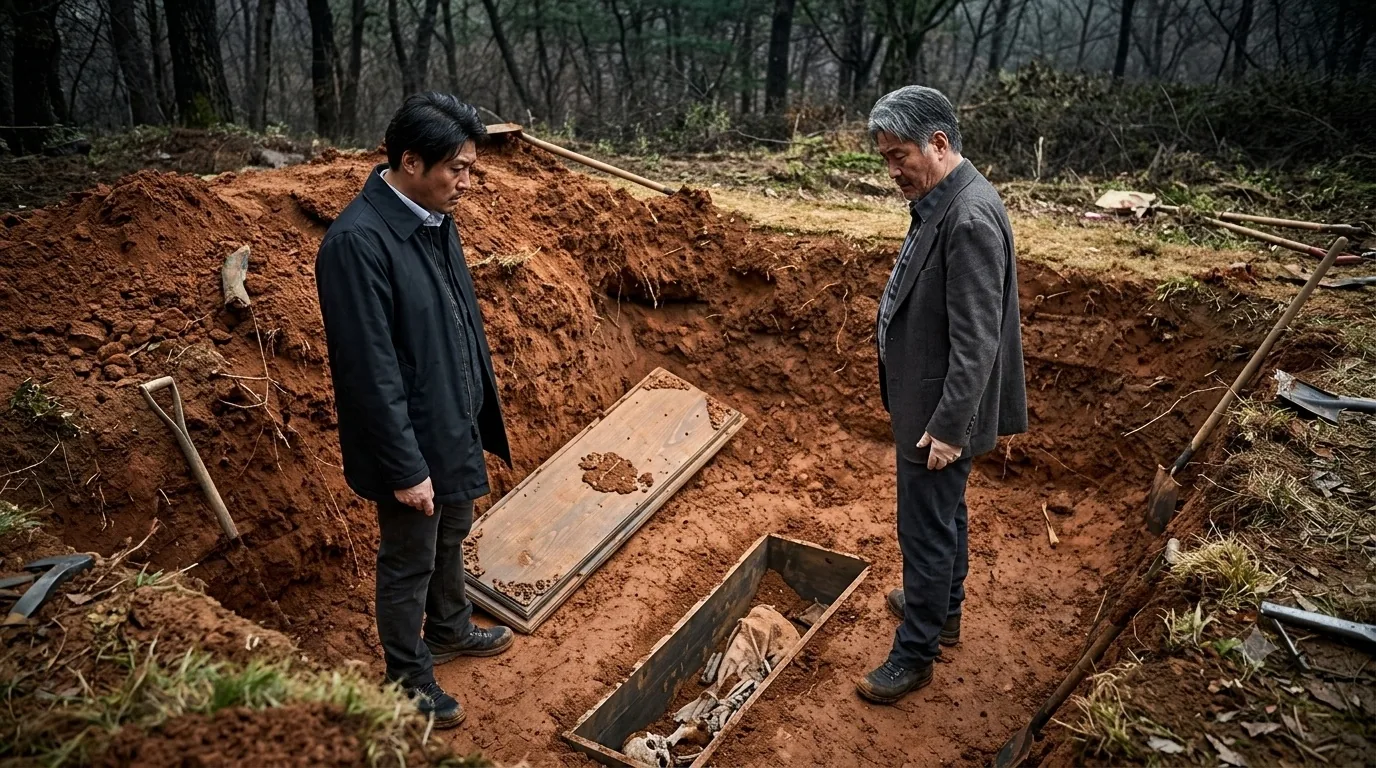 The premise in one image: a grave opened, and what comes out of it is not an ordinary reburial. This is an illustration, not a film still - our account of Exhuma follows a Korean-language script rather than a viewing. (AI illustration)
Let’s unpack it.
Did Exhuma invent its Japanese sorcerer?
The character is not in the records this piece opened, which are premodern and would not be expected to hold him, and we describe him from a Korean-language script rather than from the film. Older records do name outsiders who act on Korean ground — Ho Jong-dan from the fifteenth century, others later or at dates we could not fix — but naming them here is not a claim that any of them stands behind the film’s sorcerer. And the records do not describe one single act — motifs of defacing stelae, pressing down this land, and driving metal nails turn up in different sources that we could not arrange in one sequence.
One caution before we go on, and it matters: this is not a claim that those traditions inherited one another. We found no text showing such a descent, and the scholarship we consulted lists the figures typologically rather than genealogically. This piece deliberately avoids the word lineage.
Who was Ho Jong-dan?
He was a real official. By the Goryeosa he crossed from Song China and settled in Goryeo, won King Yejong’s favor, rose through office to Bomungak daeje, and later served King Injong as gigeo sain (起居舍人) — 「後事仁宗, 爲起居舍人」. The Goryeosa (고려사) says he was versed in miscellaneous arts and especially skilled at apseungsul (압승술, 厭勝術), a broad term for techniques believed to press down and subdue a person, an object, or a run of fortune (Goryeosa vol. 97, National Institute of Korean History). That biography, which we collated, carries no record that he cut the veins of the country.
A word about the text most often quoted beside it — and here we could read the source itself. The Dongyugi (동유기, 東遊記), by Yi Gok (이곡, 李穀), is a record of a journey that its own opening dates: “In the autumn of the ninth year of Zhizheng, the year gichuk (1349), meaning to tour Mount Geumgang, I set out from Songdo on the 14th.” It survives in the Gajeongjip (가정집) vol. 5 (Institute for the Translation of Korean Classics) and in the Dongmunseon (동문선) vol. 71. Standing at Samilpo lagoon, Yi Gok writes:
Each of these thirty-six peaks had a stele, and Ho Jong-dan took them all and sank them in the water; the base stones are still there today. This Ho Jong-dan came from the Tang of Li Sheng and took office in our country, and when he went out on circuit through the five circuits (五道), wherever he arrived he took the stelae and scraped off their inscriptions, or smashed them, or sank them in the water — and even the famous bells and chimes he stopped up by welding them with molten metal so that they would not sound.
Three things follow. What is recorded is damage to stelae and bells, not to veins of earth. The places named are in the Gwandong region and Gyeongju — Samilpo, Hansongjeong, Chongseokjeong, the bell of Bongdeoksa — and in the translated edition we collated, Jeju and Tamna are not mentioned at all. So we do not treat the Dongyugi as a text of the Jeju tradition, and we do not use it to date that tradition. Separately, and on its own account: in the ITKC translated edition we collated, nothing rendered as earth veins or blood veins appears — but the classical Chinese text is not collated, so we do not claim that the characters 地脈 and 血脈 themselves are absent, and in any case that is a finding about a Gwandong record, which we do not carry over to the Jeju passages below. (The translated Dongyugi also has him coming from “the Tang of Li Sheng,” where the Goryeosa has him from Song — but we do not set those beside each other as equal variants. We have not established which dynasty, or which person, “the Tang of Li Sheng” refers to. What the encyclopedia entry we opened does establish is that Ho Jong-dan was a man of Fuzhou in Song China who entered Goryeo service in 1111 and was still in office in 1126 (Encyclopedia of Korean Culture). As read, the Dongyugi’s phrase does not line up with those dates; we could not resolve it, we did not collate the classical original, and nothing here rests on it.)
What this fourteenth-century record does show, by itself, is that a story of this shape — an outsider defacing and sinking stelae, and sealing bells with molten metal — was already in writing, attached to Ho Jong-dan’s name, in another part of the country. Not an earlier stage of the Jeju tradition; a story of the same shape standing somewhere else.
Even the written name changes, and here the reason is on the record. The Goryeosa writes him 胡宗旦. The 1530 Sinjeung Dongguk Yeoji Seungnam, whose classical text we opened, writes him 胡宗朝 throughout its Jeju-mok — and the Institute for the Translation of Korean Classics’ textual note on that entry states why: the Goryeosa biography has 旦, and this book’s 朝 is a taboo substitution for 旦, the personal name that Yi Seong-gye, founder of Joseon, took after his accession (ITKC, classical text, note D006). The note adds that every 胡宗朝 in that Jeju-mok is the same case. The Tamnaji (탐라지) also writes 胡宗朝, in the phrase 高麗時宋胡宗朝來壓此土 as our script quotes it — we could not open that edition, so we say only that it looks like the same practice, not that it is. And that 宋 marks the dynasty he came from rather than part of the name is likewise not our inference: the 1530 entry we opened has 宋胡宗朝來壓此土. In Jeju oral tradition he is Gojongdal (고종달).
Do the Jeju records show one story growing, or several side by side?
Lay the Jeju passages out in order and it can look as if one tale grew steadily into the next. Read the classical Chinese wording of each as it actually stands — and note how much of it we could actually open — and that picture does not hold.
| Attested | Source | Who sent him | Recorded act and object | Checking |
|---|---|---|---|---|
| 15th c. | Sejong Sillok Jiriji, Jeju-mok | not stated | 鎭禳此土 — 鎭禳 is one term, a calamity-averting rite (Sillok gloss: 액풀이); the official translation reads a rite to pacify this land | Opened at the Veritable Records database (link in text) |
| 1530 (enlarged ed.) | Sinjeung Dongguk Yeoji Seungnam, Ducheon (두천, 斗泉) | not stated (the entry’s 宋 marks his dynasty of origin, not a sender) | 胡宗朝來壓其氣,遂亡 — came and pressed down its energy, and it was gone; the same volume’s Gwangyangdang entry has 來壓此土, and its compilers add ○按 … 來壓溺舟之說,恐不可信 | Translation and classical text both opened at ITKC (links in text); 地脈 does not occur in this Jeju-mok |
| 1653 | Tamnaji, Gwangyangdang | not opened — we do not report what it does or does not state | 來壓此土 — came and pressed down this land | Quoted in our script; original edition not located |
| 1918 | Tamna Ginyeon | not opened — we do not report what it does or does not state | 來壓山水之氣 — came and pressed down the energy of the mountains and waters | Secondary citation; original not collated |
| 20th-c. oral records | Jeju Gojongdal type (E0013573) | Qin Shi Huang, or the Goryeo court | Cuts the hyeol (혈), the vital point of a site said to hold the energy that would produce a king | Encyclopedia summary; oral collections not collated |
The 1530 volume enlarges the earlier Dongguk Yeoji Seungnam, first compiled in 1481 and revised more than once before 1530, so that date is bibliographic — not a claim that the motif began in 1530. The enlarged matter is marked 〔新增〕 in the text, and neither the Ducheon nor the Gwangyangdang entry carries that mark: neither is a 1530 addition. Which earlier state they belong to — the 1481 compilation, the 1485 correction or the 1499 revision — we did not establish.
Two things fall out of that table.
Where we could check, the wording is not the wording of “earth veins.” Two of these passages we can point you to. The first is the Sejong Sillok Jiriji Jeju-mok entry, which runs 適値胡宗旦鎭禳此土, 乘舟向江南 and which the National Institute of Korean History translates 「마침 호종단(胡宗旦)이 이 땅을 진무(鎭撫)하는 제사를 지내고 배를 타고 강남(江南)으로 떠나려 할 때」 — “just as Ho Jong-dan, having performed a rite to pacify (진무, 鎭撫) this land, was about to take ship for Gangnam” (Veritable Records of the Joseon Dynasty). 鎭禳 is not two verbs to be pulled apart but a single term of art. The Veritable Records gloss it 「액풀이」, the warding-off of misfortune — the annalists’ own note on 申明鎭禳 in a memorial of 1485 (Seongjong Sillok 16/1/5) — and the National Institute of Korean History translates this passage accordingly. Whatever exact nuance it carried at Jeju, the point that matters here does not depend on settling it: the characters 地脈 (jimaek, earth veins) do not appear, and no vein is named as the object. What kind of act it was we do not judge; we report what stands written. The Tamnaji’s 來壓此土 reaches us through the Korean script this piece works from; we could not locate the original edition to cite, so we no longer call it collated, and the axis of this section rests on the passages we can show. The second passage we can point you to is the 1530 Sinjeung Dongguk Yeoji Seungnam, vol. 38, Jeju-mok, which we opened in the Institute for the Translation of Korean Classics’ translated edition (ITKC). Its entry on the Ducheon (두천, 斗泉) spring — named for its shape, 斗 being a grain measure — reads 世傳飮此泉,能解飛百步。胡宗朝來壓其氣,遂亡: “It is told that whoever drank of this spring could fly a hundred paces; Ho Jong-dan came and pressed down its energy, and at last it was gone.” We opened the classical text here as well as the translation, so for this volume the characters are ours to report rather than to quote at second hand — and 地脈 does not occur anywhere in its Jeju-mok. That is now true of both passages we can show: the Sejong Sillok Jiriji’s 適値胡宗旦鎭禳此土 and the 1530 Jeju-mok. It is not a claim about the other two, which we have not opened, and it is not the claim we make about the Dongyugi, where we read only a translation and therefore say nothing about which characters stand in it.
One thing the characters show, and one thing they refuse to show — and the refusal matters more.
Three passages, three wordings. The fifteenth-century entry has 鎭禳此土; the 1530 volume has 來壓此土 at Gwangyangdang and 來壓其氣 at Ducheon. And one book holds both objects, 此土 and 其氣, so no line can be drawn between a “this land” stage and an “its energy” stage — which makes the 1653 Tamnaji’s 來壓此土 unremarkable rather than anomalous. Which of the three wordings came first, though, this piece cannot say, and here is why we cannot. The 1530 volume is an enlargement of the earlier Dongguk Yeoji Seungnam, first compiled in 1481 and revised more than once before 1530 — which of those earlier states it enlarged we did not establish. The enlarged matter is marked in the text: the Jeju-mok carries the mark 〔新增〕 at seven places — the town wall, the Byeolbang fort, two pavilions, an inscribed stone, a group of three officials under a single mark, and a filial son. It does not carry that mark at Ducheon, and it does not carry it at Gwangyangdang. Those two entries are not the 1530 additions; they stand in the older stratum the 1530 editors inherited, and how much older we do not know. So the date on the spine is bibliographic, as the note under our table says. What it leaves standing is narrow, and narrower than it first looks. The 〔新增〕 test shows only that the two entries are not part of the 1530 enlargement; the book behind that enlargement was itself compiled in 1481, corrected in 1485 and revised in 1499, and which of those states carried the Ducheon and Gwangyangdang wording we did not establish. What survives is this: 鎭禳此土 is attested in 1454, and all three candidate states postdate it, so in order of first attestation 鎭禳 still comes first. By how much, and whether anything about the wording actually changed in between, we cannot say — the earlier text may be recording something already old, and we have no way to measure it.
What the entries we opened have in common is narrow, and it is all we take from them: no 地脈, and no vein named as the object. We do not classify any of them as harm or as rite. The 1918 reading still comes to us through scholarly citation only, and the 1653 Tamnaji through our script, so we do not extend the finding to those two. Count what that leaves: of the four Jeju passages in the table we opened two, and the wording of the other two reaches us through citation — 來壓此土 in 1653, 來壓山水之氣 in 1918. Modern explanations often render such passages as “pressed down the earth veins”; in the two we opened in the original those characters do not stand there, though 氣 and 脈 belong to the same vocabulary and we do not claim the paraphrase is excluded, and this piece puts the classical wording ahead of institutional summaries. Note the scope too: this concerns these Jeju passages, not Joseon-period writing in general — vein-cutting traditions in other Joseon material, such as the Taengniji and the Imjinnok, are examined in the scholarship precisely because they are there.
Metal nails are older than the colonial period. In 1406 the Taejong Sillok records that Hwang Eom (황엄, 黃儼), a eunuch envoy from Ming China, drove copper nails (銅釘) into a tree, and that people at the time suspected it of being 壓勝, suppression sorcery (Taejong Sillok, 16th day of the 7th month, 6th year of Taejong). This is one of the passages we collated directly — and it has to be read precisely. The annal does not say Hwang Eom was pressing down Korea’s land energy. What it supports is narrower and still striking: an early case in which a foreign envoy’s metal nails were read by contemporaries as suppression magic. It is not a finished version of the iron-stake theory, and no source we found connects it to the stake in the film.
The versions recorded in the twentieth century are the most spectacular. At the Yongmeori coast (용머리해안) below Sanbangsan (산방산) on Jeju, the story goes that Gojongdal, sent on the order of Qin Shi Huang, found the shape of a dragon in ground famed as a site that would produce a king (王侯之地); when he cut the dragon’s body, blood ran from the rock, Sanbangsan groaned aloud, and no king was ever born on Jeju again (Encyclopedia of Korean Culture). Which part was cut differs by source — tail and back there, back and waist in the severed-vein entry (E0013573) — and we leave both standing. Yongmeori is in fact volcanic rock formed where magma met water, a Natural Monument since 2011; the story stayed anyway, probably — our reading, not the sources’ — because the thought of one’s own ground being damaged by another’s hand was a tremendous shock at the time.
Two cautions. The era a legend is set in is not the era it was made in: a version featuring Qin Shi Huang is not therefore older, and since we could not fix when that form first appears in writing, we record only that the encyclopedia entry describes it in twentieth-century oral tradition. And skepticism came early — early enough to be printed inside the gazetteer itself.
The 1530 gazetteer doubts its own story
The Sinjeung Dongguk Yeoji Seungnam’s Jeju-mok entry on the Gwangyangdang (광양당) shrine carries the fullest early form of the tale. Here it is entire, with the compilers’ note that closes it:
廣壤堂。在州南。漢拏護國神祠。諺傳漢拏山神之弟,生有聖德,歿爲神。高麗時,宋胡宗朝來壓此土,浮海而返。神化爲鷹,飛上檣頭。俄而北風大吹,擊碎宗朝之舟,沒于西境飛揚島巖石間。朝庭褒其靈異,賜之食邑,封爲廣壤王,歲降香幣以祭。本朝令本邑致祭。
○按:胡宗朝來仕高麗,官至起居舍人而卒,則來壓溺舟之說,恐不可信。
In brief: a shrine south of the town, to the guardian god of Mount Halla. 諺傳 — it is commonly told that — the mountain god’s younger brother became a god at his death; that in Goryeo times 宋胡宗朝來壓此土, Ho Jong-dan of Song came and pressed down this land and returned by sea; that the god became a hawk, a north wind smashed his ship, and he sank off Biyangdo. The court then enfeoffed the god, and the present dynasty has the district sacrifice to him. The note: 胡宗朝來仕高麗,官至起居舍人而卒,則來壓溺舟之說,恐不可信 — he came and took service in Goryeo, rose to gigeo sain, and died there; that being so, the account of his coming-and-pressing-down and his drowning is probably not to be believed.
Two words in that entry carry the weight — 諺傳 at its head and 恐 at its end. 諺傳 is the gazetteer’s own label: it files the story as what is commonly said, not as what the book certifies. So the closing note is not the compilers turning on their own record; it is the same hand marking, twice, how far this will go.
That is a 1530 official gazetteer printing a story and doubting it on the same page. We do not claim this entry is the source of anything later; its interest is in what it does, not in where it sits in a sequence. And keep the scope exact, in both directions. What the note doubts is 來壓溺舟之說 — the account of the coming-and-pressing-down and the drowning taken as one thing: the pressing sits inside what is doubted, not outside it. Its ground is documentary, 胡宗朝來仕高麗,官至起居舍人而卒, the career the Goryeosa also records. And its force is 恐不可信, probably not to be believed — a compiler’s doubt, not a flat denial, and we do not make it stronger than the character 恐 allows. What it does not do is question that the man existed; and iron stakes are not in this text at all.
Who else gets named? Yi Yeo-song, the Ming general
Another figure named in severed-vein tales is Yi Yeo-song (이여송, 李如松), a Ming commander sent to Joseon with the relief force, as the encyclopedia entry has it (Encyclopedia of Korean Culture). A man from the side that came to help, remembered in legend as someone who traveled around Joseon cutting the land’s veins.
When that tradition first appears in writing, we have not established. What we have is the Encyclopedia of Korean Culture’s entry on Yi Yeo-song legends, which lists the figures most often named in severed-vein tales in the order Ho Jong-dan, Yi Yeo-song, Japanese (E0045146). That is a typological listing, not a dated genealogy, and we do not read it as one — no primary record of this tradition is cited here because we found none. Why the commander of a relief force ended up in that role, the sources we consulted do not explain.
Key terms. Pungsu (풍수, 風水) — Korean geomancy, the reading of land, water, and orientation; a state science in both Goryeo and Joseon (see our companion piece on Korean geomancy and the politics of fate). Jigwan (지관, 地官) — a specialist who judges a burial site; Sang-deok’s profession. Apseungsul (압승술, 厭勝術) — techniques believed to press down or subdue a person, an object, or a run of fortune. Danmaek (단맥, 斷脈) — “severed vein,” the family of legends in which someone cuts the vital veins of the land. Onmyōji (음양사, 陰陽師) — a practitioner of Japanese yin-yang divination and ritual.
Who was the real Murayama Chijun?
The sorcerer’s name calls to mind an actual person: Murayama Chijun (村山智順), a contract researcher for the Japanese Government-General of Korea who surveyed Korean folk belief. We could not find any source in which the director or the production company said he was the model, and we have not checked how the film writes its villain’s name in hanja — so this piece records the connection as a way the film has been read, not as a fact. (How names get written and rewritten under colonial rule is a question we took up in our essay on the colonial name policy.) His Joseon-ui gwisin (조선의 귀신, 1929) was the 25th volume of survey materials and the first part of the folk-belief series, with Joseon-ui pungsu (조선의 풍수, 1931) as the second; by one researcher’s count the reports he was involved in run to 5,371 pages (Kim Man-tae, Hanguk Minjok Munhwa 66, 2018, DOI).
One point of fact about the historical man. We found no record that Murayama drove iron stakes. He is documented as surveying and recording Korean traditions of geomancy, suppression practice, and severed veins. The film’s villain is a fictional onmyōji, and whether that character is meant to refer to him we could not establish — so we record this about the man, and do not present it as a correction of the film. Whether his volumes recorded the later claim itself — that Japan drove iron stakes to cut Korea’s veins — we could not verify against the original editions. Nor do we merge the premodern traditions of metal-nail suppression with the twentieth-century Japanese iron-stake claim into one story.
How was the material gathered? The editorial note to Joseon-ui mugyeok (조선의 무격), as quoted in Kim Man-tae 2018 — we have not collated the original edition, states the method:
「本調査の資料は大部分各地の警察署の手を煩はして得たる報告に依つたものである」 — The materials of this survey depend for the most part on reports obtained by troubling the hands of the police stations in each locality.
That is: the material came through reports from police stations around the country. Two limits on that sentence — it is the note to Joseon-ui mugyeok specifically, and there is no basis for extending “for the most part” to the whole of his work, which also mixes textual citation and field observation. The folklorist Kim Tae-gon described the route as official documents descending through the Government-General’s administrative network to county offices and police stations, and judged it a coercive survey conducted through state power with patrolmen at the front (quoted in Kim Man-tae 2018; original not collated).
Assessments split by volume rather than in a single verdict. Son Jin-tae’s 1933 review (Minzokugaku 5-10) praised the reports — but by Kim Man-tae’s 2018 re-examination the praise went to Joseon-ui pungsu and Joseon-ui jeombok-gwa yeeon (조선의 점복과 예언), while the harsh verdict (cursory, inaccurate, crude, for leaning on police reports) was aimed principally at Joseon-ui mugyeok. Kim Hui-yeong rates the reports as valuable material still worth consulting while analyzing how they served to justify colonial rule, defining Korean folk belief as primitive and Koreans as passive fatalists (Ilbon Munhwa Hakbo 43, 2009, KCI). Whether a survey was accurate and what it was for are different questions, so these are not in contradiction.
Film vs. history — the film beside the record
| In Exhuma (as the Korean script this piece works from describes it; not checked against the film by us) | In the record |
|---|---|
| Beneath the grave is what the story treats as an iron stake, and a Japanese onmyōji named Murayama Junji is named as the one who drove it | Murayama Junji does not appear in the records we opened — though those are premodern texts and encyclopedia entries, not a body of material in which a twentieth-century figure would be expected to turn up. Metal-nail suppression is attested far earlier — a Ming envoy’s copper nails in 1406 were suspected of 壓勝 — but no source we found connects those cases to the film’s stake |
| A spirit guards the stake, and horse’s blood breaks the spell | The film’s staging. Whether horse’s blood appears as an apotropaic material in the folk record is something we have not checked. In the premodern records we opened, the means differ from case to case — defaced and sunken stelae, molten metal poured into bells, copper nails — and no iron nail or iron stake appears in any of them. The iron stake belongs to the twentieth-century claim, which the 1995 announcement reports without documenting it for the colonial period |
| The sorcerer is named Murayama Junji (무라야마 준지) | The name has been read as pointing to the real Murayama Chijun (村山智順), a Government-General researcher who recorded Korean folk belief and geomancy — this piece records that as a way the film has been read, not as a fact. We have not checked the film’s hanja spelling, no source explains the relationship between the names, and none confirms he was the model |
| A buried Japanese presence lies under one family’s grave | In 1995 the government removed what were reported as Japanese-driven iron stakes — 438 reports, 20 found, 16 removed at the time of announcement — figures from the announcement itself, which we opened. Whether each was driven to cut the land’s veins is explained differently by different sources |
In short: Exhuma’s iron stake is not in the premodern records this piece opened, and it stands beside a much older stock of suppression lore with no documented connection between them — the sorcerer and his guardian spirit are likewise absent from those texts, which are not material in which they would be expected, we describe the film from a Korean script rather than from the film itself, and whether the horse-blood remedy has a basis in the folk record we have not checked, while the idea of an outsider acting on this land — 鎭禳此土 in the fifteenth century, 鎭禳 being one term for a calamity-averting rite, which the official translation renders as a rite to pacify this land — and of metal nails read as sorcery, is attested centuries before the colonial period. Of the four Jeju passages we opened two, in the original as well as in translation, and they do not record the same act: 鎭禳此土 in the fifteenth-century entry, and in the 1530 gazetteer 來壓其氣, a spring gone after its energy is pressed down — a volume whose Gwangyangdang entry, filed there under 諺傳, commonly told, has 來壓此土, so that one book holds both objects. On dating: the 1530 volume enlarges an earlier one and marks its additions 〔新增〕, and neither of those two entries is so marked, so their text is not part of the 1530 enlargement — though whether it goes back to the 1481 compilation, the 1485 correction or the 1499 revision we did not establish. All three postdate the 1454 entry, and by how much we cannot say. What the two we opened share is only this — 地脈 occurs in neither, and in neither is a vein named at all; we do not classify either as harm or as rite, and we say nothing about the characters in the two we did not open. The 1530 compilers then add, in their own note, 來壓溺舟之說,恐不可信 — the account of his coming and pressing down and being drowned is probably not to be believed. The doubt takes in the pressing, not only the drowning; 恐 keeps it short of a flat denial; and it is not a statement about whether the man existed. The 1653 Tamnaji’s 來壓此土 reaches us through our script without a citable original, and the 1918 passage we did not open at all. No source we found ties the older cases to the film’s stake.
Did Japan drive iron stakes into Korean mountains? The 1995 campaign
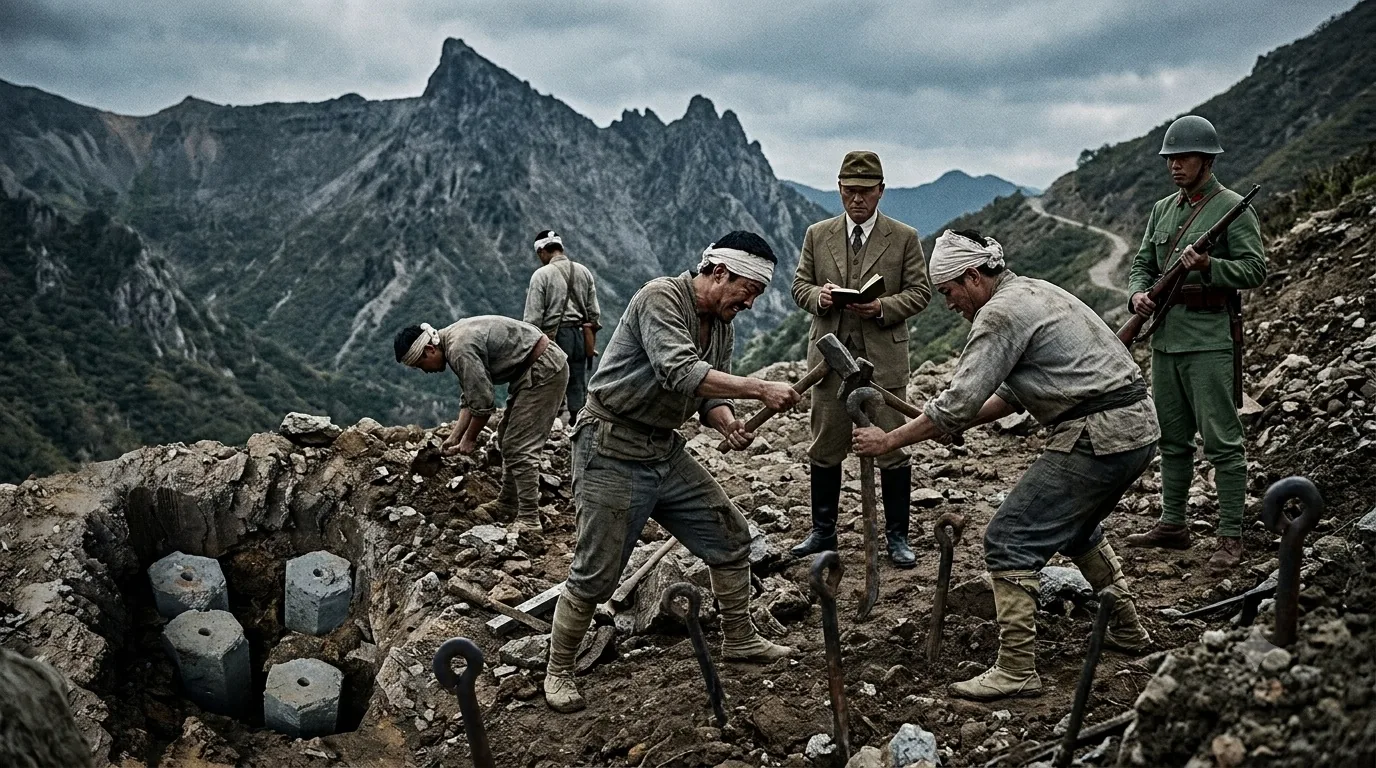 The picture the story asks you to hold. The 1995 campaign described what it pulled out in exactly these terms - but that is the campaign stating the premise of its own project, and no colonial-period record we opened establishes when, by whom, or for what purpose any individual stake went into the ground. (AI illustration)
By the late twentieth century a claim about Japanese iron stakes had reached administrative documents. We cannot show that this claim descends from the Jeju passages above. In 1995, the fiftieth anniversary of liberation, the government ran a project to pull out iron stakes said to have been driven by Japan. According to the announcement of 14 August 1995, 438 reports had come in from residents; 20 stakes were found across 15 areas; of those, 16 in 11 areas had been removed, with 4 in Gangwon Province still to go. That same year 37 place names were restored (Korea.kr policy briefing, Gukjeong Sinmun, 14 August 1995). We opened that announcement directly, so the figures in this section are ours to report. One thing in it has to be read for what it is. The announcement describes the project in its own words as the removal of 「일제가 민족정기 말살을 위해 박아놓은 쇠말뚝」 — iron stakes driven by imperial Japan to extinguish the national spirit. That is the 1995 government stating the premise of its own campaign. It is not a colonial-period source, and it does not establish when or for what purpose any individual stake was put in the ground; the purpose remains unsettled, and this piece leaves it there.
Read those numbers in stages: 438 is reports, 20 is finds, 16 is removals completed as of that date. The announcement does not say whether reports were duplicated or how far investigation had proceeded, so the gap between 438 and 16 should not be read straight off as a credibility problem with the reports. The figure of “118 iron stakes,” widely repeated online, could not be traced to a source and is left out here.
Why would such a story be useful? An interpretation
From here on, this is not what the sources say directly. It is this piece’s reading.
Severed-vein legends occupied a place where an explanation was missing. Why has this district not produced a great figure? Why does nothing go right for our family however hard we try? The frame supplies an answer: it isn’t your fault — someone ruined the land. But fixing the guilty party outside makes it harder to see what happened inside — and the variants complicate an exclusively foreign-villain reading: Ho Jong-dan was, by the record, an official of the Goryeo court whom a Goryeo king favored, and a variant of the Jeju tale has the Goryeo court itself dispatching Gojongdal.
One more turn, also a reading rather than a stated intention of the filmmakers. Hold the film’s “Murayama Junji” beside the real Murayama Chijun and the juxtaposition is suggestive rather than evidentiary: the historical Murayama documented Korean belief from inside a colonial administrative project, while the fictional Murayama is made the agent who physically wounds the land.
How did other empires collect folklore?
The same empire’s earlier case — Taiwan. After Japan colonized Taiwan, institutional surveys of “old customs” (舊慣) followed one after another, aimed at establishing law for use in the colony. That survey is a precedent often compared with the colonial surveys in Korea, though it is difficult to establish that the Taiwan model was inherited wholesale into Korea as an institutional transmission (Arnaud Nanta, CNRS, Colonial Historiography in Taiwan and Korea under Japanese Rule 1890s–1940s, Politika).
The same decade, different collectors — Ireland. From 1937 to 1939, the Irish Folklore Commission ran a schools folklore collection scheme with the Department of Education and the Irish National Teachers’ Organisation. The person standing at the door was not a patrolman but a senior primary-school pupil. Some 50,000 children in 5,000 schools across 26 counties took part, writing down stories from parents, grandparents, and neighbors, and about 740,000 pages were gathered (The Schools’ Collection, National Folklore Collection, UCD).
Keep the comparison narrow. Not all of Murayama’s surveys ran through the police; what is set side by side here is one collection method — the kind used for Joseon-ui mugyeok — not Korean colonial folklore study as a whole. Both are state-organized collections of folklore and folk belief in the same decade; the hands that knocked on the door were different.
Coming back to the grave
Sang-deok, forty years into this work, says he cannot read the place. What was buried in the ground he stood on was not only an iron stake, but a stock of much older stories about ground being acted on from outside.
The figures named in those stories differ — a man from Song China, a Ming commander, a Japanese figure — and the Jeju Ho Jong-dan passages appear in geographies and local chronicles dated from the fifteenth century to 1918, of which we can point you to two; we could not date when the other forms entered writing, so we cannot say they were circulating alongside them. So we cannot show that one face replaced another along a line. Of the four Jeju passages, two we can point you to, and they do not record the same act. The fifteenth-century one is 鎭禳此土, where the object is 此土, this land, and 镇禘 is a single term for a calamity-averting rite — the National Institute of Korean History’s translation renders it as a rite to pacify this land. The 1530 gazetteer, whose classical text we opened as well, has 來壓其氣 — the energy of a spring pressed down, and the spring gone. Three passages give three wordings — 鎭禳此土, 來壓此土, 來壓其氣 — and that same 1530 volume holds two of them, 其氣 at Ducheon and 此土 at Gwangyangdang, the latter in an entry the book files under 諺傳, commonly told. Which wording is the earliest we cannot say: the 1530 volume enlarges an earlier one and marks its new matter 〔新增〕, and neither of those entries carries the mark, so their text comes from the older stratum and the date on the spine is bibliographic. What the two we opened have in common is narrow and it is all we will claim: 地脈 occurs in neither, and in neither is a vein named at all. We do not classify either as harm or as rite, and about the characters in the two we did not open we say nothing. The 1530 compilers add in their own voice 來壓溺舟之說,恐不可信 — the account of his coming and pressing down and being drowned is probably not to be believed, a doubt that takes in the pressing as well as the drowning, and that 恐 keeps short of a flat denial. The 1653 來壓此土 reaches us through our script without a citable original, and the 1918 passage we did not open at all. The table’s twentieth-century row is different in kind — oral material reaching us only as an encyclopedia summary, where the act is cutting. Having opened two of the four, we do not say what the four share, and we cannot show that they descend from one another.
Frequently asked questions
Is the iron-stake story in Exhuma true? Two things have to be separated. The 1995 government announcement, which we opened directly, reports the campaign and gives its figures: 438 reports from residents, 20 stakes found across 15 areas, 16 removed in 11 areas. The announcement calls them iron stakes driven by imperial Japan to extinguish the national spirit — that is how the 1995 administration framed its own project, and it is not a colonial-period document establishing when or why any individual stake went into the ground. The claim that Japan drove them to cut Korea’s land veins is not historically settled. Separately, the idea of reading metal nails as suppression sorcery is older than the colonial period: the Taejong Sillok records in 1406 that a Ming envoy drove copper nails into a tree and that people at the time suspected it of being apseung (壓勝) sorcery — the annal does not say he was pressing down Korea’s land energy.
Who was Ho Jong-dan, and was he real? He was real. By the Goryeosa he came from Song China to Goryeo, won King Yejong’s favor, rose through office to Bomungak daeje, and later served King Injong as gigeo sain (起居舍人). The Goryeosa, which we collated, says he was versed in miscellaneous arts and especially skilled at apseungsul (厭勝術), a broad term for techniques believed to press down or subdue a person, an object, or a run of fortune. It does not record that he cut the veins of the land. The Dongyugi — we read the ITKC translation, not the classical text — records stelae defaced and sunk and bells sealed with molten metal during a circuit tour; it does not mention Jeju, and the land’s veins do not appear in that translation.
Then where does ‘he cut the earth veins’ come from? Not from the Jeju passages we can point to. The Sejong Sillok Jiriji has 鎭禳此土, where 鎭禳 is a single term for a calamity-averting rite — the Veritable Records gloss it aekpuri (액풀이), the warding-off of misfortune — and the National Institute of Korean History translates the passage as performing a rite to pacify this land. In the database where we read it the characters for earth veins do not appear, and no vein is named as the object; what kind of act it was we do not judge. The Tamnaji’s “came and pressed down this land” (來壓此土) reaches us through the Korean script this piece works from, and we could not locate the original edition, so we do not call it collated. Modern explanations often render such passages as “pressed down the earth veins.” In the two we opened in the original, those characters do not stand there — the objects are 此土 and 其氣. That is a statement about the characters, not a ruling on the reading: 氣 and 脈 belong to the same vocabulary, and we do not claim the paraphrase is excluded. The second passage we opened, the 1530 Sinjeung Dongguk Yeoji Seungnam, has Ho Jong-dan pressing down the energy of the Ducheon (두천, 斗泉) spring in the ITKC translation — energy, not earth veins — while the same volume’s Gwangyangdang entry, which that book files under 諺傳, commonly told, has 來壓此土, pressed down this land — so one book holds both wordings and neither names a vein. We opened that volume’s classical text as well as its translation, and 地脈 does not occur anywhere in its Jeju-mok. Its compilers add a note of their own — 來壓溺舟之說,恐不可信 — that the account of his coming and pressing down and being drowned is probably not to be believed. The other two passages in our table, the 1653 Tamnaji and the 1918 Tamna Ginyeon, are second-hand citations we have not opened, so we do not extend the finding to them, and this says nothing about Joseon writing as a whole — vein-cutting traditions in other Joseon-era material are examined in the scholarship. The encyclopedia entry on severed-vein legends, which we opened, describes cutting the hyeol (혈), the vital point of a site said to hold the energy that would produce a king; the words for water veins and earth veins do not occur in it, and we have not consulted the collected texts themselves.
Is the film’s Murayama Junji the real Murayama Chijun? We have not checked how the film writes the villain’s name in hanja, so we cannot compare the two spellings. The real man, 村山智順, is read Murayama Chijun (ムラヤマ・チジュン), and the film’s villain has a very similar name — but no source has been found in which the production explains the relationship between the names, and no material confirms that the real man was the model for the character.
Did Murayama Chijun drive iron stakes into Korean ground? We found no record that he drove stakes. He is documented as a contract researcher for the Japanese Government-General of Korea who surveyed and recorded Korean folk belief, geomancy, suppression practice, and severed-vein lore. The film’s villain is a fictional onmyōji, and whether the character is meant to refer to the real 村山智順 we could not establish, so this is a statement about the historical man rather than a correction of the film. Whether his own volumes recorded the later claim that Japan drove stakes to cut Korea’s veins has not been checked against the original editions.
Are Gojongdal and Ho Jong-dan the same person? The Gojongdal of Jeju legend is generally taken to be Ho Jong-dan. The written name differs by source, and for one source the reason is documented: the Goryeosa writes 胡宗旦, while the 1530 Sinjeung Dongguk Yeoji Seungnam writes 胡宗朝 throughout its Jeju-mok, and the Institute for the Translation of Korean Classics’ textual note explains 朝 as a taboo substitution for 旦, the personal name Joseon’s founder Yi Seong-gye took after his accession. The Tamnaji also writes 胡宗朝, as the Korean script we work from quotes it; we could not open that edition, so we say only that it looks like the same practice. Who sent him varies too: some traditions name Qin Shi Huang, a variant names the Goryeo court, and in the two early written entries we opened no sender is stated at all. The two later entries in our table we did not open ourselves; the wording our table gives for them reaches us through citation, and we do not add to it.
Is there evidence that Japan actually drove iron stakes into Korean mountains? The 1995 government announcement gives the figures in stages: 438 reports from residents, 20 stakes found across 15 areas, and 16 removed in 11 areas at the time of announcement, with 4 in Gangwon Province to be taken out around the 15 August liberation anniversary, and 37 place names restored the same year. We opened that announcement directly. Whether each of those was driven with the purpose of cutting the land’s veins is explained differently in different sources. The widely circulated figure of “118 iron stakes” could not be traced to a source and is left out here.
Do Korean folklorists still use Murayama’s material? Yes. Two assessments coexist: that the reports are valuable as documentation, and that they were the product of a colonial framework — one analysis argues that by casting Korean folk belief as primitive and Koreans as passive fatalists, the surveys served to justify colonial rule. Whether a survey was accurate and what it was for are different questions, and this piece does not choose between them.
Sources & further reading
Written from the historical script of 사뚱샘의 역사방 (SaDDungSam); that script is not public. Claims about the records are sourced inline and stand or fall on the inline source. Descriptions of the film are the exception: they rest on that script, not on a viewing. What we opened falls into two layers. Primary texts opened directly, each with a link above (five): the 1406 Taejong Sillok entry; the Sejong Sillok Jiriji Jeju-mok entry; the Goryeosa biography of Ho Jong-dan; the 1530 Sinjeung Dongguk Yeoji Seungnam vol. 38 Jeju-mok, in both the ITKC translated edition and the classical text; and Yi Gok’s Dongyugi, in the ITKC translated edition only, not the classical text. The Korea.kr policy briefing of 14 August 1995 (Gukjeong Sinmun) was also opened directly, and is modern administrative material rather than a text of the period. The Tamnaji Gwangyangdang entry is not among them: its wording reaches us through the Korean script, and we could not locate the original edition online to cite, so we no longer count it as collated. Reference works opened directly (four, and these are secondary, not sources of the period): the Encyclopedia of Korean Culture entries on Ho Jong-dan (E0063862), the Yongmeori coast (E0074984), severed-vein legends (E0013573), and Yi Yeo-song legends (E0045146). Everything else reaches us second hand and is marked as such in the text — the Tamnaji passage; the 1918 Jeju passage; the editorial note to Joseon-ui mugyeok, Son Jin-tae’s 1933 review, Kim Tae-gon’s judgement, the Nanta comparison, and the box-office figures we dropped for want of a source. Those marks are deliberate, and no conclusion here is meant to run past them. Our account of what happens in Exhuma follows the Korean script this piece works from, whose author watched the film; we did not check it against the film ourselves.
- The 1406 copper nails. Taejong Sillok, 16th day of the 7th month, 6th year of Taejong (Veritable Records of the Joseon Dynasty).
- Yi Gok’s Dongyugi (1349). Gajeongjip vol. 5 (ITKC).
- The 1530 Jeju entries and the compilers’ note. Sinjeung Dongguk Yeoji Seungnam vol. 38, Jeolla-do, Jeju-mok — Ducheon (斗泉) and Gwangyangdang, with the compilers’ 按 (ITKC translated edition; classical text, where textual note D006 explains 胡宗朝 as a taboo substitution for 旦).
- Ho Jong-dan’s career. Goryeosa vol. 97 (National Institute of Korean History); “The career and assessment of Ho Jong-dan in the reign of King Yejong” (KCI).
- The Jeju legends. Encyclopedia of Korean Culture: “Yongmeori Coast”, “Severed-vein legends”, “Yi Yeo-song legends”.
- The severed-vein theory and the colonial surveys. Nozaki Mitsuhiko (野崎充彦), Dong-A Hanhak Yeongu 12 (2017); Kim Man-tae, Hanguk Minjok Munhwa 66 (2018) (DOI); Kim Hui-yeong, Ilbon Munhwa Hakbo 43 (2009) (KCI).
- The 1995 campaign and the comparison cases. Korea.kr policy briefing, Gukjeong Sinmun, 14 August 1995 (opened directly); Arnaud Nanta, Colonial Historiography in Taiwan and Korea under Japanese Rule 1890s–1940s, Politika; “The Schools’ Collection” (1937–1939), UCD.
Thanks for reading — see you in the next one.
This article was researched and written by K-Drama History. Source: Exhuma, Explained: The Iron Stake and the Records We Could Open — K-Drama History