From the research behind Pause the Drama.
If you’ve watched Netflix’s D.P. (디피) — the 2021–2023 series that became one of Korea’s most talked-about dramas — you know its unsettling premise. Private An Jun-ho and Corporal Han Ho-yeol wear plain clothes instead of uniforms. Their job is to hunt down soldiers who ran away from their own army: through motels, subway stations, comic-book cafés and back alleys. And the deeper they get into each chase, the louder a second question grows behind the first. Not where did he go — but why did he run?
D.P. is a manhunt drama on the surface. Underneath, it is about something much bigger than any one deserter: an institution that shapes the schooling, careers, relationships and memories of nearly every Korean man.
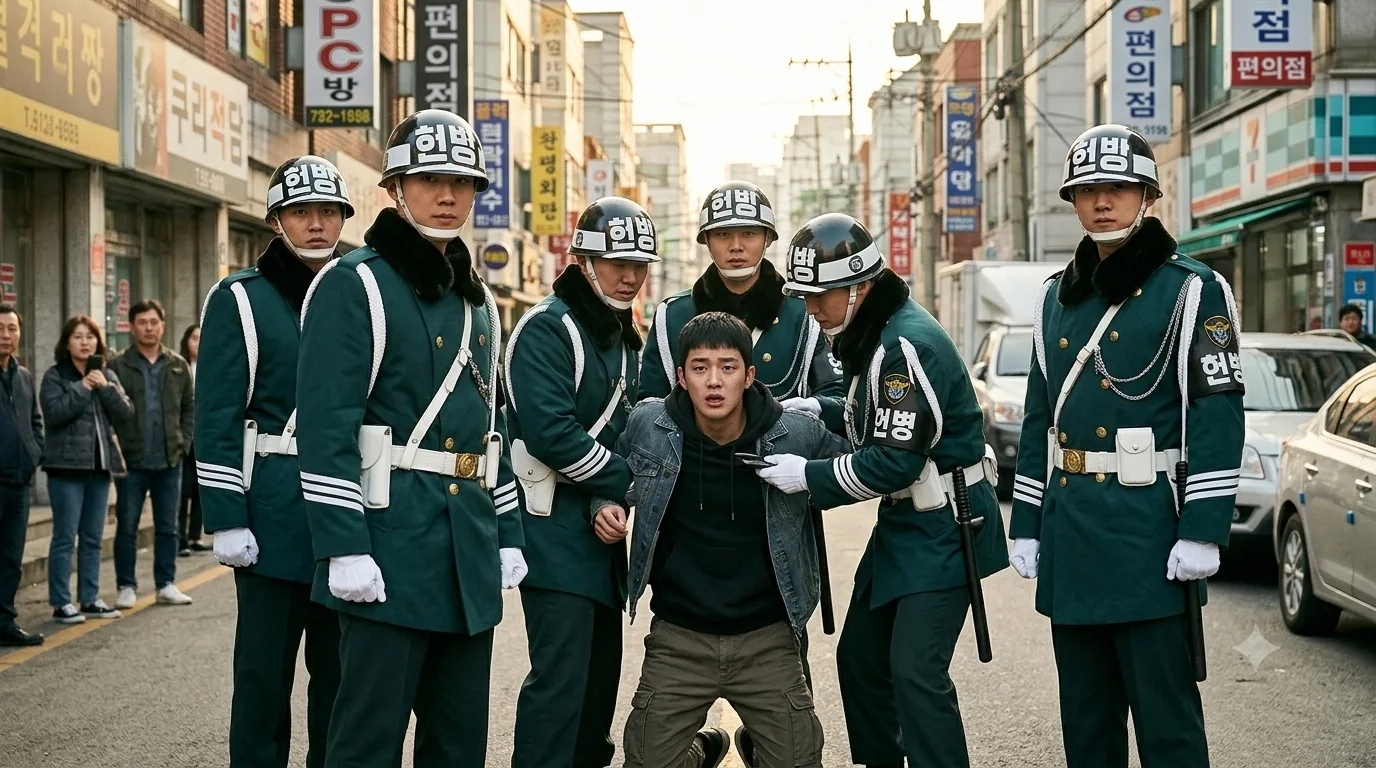 The chase the series is named for: soldiers arresting a soldier, in a country where almost every young man wears the uniform at some point. (AI illustration)
Quick answer: South Korea’s system shapes the lives of most Korean men because the law imposes a military-service obligation — even though not everyone serves as an active-duty soldier. South Korea instituted conscription with the Military Service Act of 1949; war and the unresolved standoff with the North kept it central ever since. Medical grading and other statutory decisions determine whether a man enters active duty, another form of service, or exemption, and approved conscientious objectors enter a separate, longer non-military track. For most Korean men, the timing and form of service — or the process that determines whether and how they will serve — becomes a significant factor in planning education, work and their twenties. D.P. dramatizes the sharpest edge of that system: what happens when someone inside it decides he cannot bear it, and who gets sent to bring him back.
Why does South Korea still have conscription?
South Korea promulgated its Military Service Act on 6 August 1949, institutionalizing conscription; the Korean War broke out the following year, and mass mobilization became a matter of national survival. Active fighting stopped with the 1953 armistice, but no peace treaty followed — and with two armies still facing each other across the DMZ, conscription remained the backbone of South Korean defense (병역법, Korean Law Information Center). (For why no peace treaty ever came, see our companion piece on the armistice and the DMZ.)
As of 2026, active-duty terms are about 18 months for the Army and Marine Corps, 20 months for the Navy, and 21 months for the Air Force (병무청). Far shorter than in past decades — but a year and a half carved out of the exact years when peers elsewhere are building degrees and careers is not a small thing. Before enlistment, men strategize about when to go; during service, they live apart from society; after discharge, they re-enter school or work having pressed pause on both.
One legal distinction the drama’s foreign viewers often miss: what the law imposes is the service obligation, not necessarily a rifle. In simplified terms, medical examination, physical grading and other statutory criteria determine whether a man enters active duty, another form of service such as social service, reserve or wartime-labor status, or exemption. Separately — and under a distinct legal framework — those who refuse to bear arms on grounds of conscience can apply, through a screening process, for alternative service: a longer, non-military assignment created after Korea’s Constitutional Court forced the issue. It should not be confused with ordinary social service, nor with the broader civilian-service model of a country like Finland. Women are not conscripted but may volunteer.
Because nearly every man passes through some version of it, the military becomes a generational common language. Which unit, which job, who outranked whom — it’s small talk between men who have just met. And the flip side is just as Korean: service forms and exemptions are a perpetual fairness flashpoint, scrutinized every time a celebrity or a politician’s son seems to have found a softer path.
Was the D.P. unit real?
Yes — with precision about what “real” means. D.P. is commonly glossed as Deserter Pursuit, the abbreviation Netflix itself uses (Netflix Tudum). It was not a grand official English designation in Korean law, but the thing itself existed: arrest details, run especially by Army military police, whose enlisted members tracked soldiers who had left their posts and brought them back. It was an unusual assignment even by military standards — enlisted men in civilian clothes, moving through civilian streets, chasing their peers.
The authenticity has a source: creator Kim Bo-tong served on a D.P. detail himself, and poured what he saw of the military’s contradictions into the 2015 webtoon D.P. Dog Days that the series adapts. The specific characters and cases are invented; the vantage point is not.
And here is the detail that turns the drama into a time capsule: the enlisted D.P. assignment no longer exists. The Ministry of National Defense’s investigative headquarters abolished it from July 2022, the Army from August 2022, after the revised Military Court Act removed enlisted soldiers from investigative roles (경향신문; YTN). Deserter tracking itself didn’t disappear — it passed to professional personnel, NCOs and civilian investigators. The ministry was at pains to note the abolition had been decided years earlier as part of military justice reform, not as a reaction to the show’s popularity. Either way: An Jun-ho’s job is now a historical one.
What does Korean military law call desertion or AWOL?
Everyday speech lumps every soldier who leaves his post into “deserter.” The law is more careful. The key offense in the Military Criminal Act is gunmu ital (군무 이탈) — leaving one’s unit or duties with the purpose of evading military service (Article 30, Paragraph 1). But the statute has a second prong: someone separated from his unit who fails to return within a reasonable period without justifiable cause can be punished even where evasive purpose isn’t separately proven (Paragraph 2) (군형법, Korean Law Information Center). Intent matters; so do circumstances, cause, and the simple fact of not coming back. English “desertion” and “AWOL” are approximations, not equivalents.
But D.P.’s real interrogation was never about legal classification. It’s about why a young man would accept punishment, stigma and a manhunt rather than stay one more night in the barracks.
Who is actually on trial in D.P.?
The runaways in the series don’t flee for one reason. Beatings and humiliation by seniors, family crises, fear, impulse, mental collapse — usually tangled together. Two things are simultaneously true, and the show insists on both: leaving one’s post violates the law, and the reasons deserve investigation.
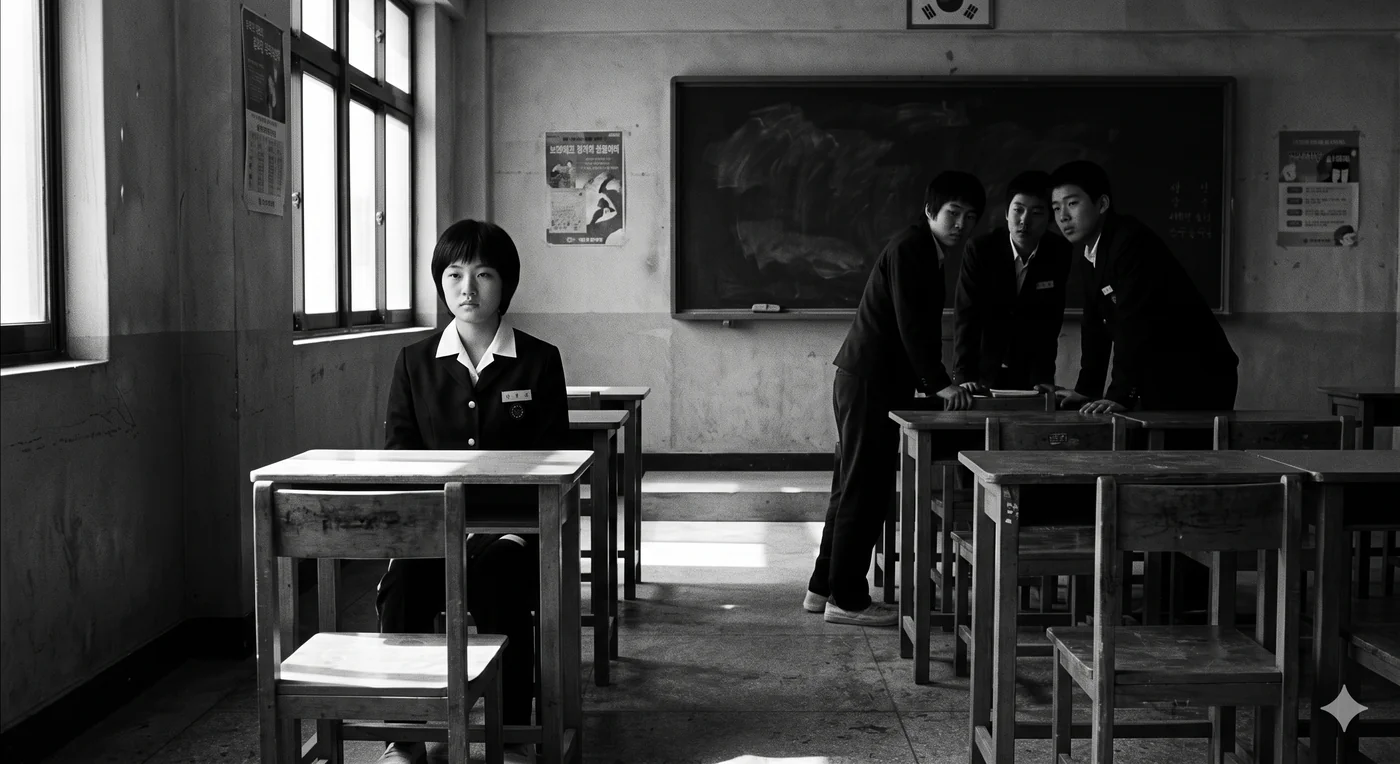
The series is set mainly around 2014 — a year seared into Korean memory. That spring, a private surnamed Yun died after sustained beatings and abuse by his seniors; a sergeant at a front-line unit went on a shooting spree; and “barracks culture” became a national scandal. The Yun case became a scandal not only because of the violence itself, but because it raised hard questions about supervision, reporting, and the military’s initial handling of the death. Reform followed in stages — barracks-culture initiatives after 2014, then, after further deaths and sexual-violence cases years later, a full overhaul of military justice, and on 1 July 2022 the launch of a military human-rights protector at the National Human Rights Commission (NHRC press release). So no, today’s military is not frozen in 2014 — and no, changed institutions are not by themselves proof that hierarchical violence and cover-up are gone.
Here’s the reversal foreign viewers can miss, and it’s the show’s sharpest edge. Jun-ho, the chaser, and the men he chases are the same kind of person: conscripts of the same age, put in different positions by the same system. One follows orders to hunt a peer; the other broke because he couldn’t endure. The drama never lets you file them into hunter and prey. When a deserter is caught, the paperwork closes — but the reason he ran is still standing in the barracks, waiting for the next man. That is why D.P. interrogates the organization, not just the runaway: the question it leaves is why nobody listened before he climbed the fence.
How unusual is Korea’s system? Finland and the United States
Two comparisons put the Korean experience in relief.
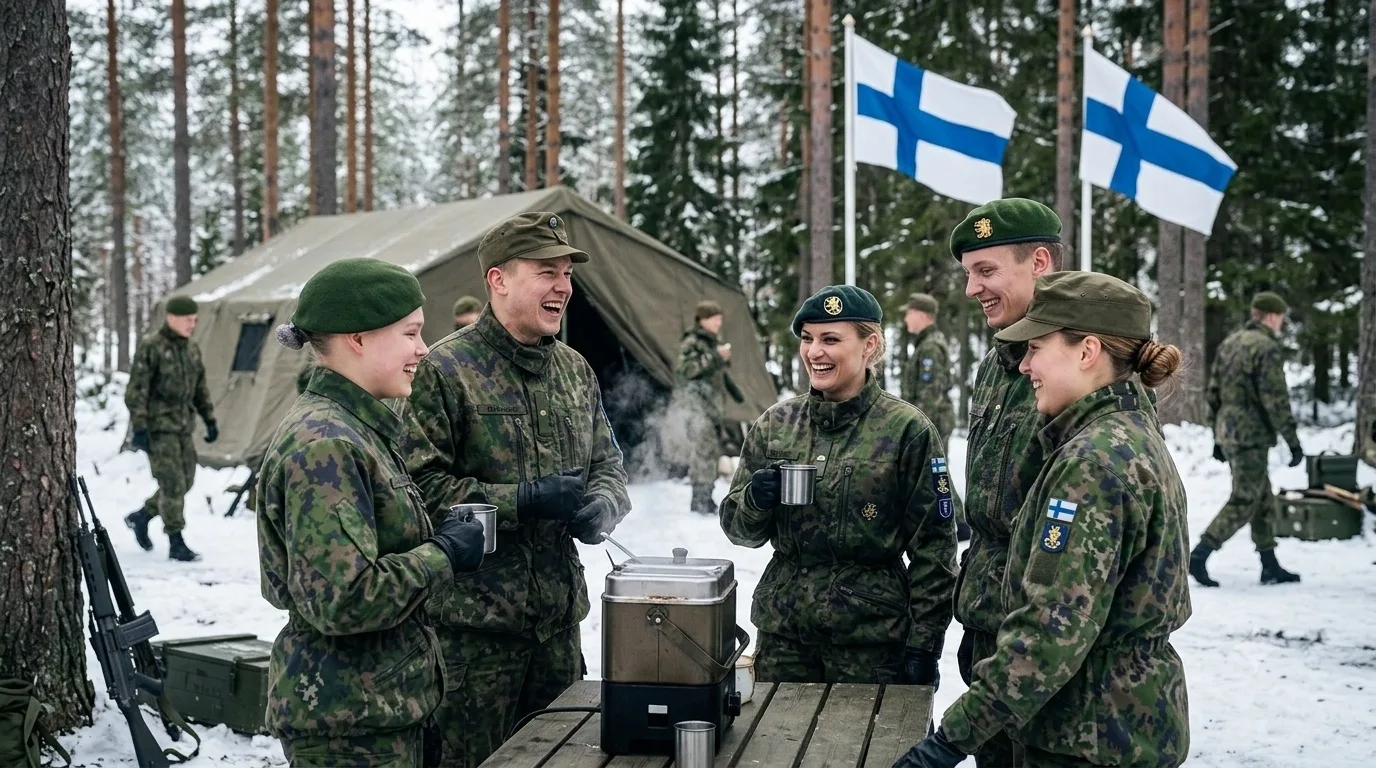 Finland: another democracy that still drafts its young men — with generally shorter service terms and a distinct non-military service option. (AI illustration)
Finland — the closest cousin. Finland, another democracy living next to a larger military threat, also imposes service on men: armed or unarmed military service, or non-military civilian service for those with convictions against bearing arms; women may volunteer. Terms run 165, 255 or 347 days depending on training track (Finnish Defence Forces). The structural rhyme with Korea — conscription plus a large reserve, justified by geography — is real. But service length, alternative tracks and barracks culture differ enough that the lived experience shouldn’t be equated. The rhyme is institutional, not experiential.
The United States — the road not taken. America ended its draft in 1973 and has filled its ranks with volunteers for half a century (U.S. Army). Military service still transforms many American lives — but entry into active service is ordinarily voluntary, not a near-universal obligation imposed on young men. What the U.S. does not have is Korea’s defining feature: an entire generation of men making the same calculation at the same age, threading enlistment between semesters and job applications. That difference is why the military saturates Korean pop culture, male friendship and generational memory in a way an all-volunteer force never quite does — and why a drama about catching deserters could become a national conversation.
Watch it again
Watch the arrest scenes again and the uniform hierarchy inverts. Jun-ho drags a broken man back to the institution that broke him, files the report, and the case closes — except nothing closes. Korea’s conscription system is simultaneously a security necessity for a divided country and a claim the state makes on a slice of every young man’s life. That double identity is why the military is where Korean ideas about patriotism and sacrifice, fairness and privilege, orders and human rights collide hardest.
D.P. is a chase drama. But the question it leaves behind isn’t where did he run — it’s what made running seem more bearable than staying.
In the next essay, we’ll take another K-drama scene that looks like pure fiction — and trace the real Korean history hiding underneath it.
Frequently asked questions
Is D.P. based on a true story? The characters and specific storylines are fiction, but the material is drawn from reality: creator Kim Bo-tong served on an actual D.P. detail during his own service, and the series draws on real barracks incidents Korean society knows well. Fiction built from documented material — not a re-enactment of one case.
What does D.P. stand for? It is commonly glossed as “Deserter Pursuit” — the abbreviation used in Netflix’s own materials. In practice it referred to arrest details, run especially by Army military police, whose enlisted members tracked and brought back soldiers who had left their posts. A real assignment, though not a formally codified English unit name in Korean law.
Do all Korean men serve in the military? The obligation applies to Korean men by law, but not everyone serves as an active-duty soldier. Medical examination and physical grading determine whether a man enters active duty, another form of service such as social service, or exemption; separately, approved conscientious objectors enter a distinct, longer non-military alternative-service track created after a Constitutional Court ruling. As of 2026, active-duty terms: about 18 months (Army/Marines), 20 (Navy), 21 (Air Force).
Why does South Korea still require military service? Because it faces North Korea across an unresolved armistice line and relies on a large active force and reserve system. Active fighting ended in 1953, but no peace treaty followed, and the military confrontation continued. Conscription has therefore remained central to South Korean defense even as service terms have shortened.
How long is mandatory military service in South Korea? As of 2026, active-duty service is approximately 18 months in the Army and Marine Corps, 20 months in the Navy and 21 months in the Air Force. Other forms of service follow different rules and periods, so these figures should not be applied to everyone with a military-service obligation.
Is alternative service the same as social service in Korea? No. Social-service personnel and conscientious-objector alternative service are legally distinct tracks. Approved conscientious objectors enter a separate, longer non-military program under its own legal framework, rather than the ordinary social-service system — and neither should be confused with Finland’s broader civilian-service model.
Do D.P. soldiers still hunt deserters today? Not as depicted. The enlisted D.P. assignment was abolished — by the Defense Ministry’s investigative headquarters from July 2022, by the Army from August 2022 — as the revised Military Court Act removed enlisted soldiers from investigative roles. The work passed to professional personnel such as NCOs and civilian investigators.
Is “desertion” the same as going AWOL in Korean law? The key offense is gunmu ital (군무 이탈) — leaving unit or duty with intent to evade service (Military Criminal Act, Article 30). The law also punishes failing to return within a reasonable time without justifiable cause. Intent matters, but so do circumstances and the failure to come back; the Korean categories don’t map one-to-one onto English terms.
Is the drama an accurate picture of today’s Korean military? Its main setting is around 2014, the year a beating death and a shooting spree forced a national reckoning. Reforms followed — through to the 2022 military justice overhaul and the military human-rights protector launched on 1 July 2022. Generalizing today’s military from the show would be misleading; assuming the reforms eliminated every form of abuse would also go beyond the evidence.
Sources & further reading
This piece was written from the historical script and fact-check of 사뚱샘의 역사방 (SaDDungSam). Key facts are sourced inline. Summary lines about the show’s themes are ours, not quotations from the series or its creator.
- The legal skeleton — 병역법 (Military Service Act) · 군형법 (Military Criminal Act), Art. 30 · 병무청 (Military Manpower Administration)
- The abolition of the enlisted D.P. assignment (2022). (경향신문, 2021-09-09 · YTN, 2021-09-09)
- The show and its source. (Netflix title page · Netflix Tudum on Season 2 and the webtoon)
- Finland’s conscription system — official English overview. (Puolustusvoimat)
- America’s all-volunteer force at 50. (U.S. Army, 2023)
Thanks for reading — see you in the next one.
This article was researched and written by K-Drama History. Source: D.P., Explained: Why Military Service Shapes Nearly Every Korean Man’s Life — K-Drama History