Why a Silla Royal Tomb Is Guarded by a Face That Looks West Asian
From the research behind Pause the Drama.
Hwarang: The Poet Warrior Youth (화랑) is set in the reign of King Jinheung, and it follows a band of young Silla aristocrats sharing friendship, love and growing up. Its hwarang are people born and raised inside Silla’s bone-rank system (골품제) — a status order in which descent set the ceiling of office a person could reach, the clothes they could wear, even the size of the house they could live in. The moment you were born, the ceiling of your life was decided. The drama presents these young people as the faces of Silla itself.
One caution the drama’s own period imposes. The detailed sumptuary articles usually quoted for the bone-rank system survive chiefly in the edict of King Heungdeok’s reign in 834 — the Samguk Sagi treatises on clothing, carriages, utensils and houses in volume 33. This article did not collate those articles in the original, and it does not assume that the same detailed regulations applied unchanged in Jinheung’s sixth century.
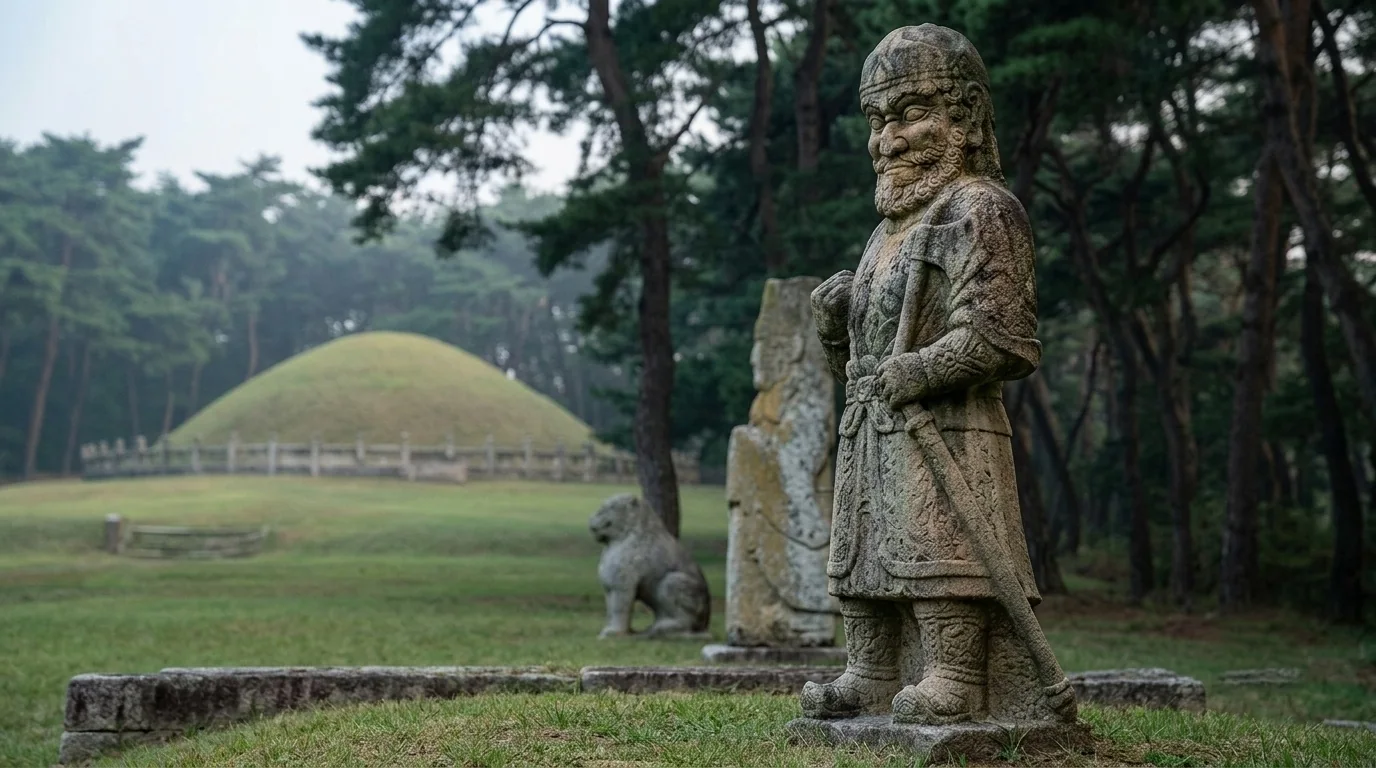
Out on the edge of Gyeongju, in front of the Unified Silla tomb identified as King Wonseong’s, stands a stone figure with a face of a quite different kind. It is taller than a person. The eyes are deeply cut, the nose stands high, the beard curls. One hand grips a sword. This face has been looking down on a king’s tomb from the same spot for more than a thousand years, and it does not look like the faces the drama shows. It has been read as Central or West Asian.
So who — or what — does this stone figure carve?
The Encyclopedia of Korean Culture writes that, because it has a West Asian face, there is also an argument that it is a Persian warrior image. That is an argument, written with a hedge, not a settled fact. But the argument is not baseless imagining. Silla tombs several centuries earlier than this one yielded Roman-type and Sasanian-Persian-type glass vessels, and a road construction site yielded a Central Asian–style gold-ornamented dagger.
The question worth asking is not “was he a Persian.” It is: how far does this sculpture show actual human contact, and how far does it show an international image travelling?
One art historian has answered that question in print, and answered it hard. In a research volume issued by the National Research Institute of Cultural Heritage, Im Young-ae argues that the model was not a West Asian at all. Her reasons are concrete rather than atmospheric. If the figure copied a West Asian, there would have to have been West Asians in Silla when it was carved — on her dating the ninth century, not the eighth — yet Tang was restricting their movement in that period and Silla was in disorder, so resident West Asians are unlikely. Even had they come, she argues, they came to trade, and a royal house building a tomb would not have set a low-status foreign merchant at the approach as its guardian. She points out that when twenty to thirty thousand West Asians were living in the Tang capital in the early eighth century, no Chinese imperial tomb was given a West Asian–looking stone attendant. And she reads the costume against the theory too: the headband and the pouch worn at the waist are, in her account, closer to typical Chinese dress than to West Asian.
What she puts in its place is a guardian lineage. Silla sculptors, she argues, had seen Chinese images of the Vajrapāni guardians (금강역사) and the Four Heavenly Kings (사천왕) — fierce protector figures of Buddhist art whose faces were already foreign-looking by convention — and built the tomb guardian out of that visual vocabulary. Her sharpest line is a reductio: if the tomb guardian must be a West Asian, then so must the models for the Heavenly Kings on the Gameunsa reliquary and the Vajrapāni figures at Seokguram.
This is one interpretation, and a forceful one, not a verdict the field has closed on. This article has read it as reported by Yonhap from her contribution to that volume, not in the volume itself. But it is the strongest published statement of the second half of the question, and it deserves a name attached to it rather than being left as a vague alternative possibility.
A note on what has and has not been checked. This article rests on institutional reference works (the Encyclopedia of Korean Culture, Urihistorynet, the National Gugak Center, the Korea Heritage Service), on scholarly abstracts, and on two classical sources read in the original. Of the primary-source passages it leans on, counted by event or by article-group, four were collated against the original text and eight were not, and no classical Chinese passage was collated in translation. Where a claim rests on popular material only, it is marked here rather than dropped silently. One more caution about tone: the Encyclopedia of Korean Culture hedges (“there is also an argument that”), while some educational material writes far more flatly — that a West Asian’s appearance was left to us. This article follows the hedged wording.
What the stone figures and the objects show
The Gyeongju tomb of King Wonseong is traditionally called Gwaereung (괘릉) and is identified as the tomb of the 38th king of Unified Silla, Wonseong (r. 785–798). The name attaches the character 掛, to hang, to the tradition that the king’s body was buried hung above a pond — that story is a tradition about where the name came from, and is best kept separate from the identification of the tomb.
The mound is about 23 metres across and about 6 metres high. Twelve zodiac deities are carved on its protective stone base. About 80 metres in front of the tomb, stone pillars, civil official figures, military official figures and stone lions stand facing one another. The number of lions differs between sources. The current body text of the Encyclopedia of Korean Culture describes four stone lions — that is, two pairs; some media captions within the same source give two. This article uses four, two pairs, and treats the other figure as an internal inconsistency in the source rather than merging the two.
The military figure is the one at issue. It stands gripping a sword. The deeply set eyes and the large nose are read as features of a Central or West Asian figure rather than a Silla one.
A detail from the Korean script is handled carefully here. That the armour was worn under an outer robe, and that the object slung behind the back is specifically a sannang (算囊), a calculating pouch, could not be confirmed against a scholarly source or a measured survey report, and this article does not assert the identification. That the figure wears a headband and carries a pouch at the waist is described by Im Young-ae — who reads that costume as closer to Chinese than to West Asian dress — but what the pouch was for is a separate claim, and it stays unconfirmed.
This figure is not unique. A military figure in a similar style survives at the tomb of the 42nd king, Heungdeok, and a warrior image with a West Asian face is reported from the square-plan tomb at Gujeong-dong in Gyeongju. Setting the three side by side, what can be said is this: exotic figural images recur across Unified Silla royal tombs and some high-status tombs. It cannot be said that the three form one fixed royal-tomb style with a single meaning and lineage — the occupant of the Gujeong-dong square tomb has not been established.
Nor was the practice confined to stone. From the Yonggang-dong tomb in Gyeongju, excavated in 1986, came 28 figural toyong (土俑, earthenware figurines placed in a tomb). Among them is a civil-official figure holding a hol tablet whose beard is rendered bushy in the manner described as West Asian. The tomb is dated to the late seventh or early eighth century and is taken as an upper-status Unified Silla burial. That the official description notes an exotically rendered beard, and the claim that an actual West Asian sat as the model, are two separate things, and this article keeps them apart.
The physical evidence is not only sculptural. From fifth- and sixth-century Silla royal-class tombs such as Hwangnamdaechong and Cheonmachong, more than twenty glass vessels have been restored, and a considerable number of them have been analysed as coming from West Asia or the Mediterranean region — Roman-type glass of the sort that flourished in the Roman imperial period, or Sasanian-Persian-type glass.
A phoenix-head glass ewer is among them. Two pieces of official documentation disagree about where in Hwangnamdaechong it was found: Urihistorynet places it in the north mound, the National Museum of Korea’s object record in the south mound. This article picks neither. Nor does it say that compositional analysis proved it was made in the old Roman Empire — the official material connects the ewer to Western glassmaking traditions, and does not go that far; the analysis report itself was not obtained.
From tomb no. 14 at Gyerim-ro in Gyeongju came a gold-ornamented dagger in a Central Asian style. Urihistorynet explains that a dagger of almost identical form was found at Borovoye in Kazakhstan, and presents it as comparative material; that phrasing is sound. What it supports is that the piece shows a Central Asian form. It does not establish a shared workshop, a shared place of manufacture, or a traced route of transmission.
One chronological point that must not be blurred. All of this — the glass, the dagger — is several centuries earlier than the tomb identified as King Wonseong’s. The glass vessels and the dagger are chiefly fifth- and sixth-century material; the tomb is dated to the late eighth. They belong to the same long story of contact, not to the same moment.
Ninth-century Islamic geographical writing enters here. Associated with the Arab geographer Ibn Khurradadhbih and his Book of Roads and Kingdoms, it transmits that at the far end of China lies a land called Silla, rich in gold, and that there were Muslims who had settled there permanently. Research finds that transmissions to this effect do exist in the Islamic geographical corpus. What needs further examination is which recension and which stage of composition the passage belongs to, whether it reports direct observation or received information, and how much actual settlement it reflects. The Arabic original and the critical edition were not collated here, and this article does not fix the Silla-related content to the year 846.
The later writer al-Mas’udi — a tenth-century author, not a contemporary of Ibn Khurradadhbih — is introduced in modern secondary citation as recording that Iraqis went out and settled there. The exact title, volume and passage, and the Arabic original, were not collated, and this article does not expand the statement to the Korean peninsula as a whole before the place-names and context of the original are checked.
What can be said plainly is narrower and still striking: by the ninth century, Silla was already written down in Islamic geographical literature. The Korean script’s line that Silla was the Arabs’ land of gold centuries before Europe knew of it is not carried over as stated — whether “known to Europe” is dated from Marco Polo’s mention of Goryeo, from a map, or from specific geographical knowledge would each give a different gap, and no source was collated here to fix it.
Where the drama sits, and where it does not
Hwarang is set in Jinheung’s reign, roughly the middle of the sixth century. The tomb identified as King Wonseong’s is dated to the late eighth. There are more than two hundred years between them, and the drama does not touch the stone figures or West Asian contact at all. This article is not explaining a scene the drama shows; it sets a Silla the drama did not show beside it.
The Korean script flags its own weakness here, and so does this version: because of that gap, this piece cites far less from the drama than others in this series do.
A further caution about the sculpture’s own date, and it turns out to matter more than a footnote.
The stone figure is a statue, not a person. And while the tomb is dated to the late eighth century, whether every stone element now standing was made at the time of the burial is a separate question. One published re-examination argues that it was not. Im Young-ae’s 2012 study of the Wonseongwangneung sculptures, reading them against the stele inscription Choe Chi-won composed for Sungboksa temple, argues that the tomb was raised immediately after Wonseong’s death but its stone sculptures were added roughly sixty years later, in the reign of King Gyeongmun. Her wider claim is that this gap is not an oddity but a pattern: in the turbulence of late Silla, royal tomb sculpture was often added decades after the burial, according to the political standing of a later king, and Wonseongwangneung is the representative case.
This is one scholar’s argument, not a settled redating, and this article does not treat it as one. But note what it does to the question. If the carving is ninth-century work, then anyone claiming it portrays a West Asian resident of Gyeongju needs West Asians in Gyeongju in the ninth century — not in the eighth.
The tomb is identified as a late-eighth-century royal tomb. The date of the military figure is disputed, and the dispute moves the target by sixty years.
What the drama does present is a world that reads as complete in itself: a capital aristocracy finely stratified by bone rank, young nobles born and raised inside the royal capital. In periods both earlier and later than the one it depicts, Silla was exchanging goods, people and stories with the lands to its west. The Silla of the drama and the Silla of the objects are two faces of one country — an internal status order and external contact coexisting, which is a different statement from any modern language about blood purity, and this article does not use that language.
What actually surprises the overseas reader
Ancient Korea is often imagined as sitting off to one side of the great Eurasian routes, peripheral to them. The objects from Silla complicate that picture. At the approach to a royal tomb, Silla placed a guardian with an emphatically foreign-looking face.
Note the shape of that sentence. It says a guardian figure rendered as foreign-looking was placed there. It does not say that a foreigner’s actual face was carved there, and the distinction is the whole point of the article.
Political, social and economic meaning
Royal tomb stonework is not decoration placed at random. The tomb system itself received Tang influence, but the arrangement of twelve zodiac deities on the protective stone base is Silla’s own application. If a military figure with a West Asian-looking face was set up on top of that, the meaning is that Silla received international iconography through the artistic networks of East Asia and reworked it, putting it to work in a funerary language of its own to express the dignity of kingship.
What that sculpture cannot be made to carry is a second job. It is important evidence for the reception of an international figural type and a guardian image. It does not by itself prove that actual West Asians visited or settled in Silla, or that a real person sat as the model. The glass and the dagger are likewise evidence that goods and styles travelled long distances; they do not automatically prove that people from the place of manufacture came to Silla themselves.
Gaeunpo (개운포), the port at present-day Ulsan, comes up often in this connection. Here the Korean script’s phrasing has been cut. Samguk Yusa’s “Cheoyongnang and Manghaesa” records King Heongang’s procession to Gaeunpo and the tale of the East Sea Dragon King and Cheoyong; there is no direct record there of Arab merchants coming and going at Gaeunpo. The link between Gaeunpo’s coastal and trading setting and the West Asian merchant hypothesis is made in modern research and commentary, and this article keeps that separate from the primary source rather than writing “there are records.”
Behind all of this lies Silla’s ninth-century maritime network. Jang Bogo, based at Cheonghaejin, commanded the sea routes across the Yellow Sea, and Silla settlements known as Sillabang had formed along the Shandong coast of Tang. Three dates here need to be kept apart rather than fused: the Samguk Sagi gives 846 for Jang Bogo’s killing while Japanese records support 841, and on either dating Cheonghaejin did not collapse immediately — it was formally abolished in the second lunar month of 851, as the Samguk Sagi records under the thirteenth year of King Munseong. The Korean script’s line tying Ibn Khurradadhbih’s notice, Jang Bogo’s death and Cheonghaejin’s fall to a single moment has been removed, because none of the three can be pinned to that shared point.
The network that is directly attested in Jang Bogo’s activity and in Silla merchants’ operations is the East Asian one linking Silla, Tang and Japan. That Silla people encountered West Asian merchants and goods in Tang’s international cities and ports is a further possibility; that Silla ran a regular relay route connecting directly to the Arab world is a separate claim, and this article does not make it. In the same spirit, “the eastern end of the Silk Road” is used here as a figure of speech and not as a fact — the defensible statement is that Silla was connected to Eurasian material culture through East Asia’s overland and maritime relay networks.
Legend, myth and later transmission
The occupant of the tomb is himself a story. In 785 King Seondeok died without a son, and the officials resolved to enthrone Kim Ju-won, who stood ahead of Kim Gyeong-sin in the succession and whom they moved to raise up first. But Kim Ju-won’s house lay twenty li north of the royal capital, heavy rain had swollen the Alcheon (the Bukcheon), and the river could not be crossed. People took this for the will of Heaven and enthroned the sangdaedeung Kim Gyeong-sin instead. He is King Wonseong.
The Samguk Yusa adds flesh. Kim Gyeong-sin had a strange dream, and Achan Yeosam — the original text writes 여삼, and notes that other editions give 여산 — read it as an auspicious dream of ascending the throne, and told him to sacrifice secretly to the god of the Bukcheon. Afterwards the Bukcheon overflowed.
The story that rain changed a king is hard to take at face value. Modern scholarship does propose that Kim Ju-won was excluded from the throne by planned political action on Kim Gyeong-sin’s side. That is the level at which it should be stated — the cited record does not say that Kim Gyeong-sin’s troops physically blocked the river crossing or the entry to the palace.
There is also a report that the Sinjeung Dongguk Yeoji Seungnam contains no flood story at all, saying only that Wonseong entered the palace first. This article has confirmed the sentence as quoted in the Samguk Sagi annotations, but did not open the original text — volume 44, Gangneung Daedohobu, the entry on Kim Ju-won among persons. The judgement that the flood story is absent there awaits collation of the full original. The three accounts are left standing separately rather than merged.
Probably a man lower in the succession becoming king overnight was hard for people at the time to accept, and that is why the talk of Heaven’s will and of dreams attached itself and survived.
Cheoyong
The story that touches the West Asian face most directly is Cheoyong’s. The Samguk Yusa relates that in the reign of King Heongang (r. 875–886), Cheoyong, a son of the Dragon King of the East Sea, came to the capital in the king’s train and drove off the plague spirit with song and dance. The Cheoyong song and the Cheoyong dance were transmitted for centuries afterwards.
Separately, the Samguk Sagi has an entry for the fifth year of King Heongang (879) in which four men, of unknown origin, sang and danced before the royal carriage. There is a view connecting this to the Cheoyong tale, but the two are different records, and this article keeps them apart. Neither the classical Chinese original of that entry nor the state of scholarly discussion on whether the two describe one event was checked here.
On Cheoyong’s identity, several views coexist: that he is purely a figure of tale; that he was the son of a local strongman of the Ulsan region; that he was a hwarang connected to the royal house of King Gyeongmun; and that he was an Arab or Persian merchant. The last view rests on the exotic impression emphasised in later Cheoyong masks and Cheoyong iconography, on Gaeunpo as a coastal setting, and on records of Arab merchants’ contact with Silla. That correction matters: the Samguk Yusa itself does not describe Cheoyong with deep eyes, a high nose or a beard — the foreign look is something later images and modern interpretation built. This view is not established as the scholarly consensus.
Some popular material introduces the military figure at King Wonseong’s tomb as Cheoyong’s face. No confirmed scholarly theory connects the two. Where and when that combination first started could not be determined here; the most that can be said is that some popular and tourism material links them, and that it is not an established view.
The Kushnameh
The Persian epic Kushnameh was composed in 501–504 AH, that is 1108–1111 CE — an early twelfth-century work. Its author is not named within the work itself and is attributed through later literature to Hakim Iranshan (Iranshah) ibn Abi’l-Khayr.
In it, the legendary Iranian figure Abtin takes refuge in a place called Basila. Abtin is not a historical prince who fled after the Sasanian empire fell in 651; he belongs to the mythological Iranian lineage of Jamshid, Zahhak and Fereydun. In Basila he marries Frarang, daughter of Tayhur, king of Basila. Polo matches and hunts appear too. The Kushnameh is an epic, not a historical record, and there is no material establishing the marriage of Abtin and Frarang — of an Iranian hero and the princess of a Basila that some identify with Silla — as history.
Note also that the marriage runs the other way from the way it is often told. It is not a Silla prince marrying into a Persian royal house.
As for Basila = Silla: the reading has been proposed and is being researched. But the work’s geographical and social descriptions include elements that do not match actual Silla, and neither the place-name identification nor the historicity of the plot is settled. The Persian manuscript (OR 2780) and the relevant line numbers were not collated here.
The dance did survive
The tale of a strange figure entering the royal capital, singing and dancing and going on to serve the king, left a strong impression on later ages — strongly enough that the tale and the epic both lived a long time.
And the dance really did survive. The National Gugak Center’s account describes Cheoyongmu performed in the Goryeo narye (the court rite for expelling malign spirits); a change from a dance performed by one person to the five-direction obang cheoyongmu; and, in the reign of King Sejo, its combination with the crane dance (hakmu) and the lotus-pedestal dance (yeonhwadaemu). Two things the Korean script asserted are not carried over: that Goryeo’s Cheoyongmu was throughout a two-person ssang cheoyongmu, and that it first became a formal court dance under King Sejong. Both would need separate grounds. The start of the combined form under Sejo and its codification in the Akhak gwebeom under Seongjong are also two different facts, and the Akhak gwebeom itself was not collated.
The Korean script’s sentence about a complete break in transmission and a 1928 re-choreography from old scores and holgi is removed — the official material collated here does not establish it, and it should not return without specialist research. What is documented: designation in 1971 as Important Intangible Cultural Property No. 39 — that was the official designation title then, and the current term should not be applied backwards — transmission today as national intangible heritage, and inscription on the UNESCO Representative List in 2009.
So: a dance tradition originating in a ninth-century Silla tale, developed into a court dance across Goryeo and Joseon, now stands on a UNESCO list. That is the accurate sentence. The version that says a foreigner of unknown identity danced it in the ninth century and we still dance the same steps is not — neither Cheoyong’s foreignness nor an unbroken choreography is established.
One comparison that holds, one that had to be dropped
Tang — Sogdians in Chang’an
Eighth-century Chang’an really did have resident West Asian merchants, Sogdians among them. The Sogdians were a Central Asian caravan people from the Samarkand region who played a key role in Silk Road trade — a key role, not virtually the whole of Eurasian commerce. West Asian-looking pottery figurines resembling them are commonly excavated from Tang tombs, grooms leading horses especially often. Since Silla’s own royal tomb system received Tang influence, it is possible that the idea of placing West Asian figures in a tomb also came in by way of Tang.
The Korean script went further and contrasted Tang’s figurines as a reproduction of a common urban scene against Silla’s elevation of the same idea into a colossal stone guardian. That comparison is dropped here. Tang tomb figurines of West Asian type may themselves have had composite funerary functions — attendants, grooms, merchants, members of the afterlife retinue — rather than being a copy of street life, and a developmental framing of Tang as everyday and Silla as elevated would need specific Tang tomb cases and specialist scholarship, which were not collated.
Egypt — dropped entirely
The Korean script compared Nubians, Libyans and Asiatic foreigners in Egyptian temple reliefs and tomb paintings, mostly shown as bound captives or tribute-bearing subject peoples, against Silla’s foreigner-featured figure standing as a guardian rather than as a record of conquest. That comparison does not appear in this article. Egyptian royal art does depict foreigners as captives, enemies and tribute-bearers in many cases, but depending on period and scene they also appear as merchants, soldiers, migrants and envoys; without naming a specific dynasty, site and scene, the generalisation about Egypt as a whole and the neat contrast with the Silla guardian cannot be supported. No specific Egyptian site or specialist study was collated here.
Japan — Shōsōin
The Shōsōin at Nara holds Persian-style glassware and textiles that came in along the Silk Road. It was built as the treasure storehouse of Tōdai-ji and is now administered by the Imperial Household Agency.
The Korean script concluded from this that Japan imported objects while Silla went further and carved the West Asian face itself, which made Silla the more active party in exchange. That conclusion is lowered here. The Shōsōin holds both objects transmitted from the continent and objects made in Japan in received foreign styles, and without checking the place of manufacture of individual items, “mostly imports” cannot be asserted; nor can the relative vigour of two countries’ foreign contact be ranked from two different classes of object. What can be said is that Silla and Japan each received Eurasian goods and imagery within their own royal and funerary cultures.
Back to Hwarang
The hwarang the drama shows are a youth of familiar faces, born and raised inside Silla’s bone-rank order.
Some two hundred years after that, the figure standing guard before a Silla king’s tomb wore an unfamiliar, foreign-looking face. Glass vessels of Western type reached Silla tombs centuries earlier still; a dagger came in a Central Asian form; ninth-century Arab geographical writing set this country down as a land overflowing with gold. A capital society stratified by bone rank, and a society tied into Eurasian material culture through East Asia’s relay networks — both were Silla.
The Silla the drama did not show may be the more surprising one. If you go to Gyeongju, don’t come home having seen only Daereungwon and Cheomseongdae. A little outside the city, in front of a royal tomb, a foreign-looking face has been holding its position for a thousand years — and the question of who put it there, and why, is still open.
This article was researched and written by K-Drama History. Source: Why a Silla Royal Tomb Is Guarded by a Face That Looks West Asian — K-Drama History