Once Upon a Time in a Battlefield, Explained: Could Gyebaek and Kim Yu-sin Understand Each Other?
From the research behind Pause the Drama.
In the 2003 film Once Upon a Time in a Battlefield (황산벌), directed by Lee Joon-ik (이준익), the first weapon drawn is not a spear. It is a mouth.
The year is 660. On the plain of Hwangsanbeol (황산벌), the Samguk Sagi (『삼국사기』, 三國史記) records a Silla army of 50,000 facing the suicide corps of 5,000 under the Baekje general Gyebaek (계백, 階伯). Every description of the film in this article follows the Korean-language history script it works from, whose writer describes the film’s scenes, together with the Korean Film Archive record; the film was not screen-checked on our side, and the attribution is made here once rather than sentence by sentence. The film opens instead with a summit — representatives of Tang, Goguryeo, Baekje, and Silla seated together, talking — and the armies then swear at each other in modern regional dialects: the Baekje side Jeolla-style, the Silla side Gyeongsang-style. King Uija (의자왕, 義慈王) is given a Chungcheong-style one, so the king of Baekje and the general of Baekje do not sound alike either.
Then comes the joke the film is built on. A Baekje coded message contains the word geosigi (거시기) — and the Silla camp, unable to decode one word, convenes a serious meeting about it.
The device is built out of something a Korean speaker today can place at once — modern regional dialect — and nothing of the kind survives for 7th-century speech. Then the question stays behind. How did these people actually talk to each other? If a man of Goguryeo sat down opposite a man of Silla, did they need an interpreter?
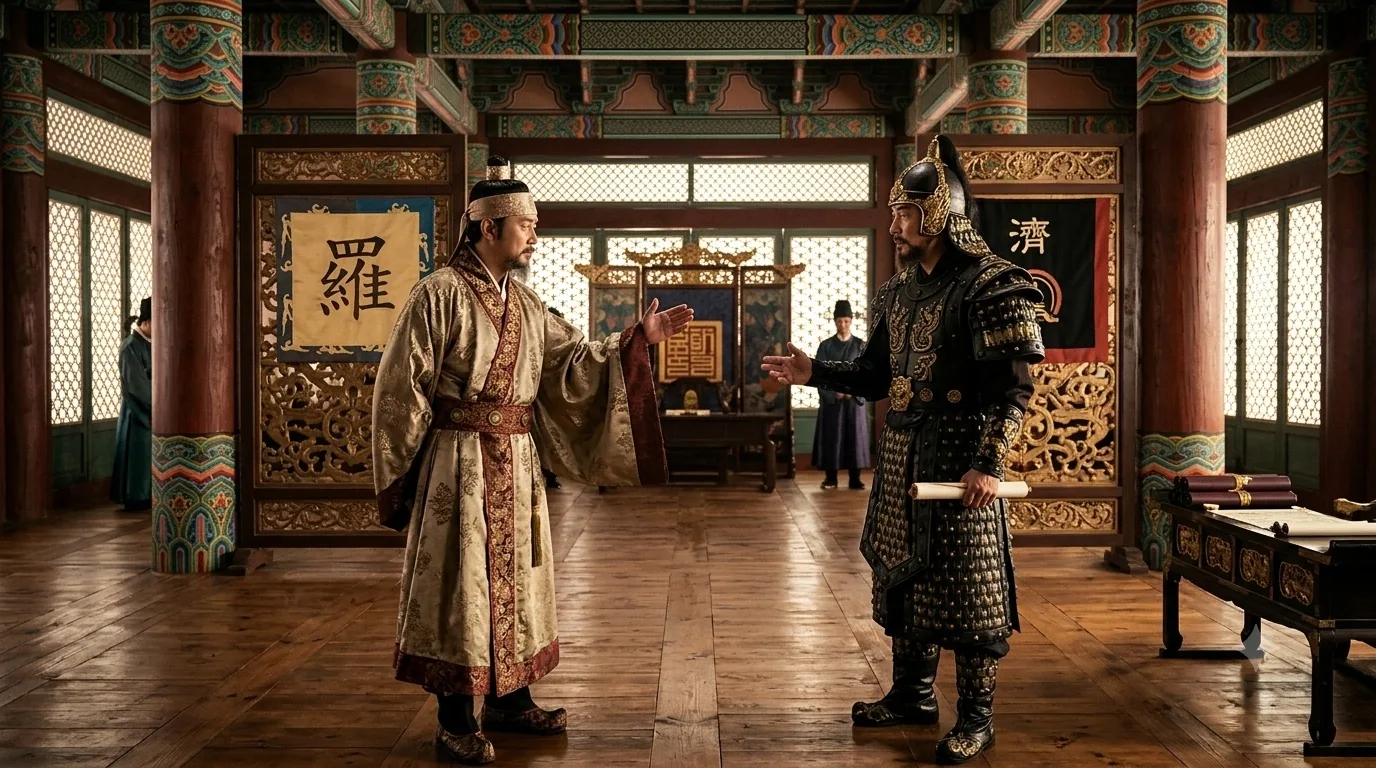 Two courts, two banners, one conversation — the scene the film plays for laughs and the question this article’s sources cannot answer. (AI illustration)
Quick answer: We do not know whether Gyebaek and Kim Yu-sin could have spoken to each other directly. No surviving source consulted here records an interpreter between Baekje and Silla — but absence from the record does not prove that none was used. The Chinese histories describe some of these languages as similar and others as different, and none of them measures whether speakers could understand one another. Beyond the sources, the standard Korean survey’s section on this question says the surviving language material does not allow the relations among the three languages to be determined conclusively — a section that page itself marks as the contributor’s own view rather than an institutional position; the specialist studies beyond it were checked here at the level of bibliography only, and this article judges among none of them.
One thing to hold onto before we start: genealogical relatedness and actual mutual intelligibility are not the same question. Languages can be closely related and still leave their speakers struggling, depending on period, region, and contact.
The Liangshu did not write that Baekje’s language was the same as Goguryeo’s. It wrote roughly the same. That qualifier, and the clause in the same sentence that names where the two differed, both come from the record itself.
And one more thing. Not one word of the speech of the Three Kingdoms survives as sound. Everything we have was written in Chinese characters; the actual pronunciations are not preserved, and phonetic values can only be estimated indirectly, mainly through the way Chinese characters were used to transcribe them.
Let’s unpack it.
Did Baekje and Goguryeo really speak the same language?
In the film, Gyebaek and King Uija sound different from each other, though both are men of Baekje. In the records, it is Baekje and Goguryeo that are described as close. The Liangshu (『양서』, 梁書), the history of the Liang dynasty (502–557) compiled in the 7th century, says this in its account of Baekje in volume 54:
今言語服章略與高驪同, 行不張拱, 拜不申足則異 — “At present their language and dress are roughly the same as Goguryeo’s; but in their gait they do not spread the arms, and in bowing they do not extend the leg — in these they differ.”
Two things in that sentence have to be kept apart, because they are routinely run together. The first is 略 (ryak) — “roughly,” “broadly,” “for the most part.” It is the source’s own hedge, and it sits on language and dress: not identical, close. The second is 則異, “in these they differ” — and what it marks as different is not language. The same sentence that calls Baekje’s speech and dress broadly like Goguryeo’s goes on to name gait and bowing as the points of difference. So the passage gives a hedged statement of similarity in language, and an explicit statement of difference in non-linguistic custom. Neither is a measurement. It is evidence that a Chinese observer saw the two as quite close; it is not evidence that a man of Baekje and a man of Goguryeo could converse without difficulty, and it is not the source saying their languages differed.
The same passage then complicates itself: 其言參諸夏 亦秦韓之遺俗云 — their speech, it says, has Chinese mixed into it, and is also said to be a remnant custom of 秦韓. The reading of 秦韓 in this line is disputed, so no argument is built on it. What the passage shows is that the observer was not presenting Baekje speech as a simple copy of Goguryeo’s.
There is an earlier record too — and it is worth quoting whole, because the usual excerpt cuts it in half. The Sanguozhi (『삼국지』, 三國志), describing the 3rd century, says of Goguryeo: 言語諸事, 多與夫餘同, 其性氣衣服有異 — “in language and in many matters they are largely the same as Buyeo (부여, 夫餘); their temperament and their dress differ” (Korean History Database). The same sentence that records the resemblance records a difference in the next breath. So the often-drawn chain — Baekje roughly like Goguryeo, Goguryeo largely like Buyeo — is a looser thing than a chain of resemblance: the operative words are 多 and 略, “largely” and “roughly.” And in both passages the note of difference that follows is about something other than speech — gait and bowing in the Liangshu, temperament and dress in the Sanguozhi. These histories hedge the likeness of language and then change the subject; neither registers a difference of language itself. (The 高驪 / 高麗 of these histories means Goguryeo, not the later Goryeo dynasty.)
The limits are plain. These are surveys of foreign customs, not linguistic investigations, and nothing in them says whether what was compared was the speech of the court or the speech of the fields.
Could Baekje and Silla understand each other?
This is the question the film actually poses, and it has to be answered plainly: no source consulted here settles it. No record directly comparing the speech of Baekje and Silla themselves appears in what this article opened. What does appear is a comparison of the earlier groupings in those same regions. The Sanguozhi, describing the 3rd century, says of Jinhan (진한, 辰韓): 其言語不與馬韓同 — “their language is not the same as Mahan’s” — and goes on to list correspondences word by word: 名國爲邦, 弓爲弧, 賊爲寇, 行酒爲行觴 (Korean History Database). Of Byeonjin (변진, 弁辰) it sets resemblance and difference in a single sentence, exactly as the Liangshu and the Goguryeo entry do: 言語法俗相似, 祠祭鬼神有異 — “their language and their laws and customs are similar” to Jinhan’s, “in their rites to the spirits there are differences” (Korean History Database). The same Jinhan entry then compares their speech to that of 秦 people, a remark the database carries with variant readings; no argument here rests on it, as with the 秦韓 of the Liangshu passage above. And the limit has to be kept in view: these are Mahan, Jinhan and Byeonjin in the 3rd century — the groupings that preceded Baekje and Silla in those regions, not Baekje and Silla themselves. How any of it carries into the later speech of Baekje and Silla is not something this article can answer. The Liangshu sentence about Silla speech getting through by way of Baekje, taken up in the next section, is about mediation at the Liang court, not a comparison of the two languages.
Why did a Silla envoy have to travel with Baekje?
The film opens with four delegations in one room, talking. The 6th-century record shows something else entirely: a Silla mission reaching Liang in Baekje’s train. The Liangshu records that in 521 Silla sent its first embassy to Liang and presented tribute alongside the Baekje envoys, and its account of Silla puts it this way (Korean History Database, 梁書 東夷列傳 新羅):
語言待百濟而後通焉 — “Their speech got through only by way of Baekje.”
That line is often quoted today as proof that Baekje and Silla understood each other. The text does not say that; what it describes is Baekje mediating between Silla and Liang. The passage does contain 通 — 通焉, and then they get through. What it does not contain is a term for an interpreter as such: neither 譯 nor 通事 appears in this account. So the line records that communication happened, not by what means, and it settles nothing either way. The two languages may have been close enough for a Baekje man to relay Silla speech; or different enough that Baekje happened to have people who knew Silla speech. In the Liangshu’s account, Baekje mediates the communication between Silla and Liang — and the record does not tell us by what means.
The same account holds one more sentence that surprises readers coming to it fresh: 無文字, 刻木爲信 — “They have no writing; they notch wood as tokens.” Taken at face value, that says 6th-century Silla was without writing. But Silla has left stone monuments inscribed in Chinese characters, and while their dating is disputed — the Naengsuri stele (냉수리비) is placed at either 443 or 503, the Jungseongri stele (중성리비) at either 441 or 501 — under any of those readings, Chinese-character inscriptions existed before the 521 embassy. The inscriptional evidence makes it difficult to read 無文字 as a literal statement that no writing was used anywhere in Silla. What exactly the Liang court meant by the phrase — and why it was set down that way — is harder to establish, and this article does not settle it.
Why did the king of Baekje have two titles?
The Zhoushu (『주서』, 周書), in its account of Baekje in volume 49, records (Korean History Database, 周書 異域列傳 百濟): 王姓夫餘氏 號於羅瑕 民呼爲鞬吉支 夏言竝王也 — the king’s surname is Buyeo; he is titled eoraha (어라하, 於羅瑕), and the people call him geongilji (건길지, 鞬吉支); in Chinese, both mean “king.” The queen, it adds, was called eoryuk (어륙, 於陸).
On the strength of this sentence a bilingual-state hypothesis for Baekje was once advanced. That discussion was not opened for this article, and its content is not reported here. What the source says is that the king’s title and the people’s word for him were different; it does not say what kind of speech either belonged to, and a split between an official title and a popular one within the same language is left just as open by the text. And the actual 6th-century pronunciations behind those characters are not established: Chinese characters are a shell that carried sound, and the sound values of the characters themselves varied by period and region.
Here is what the film shows, set beside what the record says:
| In the film | In the historical record |
|---|---|
| The film opens with representatives of Tang, Goguryeo, Baekje, and Silla seated together and talking | The Liangshu records that in 521 Silla’s first embassy reached Liang in the train of Baekje’s envoys, its speech getting through “by way of Baekje” — the means of mediation unrecorded |
| Baekje troops are described as cursing in a Jeolla-style dialect, Silla troops as answering in a Gyeongsang-style one | Baekje–Goguryeo and Goguryeo–Buyeo are compared in the records; Silla’s speech is compared with neither. Modern provincial dialect boundaries cannot be projected back onto the 7th century |
| King Uija is described as speaking a Chungcheong-style dialect — unlike Gyebaek’s, though both are of Baekje | No record identified in the sources consulted here supports the regional dialect difference the film draws. What the Zhoushu reports is a different thing: an official title and a popular title for the same king |
| A Baekje coded message is described as containing geosigi, with the Silla camp convening a meeting because it cannot decode the word | The National Institute of the Korean Language answers that geosigi is a standard word, used as a pronoun and as an interjection, and says nothing about region; this article opened nothing else on that question. Nothing in the sources consulted here supports treating it as Baekje speech |
In short: the battle and the commanders are historical, and the Samguk Sagi records a heavy disparity of numbers — but the film’s language elements — the dialects, the cursing, the code word — are modern comic devices laid over a question this article’s sources cannot answer.
What does it mean that interpreters are missing from the records?
In the film, the Silla camp holds a straight-faced council because it cannot make out one word. Nothing like that scene appears in the sources.
Take the most quoted example, the biography of Geochilbu (거칠부, 居柒夫) in volume 44 of the Samguk Sagi. Geochilbu of Silla shaves his head, passes himself off as a monk, crosses into Goguryeo, and sits in on the lectures of the master Hyeryang (혜량, 惠亮). Asked where he is from, he says he is a man of Silla. That evening Hyeryang calls him aside, takes his hand, and tells him he does not seem an ordinary man and had better go home before he is caught. An enemy agent recognized, warned, and let go — and not a line about interpreting. The same holds for Kim Chun-chu’s (김춘추, 金春秋) mission to Goguryeo in 642 to request troops (Samguk Sagi vol. 5, Queen Seondeok year 11).
Here is the trap in that.
That the sources did not record an interpreter does not mean there was no interpreter.
Every conversation in the Samguk Sagi was set down in Literary Chinese in the 12th century. None of it is a recording of actual speech. Even where interpreting took place, it may simply not have been carried into the compiled record.
And that is not idle speculation, because interpreting in ancient East Asia is attested. The Sanguozhi account of Buyeo contains the line 譯人傳辭, 皆跪, 手據地竊語 — interpreters conveying words, everyone kneeling, hands on the ground, speaking low (Korean History Database). And the ink inscription of the Deokheungri painted tomb (덕흥리 벽화고분) carries the office-title tongsari (통사리, 通事吏) (Korean History Database); the inscription itself records that in the 18th year of Yeongnak — 408 — on the 25th day of the 12th month, the tomb was completed and the coffin moved.
That item comes with a genuine surprise attached, and it has to be stated as what it is. The database’s annotations gloss 通事 as an interpreter’s post, and Jeong Seung-hye’s 2017 study reads the 通事吏 of the tomb’s Governor’s Audience scene (〈太守來朝圖〉) as a translating post within the administration the tomb depicts, and announces in its title the discovery there of a female interpreter (KCI). Its abstract states that the Goguryeo material shows a woman holding the office of 通事吏, and that is the whole of what was opened here — the bibliographic record and the abstract; the grounds the study gives for the identification are in the full text, which is neither quoted nor assessed in this article. The scene the study names in its title is itself worth marking: 太守來朝圖 is governors coming to court, an administrative audience, not an exchange between the Three Kingdoms. It is in any case a research interpretation, not something the inscription states in words. And whether the administration in question was Goguryeo’s own turns on an unsettled question: the origins of the tomb’s occupant, a man named Jin (진, 鎭), his political affiliation, and the nature of his offices are all debated.
One limit on both of these examples should be marked plainly. The Buyeo passage concerns dealings with Chinese-side interlocutors; for the Deokheungri inscription, whose subject’s origin and affiliation are themselves unsettled, this article does not settle whom the 通事吏 served. No record of interpreting between the Three Kingdoms themselves has been identified in the sources consulted here.
So the conclusion runs in both directions at once. Silence in the sources is not evidence that everyone understood each other; nor is it evidence that the three languages were wholly different. The silence of the record takes nobody’s side.
Two things can be added without overreaching. The written records and the inscriptions show Literary Chinese functioning across elite administration and diplomacy in all three kingdoms, which gave rulers and the people who handled envoy work a medium that did not depend on speech. And it is reasonable to suppose — though the records do not show it — that among border villagers, envoy parties, monks, and traders in states that spent centuries at war, in alliance, and exchanging marriages and prisoners, some people knew the other side’s speech. That communication was possible is a different claim from the claim that the languages were the same.
What does the standard Korean survey actually say?
Whether the specialist literature is divided is not something this article opened. What it confirmed is narrower: the standard survey section states that the surviving language material does not allow the relations among the three languages to be determined conclusively, and it carries a notice that the view is the contributor’s own. What the specialist studies behind that section conclude is not something this article can report — they were not opened here.
The relevant section of Sinpyeon Hanguksa (『신편 한국사』) vol. 8, published by the National Institute of Korean History, says it outright: 현전하는 언어자료의 비교에 의해서는 고구려·백제·신라 언어 상호간의 관계를 단정적으로 규정할 수 없다 — by comparison of the surviving language material, the mutual relations of the Goguryeo, Baekje, and Silla languages cannot be determined conclusively (Urihistorynet). The same section adds that on language material alone it is also hard to conclude that Silla and Baekje speech stood closer to each other than to Goguryeo: 순전히 언어자료의 비교에 의해서는 신라어와 백제어가 고구려어 보다 가까웠다고 결론 짓기도 어렵다. The page carries the standard notice that the contributor’s views are his own and may differ from the institute’s official position.
The specialist studies behind that summary were not opened for this article. They are listed below by bibliography alone, and what each of them concludes is not reported here — only the ground each one works on, as its own title states it: Lee Geun-su (이근수) on whether the Goguryeo and Silla languages are different languages; Park Jong-deok (박종덕) on the Silla-based account of the formation of Korean; John Bentley on Baekje and Korean from data in the Nihon shoki; Lee Seung-jae (이승재) on ancient Korean recorded on wooden tablets (목간, mokgan); Ki-Moon Lee and S. Robert Ramsey’s history of the Korean language; and Alexander Vovin on whether Goguryeo and Baekje were different languages or dialects of Old Korean.
This article opened none of these, so it designates none of them as the accepted view — that is a limit of this article, not a finding about the field.
Why does this question matter?
After the battle, Baekje’s central dynasty fell in 660 — though a Baekje restoration movement fought on, with major engagements continuing until 663. In the north, Balhae (발해) was founded later, in 698, as a separate event.
And the surviving material leans heavily to the side that survived. That is a fact about what was kept, not a verdict on what happened to the other two languages, and what follows from it is not something this article can weigh.
People of the Three Kingdoms did not ask this question. It came up much later, for a simple reason: the moment you ask where modern Korean came from, this problem is waiting. After 676, Silla held the territory south of the Taedong River — and the surviving linguistic material leans heavily to the Silla side. The best-known continuous materials — hyangga poetry, idu transcription — survive on the Silla side; that much is the standard handbook picture, and this article is repeating it rather than weighing the specialist literature, which it checked at the level of bibliography only. What the survey section opened here will support is this much and no more: that the surviving language material does not allow the relations among the three languages to be determined conclusively, and that on that material alone it is hard even to conclude that Silla and Baekje speech stood closer to each other than to Goguryeo. How much Baekje and Goguryeo contributed to the formation of later Korean is not something this article can weigh.
Which is why the argument does not stay inside linguistics. How one classifies Goguryeo’s language is a question for historical linguistics — but that classification has also been used in some modern historical and identity disputes, including ones reaching beyond Korea’s borders. The two things are worth keeping apart.
Is the film’s dialect history?
This is the film’s largest departure — and also its cleverest. The Jeolla-style, Gyeongsang-style, and Chungcheong-style speech in the film is 21st-century Korean. There is no basis in the sources consulted here for saying a 7th-century person of Baekje spoke today’s Jeolla dialect, nor for treating geosigi as an ancient word. The National Institute of the Korean Language answers a query about the word directly — 「‘거시기’는 표준어가 맞습니다」, geosigi is indeed a standard word, used both as a pronoun for a person or thing whose name does not come to mind or is awkward to say and as an interjection in the same situation (국립국어원). That answer says nothing about region, and this article opened nothing else on the question. Either way, none of it bears on antiquity.
That does not make the film nonsense. Records survive that compare Baekje with Goguryeo, and Goguryeo with Buyeo — each noting resemblance and difference in the same sentence. The device sets a difference a Korean speaker today can place at once beside one nobody can place at all.
There is a side effect. Today’s map — Baekje as Jeolla, Silla as Gyeongsang — gets projected straight back onto antiquity, and the Three Kingdoms had no provincial dialect boundaries in the modern sense. The film turns that map into satire.
Yasa: how did a Baekje youth teach Silla children a song?
King Uija’s father was King Mu (무왕, 武王) of Baekje, and to King Mu is attached a story every Korean learns at school, recorded in the Samguk Yusa (『삼국유사』, 三國遺事), volume 2, in the “Giyi” chapter entry on King Mu. Seodong (서동, 薯童) of Baekje slipped into the Silla capital, handed out yams to the children, and had them sing a song: that Princess Seonhwa (선화공주, 善花公主) met Seodong in secret every night. The song spread, the princess was expelled from the palace, and Seodong took her as his wife. This is the Seodongyo (서동요).
It is a tale, not an event established as fact. The sarira dedication record recovered in 2009 from the west pagoda at Mireuksa Temple (미륵사지) in Iksan names King Mu’s queen as the daughter of the jwapyeong Sataek Jeokdeok — which does not match the Princess Seonhwa founding narrative. That mismatch is as far as the evidence reaches; it does not by itself make the whole Seodong tale false.
What makes the tale interesting here is narrower than it first looks. A Baekje youth teaches children a song in the Silla capital and it catches on — and the tale does not stop to mention a language barrier. Which tells us only that the compiler did not think it needed explaining, and nothing about what speakers could actually understand.
Back to Hwangsanbeol
The film’s joke turns out to have been a precise question. Its premise — that the two armies trade insults in different dialects, and that one Baekje word stops the Silla camp cold — is a comic device, not reconstruction. But the question that premise throws out is one this article’s sources cannot answer, and one the specialist literature listed below was not opened here to settle. What is left is the shell written in Chinese characters. The sound is gone — recoverable, if at all, only as estimate from the way Chinese characters were used to transcribe it.
And the film meets a version of the same problem itself. Geosigi — a word that slides, depending on the moment, toward that thing, that other thing, whatchamacallit, anyway, you know — exists less as a meaning than as a use: what it points to is settled by the moment, not by the word.
A word whose reference is settled by the moment and not by the word is a hard thing to pin down even with a dictionary entry in front of you; the speech of the Three Kingdoms reaches us with no sound at all — only scattered word-glosses in Chinese histories, and Chinese characters used to write it down.
A note on the film: where it can be watched is for each service to say.
Frequently asked questions
Is Once Upon a Time in a Battlefield (황산벌) a true story? Partly. The Battle of Hwangsanbeol in 660, and the figures Gyebaek, Kim Yu-sin, and Gwanchang, are historical, and the Samguk Sagi records a Silla army of 50,000 against Gyebaek’s suicide corps of 5,000. But the dialogue — the cursing match and the coded word geosigi — is the film’s own invention, and should be read as a comic device rather than reconstruction.
Did people of the Three Kingdoms talk to each other without interpreters? This cannot be settled. Several conversation accounts in the Samguk Sagi, such as the Geochilbu episode and Kim Chun-chu’s 642 mission to Goguryeo, do not mention any interpreting step. But ancient East Asian material does record interpreting: the Sanguozhi account of Buyeo describes interpreters conveying speech, and the Deokheungri tomb inscription carries the office-title 通事吏, which research reads as a translating post. The Buyeo passage concerns dealings with Chinese-side interlocutors; for the Deokheungri inscription, whose subject’s origin and affiliation are themselves unsettled, this article does not settle whom the 通事吏 served. No record of interpreting between the Three Kingdoms themselves has been identified in the sources consulted here — but these cases do show that the absence of an interpreter from a given narrative is not evidence that none was present.
Were the Baekje and Goguryeo languages the same? The Liangshu account of Baekje records that at present their language and dress are roughly the same as Goguryeo’s — and then, in the same sentence, that in their gait they do not spread the arms and in bowing they do not extend the leg, and in these they differ (今言語服章略與高驪同, 行不張拱, 拜不申足則異). The qualifier 略, roughly, comes from the source itself — and so does the closing 則異, but what that phrase marks as different is gait and bowing, not language. The passage hedges the likeness of speech and then names a difference of custom; it never records a difference of language. The same passage then adds that Baekje speech contained elements the observer connected to Chinese usage and to remnant customs he associated with 秦韓 — a phrase whose reading is itself disputed. The record shows a Chinese observer seeing the two as close while marking where they parted; it does not measure whether speakers could understand one another.
What about the Baekje and Silla languages? This article does not settle it, and the reason is worth stating plainly: no record directly comparing the speech of Baekje and Silla themselves appears in what was opened here. The nearest thing is the Liangshu account of Silla, 語言待百濟而後通焉, their speech got through only by way of Baekje — a record of mediation at the Liang court, not a comparison of the two languages. What does appear is the Sanguozhi on the earlier groupings in those regions — Jinhan’s language is not the same as Mahan’s (其言語不與馬韓同), while Byeonjin’s language and customs are similar to Jinhan’s though its rites to the spirits differ (言語法俗相似, 祠祭鬼神有異) — and those are 3rd-century Mahan, Jinhan and Byeonjin, not Baekje and Silla, so how any of it carries into the later speech of the two kingdoms is not something this article can answer. Work exists on wooden-tablet (목간, mokgan) material, notably by Lee Seung-jae, and on Baekje vocabulary preserved in the Nihon shoki, notably by John Bentley, but those studies were not opened here and what they conclude is not reported. What the standard Korean survey states is that the surviving language material does not allow the relations among the three languages to be determined conclusively.
Are the dialects in the film — and the word geosigi — the actual speech of the Three Kingdoms? No. The Jeolla-style, Gyeongsang-style, and Chungcheong-style speech in the film is modern Korean regional dialect — a layer a Korean speaker today can place at once, which 7th-century speech is not. There is no basis in the sources consulted here for holding that a 7th-century person of Baekje spoke today’s Jeolla dialect, and today’s provincial dialect boundaries should not be projected back onto the Three Kingdoms. The National Institute of the Korean Language answers that 거시기 is a standard word (표준어), used as a pronoun and as an interjection, and that answer says nothing about region; this article opened nothing else on that question.
Did Silla really have no writing? The Liangshu account of Silla states ‘they have no writing; they notch wood as tokens’ (無文字 刻木爲信). But the datings of the Naengsuri and Jungseongri steles are disputed — 443 or 503 for the former, 441 or 501 for the latter — and under either reading, Chinese-character inscriptions predate the 521 embassy. So the line is hard to read as meaning Silla people used no writing at all. What the Liang court meant by the phrase is harder to establish, and this article does not settle it.
Did Baekje have two languages? The Zhoushu records that the king was called eoraha (어라하, 於羅瑕) while the people called him geongilji (건길지, 鞬吉支), and the queen eoryuk (어륙, 於陸). A bilingual-state hypothesis was later built on this sentence; that discussion was not opened for this article and its content is not reported here. The source says that the king’s title and the people’s word for him differed, not what kind of speech either belonged to, so a split between an official title and a popular one within a single language remains equally open. The actual 6th-century pronunciations behind those characters are not established.
Did the Seodongyo story really happen? It is a tale recorded in the Samguk Yusa, not a verified event. The sarira dedication record recovered from the west pagoda at Mireuksa Temple in Iksan in 2009 names the queen of King Mu as a daughter of the jwapyeong Sataek Jeokdeok, which does not match the Princess Seonhwa founding narrative. That mismatch is as far as the evidence goes; it does not by itself disprove the whole Seodong tale.
Sources & further reading
This piece was written from the historical script of 사뚱샘의 역사방 (SaDDungSam); that script is not public. Claims about the records and the language material are sourced inline and stand or fall on the inline source. Descriptions of the film are the exception: they rest on that script, not on a viewing, and no inline source is given for them. Because this article’s subject is precisely the limits of evidence, the sources below are split by one plain fact: whether a link is given or not.
- Cited with a link, to the National Institute of Korean History’s Korean History Database, with the database article ID in parentheses: the Sanguozhi accounts of Goguryeo (jo_004_0010_0030_0020) and Buyeo (jo_004_0010_0020_0020), the Liangshu accounts of Baekje (jo_008_0010_0030_0040) and Silla (jo_008_0010_0040_0030), the Zhoushu account of Baekje (jo_010_0010_0020_0020), and the Deokheungri tomb inscription (gskh_001_0020_0040_0030).
- Cited by document, without a link: the Samguk Sagi passages (Geochilbu; Queen Seondeok year 11; King Uija year 20) — their database article IDs were not confirmed, so no URL is given rather than a guessed one. No Chinese original is quoted from them above. The same applies to the film material, and the scope there is wider than a quotation check: every description of the film in this article — the opening summit, the dialects, the cursing match, the coded word — rests on the Korean-language history script this article works from, whose writer describes the film’s scenes, together with the Korean Film Archive record linked above — not on a screen check of the film on our side.
For broader reading:
- The state of the question. “The mutual relations of the languages of the Three Kingdoms,” in Sinpyeon Hanguksa (신편 한국사) vol. 8, National Institute of Korean History — read on Urihistorynet; attributed to Song Ki-joong in the volume, though the page itself carries no byline.
- In Korean. Lee Geun-su, Hangeul 177 (1982), 39–60; Park Jong-deok, Dongasia Godaehak 25 (2011), 1–30; Lee Seung-jae, Ancient Korean Recorded on Wooden Tablets (목간에 기록된 고대 한국어), Ilchokak, 2017.
- In English. Ki-Moon Lee and S. Robert Ramsey, A History of the Korean Language, Cambridge University Press, 2011; Alexander Vovin, “Koguryŏ and Paekche: Different Languages or Dialects of Old Korean?”, Journal of Inner and East Asian Studies 2-2 (2005), 107–140; John R. Bentley, “A New Look at Paekche and Korean: Data from Nihon shoki,” Language Research 36-2 (2000), 417–443.
- The Deokheungri interpreter figures. Jeong Seung-hye (정승혜), 古代의 譯人 — 덕흥리 벽화고분 <太守來朝圖>의 여성 통역관의 발견과 관련하여, Mokgan-gwa Munja (木簡과 文字) 19 (2017), 169–186 (KCI; DOI 10.35302/wdis.2017.12.19.169). The bibliographic record and the abstract were consulted there; the full text was not opened, so this article reports only that the study advances the identification, not the grounds it gives for it.
Thanks for reading — see you in the next one.
This article was researched and written by K-Drama History. Source: Once Upon a Time in a Battlefield, Explained: Could Gyebaek and Kim Yu-sin Understand Each Other? — K-Drama History