Did Hangul Borrow From the Mongols' Phags-pa Script? What the Evidence Actually Says
Theme: Knowledge & Science
From the research behind Pause the Drama.
In the second lunar month of 1444, a group of Joseon scholars knelt and submitted a memorial against King Sejong’s new letters. One clause of it reads like a piece of comparative linguistics that nobody asked for.
From antiquity, within the Nine Provinces, though climate and custom differ, there has never been a case of a separate script being made on account of a regional speech. Only such peoples as the Mongols, the Xia, the Jurchen, the Japanese and the Tibetans each have their own letters — but these are all matters of the Yi and Di, not worth speaking of.
Read that again slowly. Before Joseon’s literati could argue that a new script was unprecedented, they had to produce a list of everyone who had already made one. They knew the list. They had it ready. Their objection was not that the thing could not be done — it was about the company doing it would put them in.
This piece is a companion to our main essay on why Sejong’s own scholars tried to block Hangul. That one answers why the script was made and why it was resisted. This one picks up the list in the petition and asks a question the petitioners never thought to ask: once a script is invented, what makes it last?
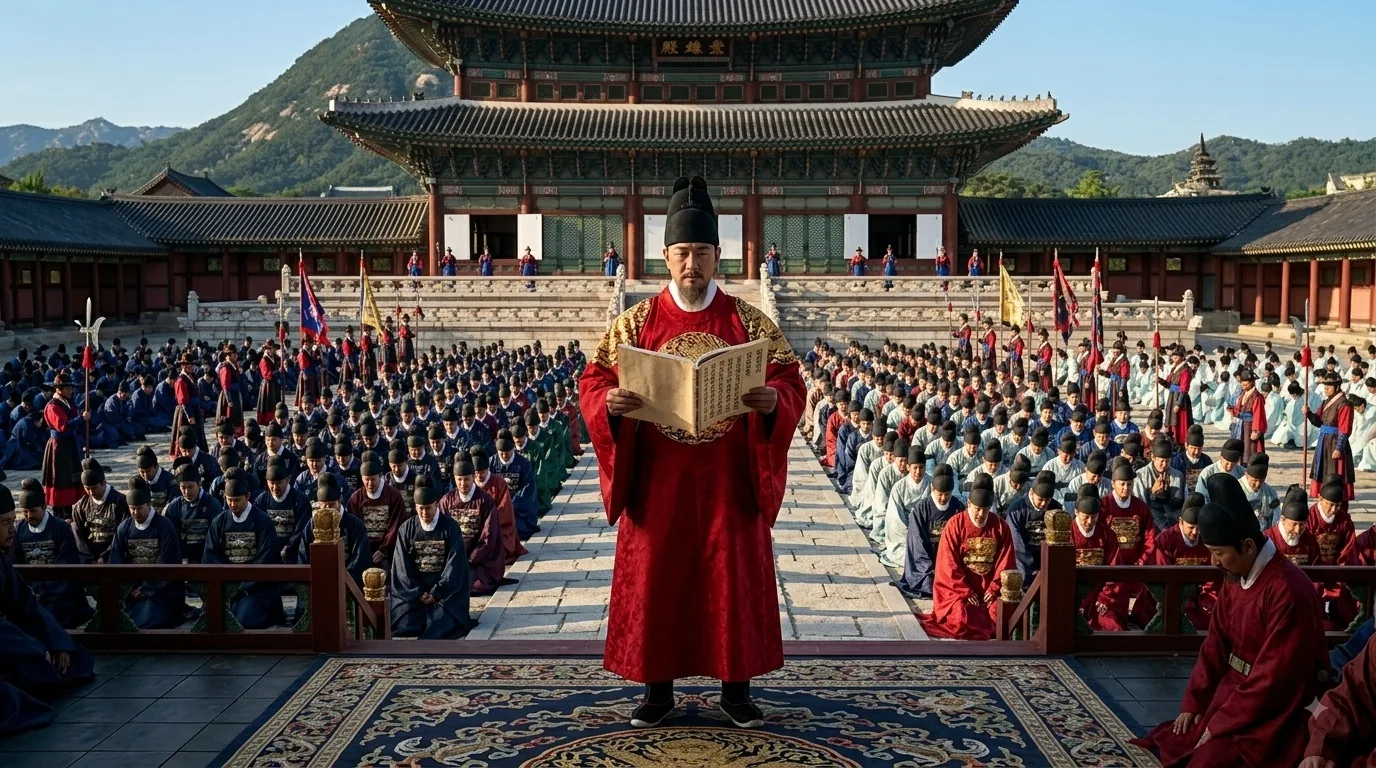 A script announced from the top of a state that already had one — and the machinery to carry it. (AI illustration)
Quick answer: We do not know whether Hangul borrowed from Phags-pa. A documented line of scholarship — Yi Ik and Yu Hui in Joseon; Gari Ledyard, Yu Chang-gyun and Chung Kwang in the modern period — argues that the Mongol script was consulted for its design. Against it, the Encyclopedia of Korean Culture reports that many readers take the Veritable Records phrase 倣古篆 as a remark about how the letters ended up looking rather than where they came from, and the Hunminjeongeum Haerye derives the letter shapes from the speech organs. No surviving primary source says Sejong copied Phags-pa.
The comparison is still worth making, for a different reason. Phags-pa, the Hunminjeongeum and the Cherokee syllabary are three invented scripts with three different relationships to political power. Phags-pa was commissioned by Kublai Khan and promulgated by edict in 1269, and that edict defined its job — documents issued under the imperial seal; a 2025 study by Morris Rossabi finds it was used in practice almost only for state issuances, and when the Yuan fell that official ground largely fell with it. Sequoyah began with no state commission, demonstrated his syllabary in 1821, and the Cherokee Nation adopted it in 1825. The Hunminjeongeum had footing in both places at once: inside state recruitment within months of the 1446 promulgation, and on a Seoul wall by 1449, where someone used the new letters (original text) to tell the Chief State Councillor to stop bungling his job.
Let’s unpack it.
The comparison in this article is not ours — it is in the petition
The 1444 petition is preserved in the Veritable Records of Sejong; the original text is here.
The memorial of 1444 is best known for its politics, and we covered those in the main essay. What gets skipped is the geography in it.
The Chinese text of that clause runs:
自古九州之內, 風土雖異, 未有因方言而別爲文字者, 唯蒙古、西夏、女眞、日本、西蕃之類, 各有其字, 是皆夷狄事耳, 無足道者。
Five peoples, named in order: the Mongols, Xia (the Tangut state of Xixia), the Jurchen, the Japanese, and Seobeon (西蕃, the Tibetan lands). Each, the petitioners concede, has its own letters. The concession is immediately withdrawn — these are all matters of the Yi and Di, not worth speaking of — but it has been made.
One caution before we go further. This was one clause in a long document. The same memorial argued from Joseon’s service to China, from the sufficiency of the existing idu notation, from the training of clerks, from legal fairness, and from the way the project had been pushed through without consultation. Reducing the whole memorial to this single motive would flatten it. What the clause gives us is not the reason for the opposition — it is a list, and the list is useful.
This article takes one name from it, and adds one the petitioners could not have known.
The Mongols’ Phags-pa script is a particularly useful institutional parallel to the Hunminjeongeum: a script commissioned by a monarch, made by a named person, promulgated by decree. The Cherokee syllabary of Sequoyah, released in 1821 on the other side of the world, is a useful contrast: an invented script that no monarch commissioned. Xixia, Jurchen and Japanese are real cases and would repay the same treatment; they are outside the material this piece could verify, and are left aside rather than half-covered.
Mongolia: a script the empire commanded, and almost only the empire used
The Yuanshi, the official history of the Yuan dynasty, tells the story in its chapter on Buddhism and Daoism. Kublai, on taking the throne, honoured the Tibetan monk Phags-pa as National Preceptor and “commanded him to make a Mongol new script; when the letters were finished he presented them.” The history’s technical note is brief: 其字僅千餘, 其母凡四十有一 — “its letters are barely a thousand and some in combination; its mother-letters number forty-one.”
That figure is worth handling carefully. Forty-one is the count of basic letters; the Encyclopedia of Korean Culture glosses them as initials. It is often quoted alongside the Hunminjeongeum’s twenty-eight as if the gap were the proof of a multilingual design. It is not — you cannot infer purpose from a letter count. The purpose is stated outright, in the promulgation edict of Zhiyuan 6 (1269), which the Yuanshi preserves:
故特命國師八思巴創爲蒙古新字, 譯寫一切文字, 期於順言達事而已。自今以往, 凡有璽書頒降者, 竝用蒙古新字, 仍各以其國字副之。 Therefore we specially commanded the National Preceptor Phags-pa to create a Mongol new script, to transcribe all writings, so that speech may run true and matters be conveyed. From this day forward, all documents issued under the imperial seal shall use the Mongol new script, with each nation’s own script appended alongside.
Two things are in that sentence. 譯寫一切文字 — to transcribe all writings — is the multilingual intent, from the primary source rather than from arithmetic. And 凡有璽書頒降者 — all documents issued under the imperial seal — is the domain. The decree that brought the script into the world also drew, in the same breath, the boundary of where it was to live.
Practice narrowed even that. Morris Rossabi’s 2025 study of communication in the Yuan and early Ming states the finding plainly: despite repeated injunctions from the Yuan court, the script was used almost solely for government issuances — paper money, seals, and the paiza passes carried by imperial travellers. That is a scholarly assessment of a tendency, not a claim that no other use existed; Phags-pa also appears on stelae, in books, on Buddhist objects, on ceramics, and in owners’ names on goods. But the centre of gravity is unmistakable, and it is the state.
Then the state went. On the script’s official endpoint the sources are not uniform. The Encyclopedia of Korean Culture says it served as the Yuan’s official script until 1352, and general reference works often repeat that the latest dateable Mongolian-language inscriptions fall in 1351–1352. Specialist catalogues of surviving Phags-pa material do not all agree, and later dated pieces have been reported. So we will not make 1352 a wall. What is safe is narrower and enough: the script’s official life ended with the dynasty that mandated it.
The Encyclopedia adds a strange coda. In China, the Encyclopedia says, the script was thoroughly suppressed from the founding of the Ming, and even the names for it fell out of use there. In Joseon it came to be called cheobawoljin (帖兒月眞) or cheopwoljin (帖月眞) — Mongolian for “square letters” — or simply jayang (字樣), “letter-shapes.” Those Joseon names are attested. Whether Joseon adopted them because of Ming prohibition is the encyclopaedia’s own connective tissue rather than something a primary document states, so we note the names and leave the causation alone.
Did the Hunminjeongeum come from Phags-pa? Here is who argues what
This is the question the whole piece has to hold steady, because it is genuinely unsettled and because it is easy to write it as though it were not.
What the Encyclopedia of Korean Culture says. Its ‘Phags-pa script’ entry states that the script “is known to have been consulted” for the Hunminjeongeum, and then does something more useful than asserting it — it names the lineage of the argument. The connection was raised in the Joseon period in Yi Ik’s Seongho saseol and Yu Hui’s Eonmunji, and has been pursued in modern scholarship by Gari Ledyard (1966/1998), Yu Chang-gyun, and Chŏng Kwang (2009, 2012). Note what that sentence is and is not: it is a state-institution encyclopaedia reporting a well-established line of research. It is not a statement that the field has converged.
What the central textual hinge is. It is three characters — though the debate is not only textual; the argument for Phags-pa influence also compares letterforms. The Veritable Records entry recording the creation — a monthly entry for the twelfth month of Sejong 25 (1443), which is why no exact day should be quoted for it — reads:
是月, 上親制諺文二十八字, 其字倣古篆, 分爲初中終聲, 合之然後乃成字… This month the king personally made twenty-eight eonmun letters. The letters imitate the ancient seal script (倣古篆) (original text); they are divided into initial, medial and final sounds, and only when combined do they form a syllable…
倣古篆 — “imitating the ancient seal script.” The Phags-pa script was itself known in Chinese usage as a Mongol script in seal form. Readings that trace Hangul’s design to Phags-pa lean heavily on the possibility that 古篆 here points that way. Readings that do not, take 古篆 in its ordinary sense of Chinese seal script — and observe that the Hunminjeongeum Haerye of 1446, the script’s own explanatory manual, derives the consonant shapes from the configuration of the speech organs, which is not how Phags-pa letters are constructed. Both readings are built on the same three characters, and the entry does not adjudicate between them.
What this article does with that. It reports both, attaches names to the argument, and stops. The comparison being drawn in these pages is structural, not genealogical: what happened to three scripts after they were made. Two of the three cases here — Phags-pa and Cherokee — have no contact with each other whatsoever, and 375 years separate the Hunminjeongeum’s promulgation from Sequoyah’s release. Reading descent into a lineup is exactly the error worth naming out loud.
Cherokee: a script that began without a state commission
Sequoyah is the case that breaks the pattern in the 1444 list, because no throne commissioned it.
The U.S. National Library of Medicine’s Native Voices timeline records him as a Cherokee silversmith in northeast Alabama who, working among white settlers, was struck by their writing — what Cherokee people called “talking leaves.” The Smithsonian’s National Museum of the American Indian dates the start of his work to as early as 1809. The Oklahoma Historical Society’s signed entry by William L. Anderson describes the method by which he got there: he first tried to make a symbol for every word, found it unworkable, and switched to a symbol for each sound unit — arriving at 86 symbols, later reduced to 85. He released the system in 1821.
The structural point matters for the comparison. Sequoyah’s is a syllabary, not an alphabet: one sign per syllable, with no separate letters for consonant and vowel. Sejong’s solution assigns letters to individual sounds and then stacks them into syllable blocks. Different problems, different answers — which is why asking which of these scripts is “best” has no common scale to be measured on.
Then comes the part where the sources split, and it is the most famous part.
- Oklahoma Historical Society (SE020) records that Sequoyah demonstrated the system before the Cherokee Council in 1821, using his daughter Ahyokah. It says nothing about a trial.
- National Geographic Education, and Cherokee-side accounts, describe something considerably more dramatic: that as word of the writing spread, Sequoyah and Ahyokah were charged with witchcraft, that an 1811 Cherokee law entitled them to a civil trial, and that they were put in separate rooms and made to exchange written messages to test whether the marks really carried speech.
We are not going to pick. Silence in one entry is not denial, so the accurate description is that the accounts differ in scope, not that they conflict. The demonstration before the Council is on both sides of the split; the trial framing appears in later institutional education materials and community accounts and has not been matched here to a contemporary document. Treat the courtroom scene as a story that may well be true rather than as an established fact.
What followed is better anchored. The Cherokee National Council awarded Sequoyah a medal in 1824, in the Oklahoma entry’s words, as a token of respect and admiration for his ingenuity. The Smithsonian records that in 1825 the Cherokee Nation officially adopted the syllabary and promptly commissioned a written version of Cherokee law, and that by 1828 the Cherokee were publishing a newspaper with type set in Cherokee and English.
So the sequence runs: one person’s invention → adoption inside a community → recognition and support from political institutions. Not a state handing letters down, and not a community operating with no institutions at all — the Cherokee Council is present in the story from 1821 onward. The order of arrival is the thing that differs.
Joseon: a script with footing above and below
Set against those two, the Hunminjeongeum starts out looking like Phags-pa. A monarch made it. The Sillok says so directly — 上親制諺文二十八字, the king personally made twenty-eight eonmun letters — and it was promulgated under the state’s name in 1446.
What differs is what happened next, and here two persistent misreadings are worth correcting at once.
First: it was not shut out of the state. The Encyclopedia of Korean Culture’s ‘Hangul’ entry records the Haerye being compiled, the Dongguk jeongun replacing the old fanqie method for Sino-Korean readings, and the Yongbi eocheonga, Worin cheongangjigok and Seokbo sangjeol being printed to demonstrate what the new letters could do. And the machinery reached the hiring desk fast. On the twenty-sixth day of the twelfth month of 1446 — the same year as the promulgation — an order went to the Ministry of Personnel:
今後吏科及吏典取才時, 訓民正音, 竝令試取。雖不通義理, 能合字者取之。 Henceforth, at the recruitment examinations for the clerical track, the Hunminjeongeum shall also be tested. Even those who do not grasp its principles are to be selected if they can combine the letters.
Precision matters here, because the loose version of this fact travels widely. This is the clerical recruitment examination (chwijae) for the ligwa and lijeon tracks — not the gwageo, the great civil-service examination that made men into officials. The new letters entered state recruitment through the clerks’ door, not the ministers’ — the script itself was already inside the state, made by the king and used in official publication.
Second: the word eonmun was not simply an insult. This is the correction that most needs making, including against our own earlier phrasing. The Sillok’s own entry recording the creation of the script calls it 諺文 — the court, in the act of recording its king’s invention, used that word. It functioned from the beginning as the ordinary designation for the new letters as against hanmun, classical Chinese. In particular contexts — the 1444 memorial’s framing of vernacular writing as beneath serious learning is the clearest — it certainly carried low social standing. But “the dismissive term for Hangul” states as a fixed meaning what was actually a range of usage.
And it did reach downward. The sharpest single record is from 1449, three years after the promulgation. The Sillok entry for the fifth day of the tenth month is a list of appointments — Ha Yeon made Chief State Councillor, Hwangbo In Left State Councillor, and so on — and then, in an aside about Ha Yeon’s fussiness and age, this:
人有以諺字書壁上曰: “河政丞且休妄公事。” Someone wrote on a wall in eonmun letters: “Chancellor Ha, cease bungling state affairs.”
Read it exactly. 人 — someone, unidentified; there is nothing in the text establishing that the writer was a commoner. It was written on a wall (壁上), not posted as a placard. And the target is not “the state” in the abstract but a named man in the highest civil office in the country. Within three years of promulgation, the new letters were being used by a person outside the record to insult the chief minister, and the court historians wrote it down.
One further caution about compression. It is tempting to line these facts up as though the state uses and the private uses arrived together as one finished structure. They did not. The state publications and the 1449 wall writing are early; letters between family members, vernacular fiction, women’s correspondence and the rest of the unofficial literature grew across the following centuries. What the early record shows is that both directions were open from the start, not that both were fully developed at once.
What’s often said, and what the records actually say
| Commonly said | What the sources support |
|---|---|
| Hangul was copied from the Phags-pa script | Unsettled. The Encyclopedia of Korean Culture says Phags-pa “is known to have been consulted” and names the researchers — Yi Ik, Yu Hui, Ledyard, Yu Chang-gyun, Chŏng Kwang. The core evidence is the Sillok’s 倣古篆, which is read both ways |
| Hangul was ignored after promulgation and was a script for commoners only | It was tested in clerical recruitment from 1446 and carried major state publications. What it lacked was the top tier — central administration, law and diplomacy stayed in classical Chinese for most of the dynasty |
| Eonmun was the contemptuous name for Hangul | The Sillok’s own creation entry uses 諺文. It was the ordinary designation for the new script against hanmun, and carried low standing in some contexts — a range of usage, not a fixed slur |
| In 1449 the common people posted placards mocking the state in the new script | The entry says someone wrote on a wall, in eonmun letters, criticising Chancellor Ha Yeon by name. Not a placard, not identified as a commoner, not the state in general |
| The Phags-pa script simply died out in 1352 | The Encyclopedia gives 1352 for official use, and reference works often cite 1351–1352 as the last dateable Mongolian inscriptions; specialist catalogues differ. Its official life ended with the Yuan — that much holds |
| Sequoyah was tried for witchcraft before the syllabary was accepted | Accounts differ in scope. National Geographic Education and Cherokee-side sources carry the trial; the Oklahoma Historical Society’s signed entry records only the 1821 demonstration before the Council |
Key terms. Hunminjeongeum (훈민정음) — “the correct sounds for instructing the people”; the name of the script at creation and of the 1446 document that promulgated it. Eonmun (언문) — the everyday designation for the new letters as against classical Chinese; used by the Veritable Records themselves in the entry recording the script’s creation, and low-status in some contexts rather than a fixed term of contempt. Phags-pa script (八思巴文字) — the square script commissioned by Kublai Khan from his Tibetan National Preceptor and promulgated in 1269; also called the Mongol new script (蒙古新字), and in Joseon cheobawoljin / cheopwoljin / jayang. Paiza (牌子) — the inscribed metal passes carried by authorised travellers in the Mongol empire; one of the few document types on which Phags-pa is routinely found. Syllabary — a writing system assigning one symbol per syllable rather than per individual sound; the Cherokee system is one, Hangul is not. Chwijae (취재) — Joseon’s recruitment testing for clerical and technical posts, distinct from the gwageo civil-service examination.
Three scripts, three positions — and one thing they share
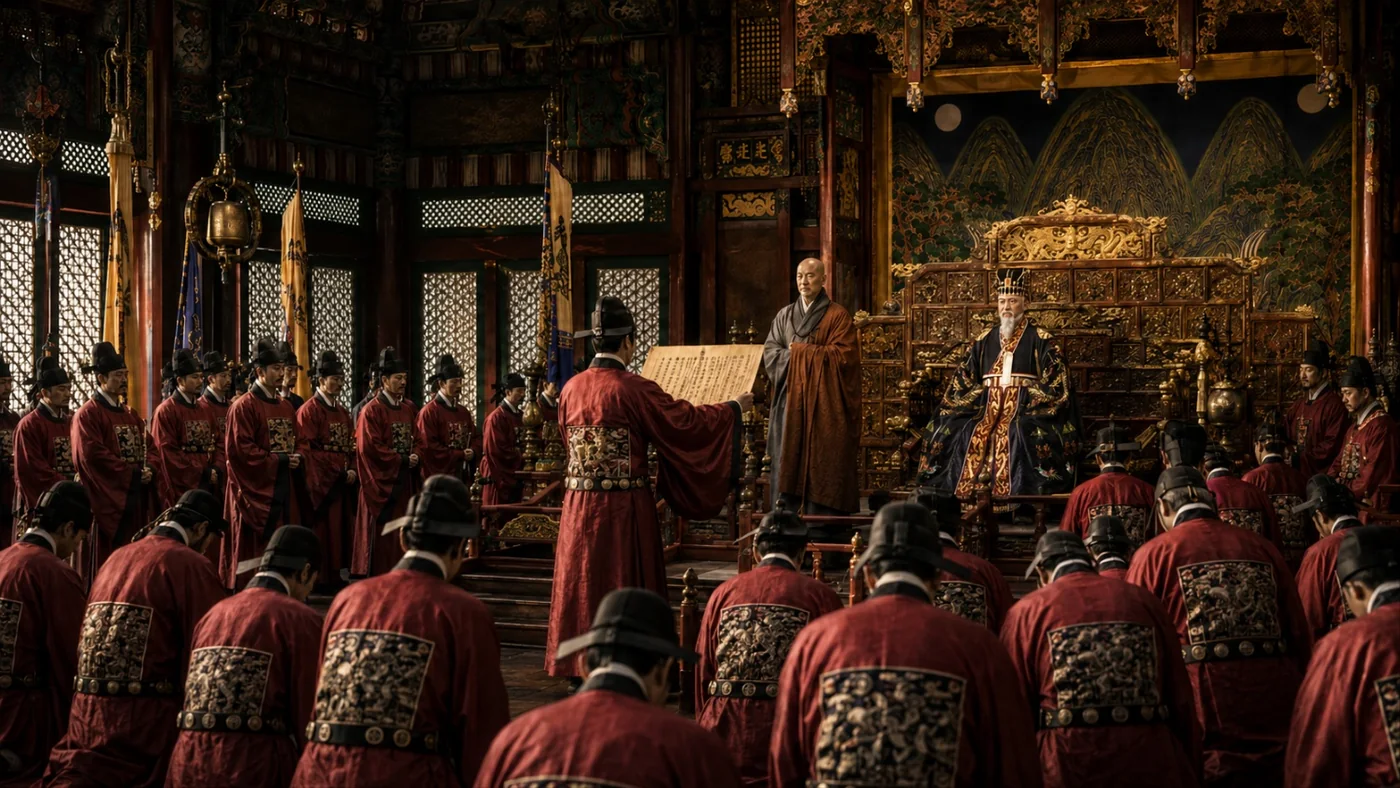
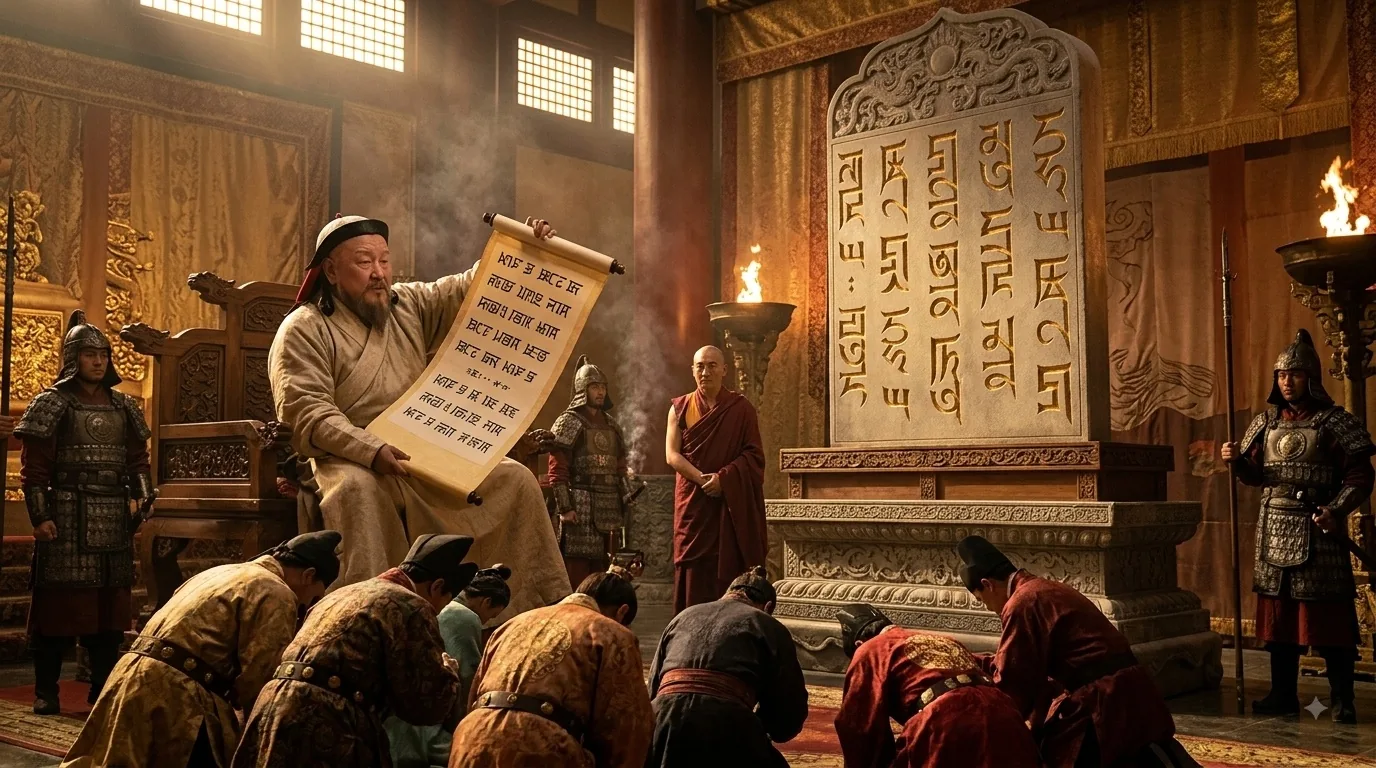 Phags-pa was promulgated by edict in 1269, and the edict defined its job: documents issued under the imperial seal. (AI illustration)
| Phags-pa script | Cherokee syllabary | Hunminjeongeum | |
|---|---|---|---|
| Timing | Commissioned by Kublai Khan; promulgated by edict 1269 | Begun as early as 1809; released 1821 | Created 1443 (12th month); promulgated 1446 |
| Maker | Phags-pa, National Preceptor, on the Khan’s command | Sequoyah, working on his own, no state command | Sejong, the king himself |
| Type | Phonemic script, Tibetan-based letterforms | Syllabary | Phonemic script, stacked into syllable blocks |
| Size | Forty-one mother-letters (Yuanshi) | 86 symbols, later 85 | 28 letters |
| Languages intended | Mongolian plus the empire’s languages — “to transcribe all writings” | Cherokee | Korean |
| Place in the state | Official script by decree from promulgation | Medal 1824, official adoption by the Cherokee Nation 1825 | Clerical recruitment test and state publications; classical Chinese retained the top tier |
| Place outside it | No everyday use established in the sources consulted here | Where it began — community use preceded institutional adoption | Wall writing by 1449; private letters and fiction expanding over later centuries |
| Afterwards | Its official base largely ended with the Yuan; suppressed in Ming China; survives on stelae, seals and coinage as research material | Newspaper from 1828; in use today | Used by the state from the start but subordinate to Classical Chinese for centuries — Korean became the language of official documents only by royal edict in 1894 — and the standard script of Korea in the modern era |
All three are unusually well documented as deliberately created writing systems. Most scripts were not designed — they drifted, borrowed and hardened over centuries, and cannot be traced to a person or a year. These three can.
But even that shared feature needs a qualification, because the records are not the same kind of record. The Hunminjeongeum has a contemporary explanatory document — the 1446 Haerye, which sets out the reasoning behind each letter shape — alongside the court’s own annals. The Phags-pa script has Yuan-era administrative material plus the Yuanshi, compiled afterwards. Sequoyah’s method is known largely through later institutional and biographical accounts. Three scripts whose making is documented, by three different kinds of documentation. That distinction is worth holding onto, and it is a narrower and more defensible claim than the sweeping version — including the sweeping version in our own earlier essay, which said that Hangul is one of the very few scripts whose creator, date and design principles are all preserved. The Cherokee case shows why that needs tightening: what distinguishes the surviving evidence for Hangul in this comparison is not that its origin is documented, but that a document from the moment of its creation explains the design of every letter.
So what does keep a script alive?
Here is where this article states an interpretation, and labels it as one.
Line the three up and a pattern suggests itself: the Phags-pa script’s daily use was concentrated in one place, and that place was the state. Rossabi’s assessment supports the concentration. The 1269 edict shows the state itself drawing the boundary. And when the Yuan collapsed, the ground the script stood on went with it. The Cherokee syllabary began with no state footing and acquired institutional backing afterward; it is still in use. The Hunminjeongeum had footing in both places within a few years of promulgation — and the part of it that never depended on any office may be the part that was hardest to undo.
Now the qualifications, because they are the honest part of the argument.
This is a reading of three cases, not a law. Three is not a sample. It is also an explanation constructed with the outcomes already known, which is the condition under which tidy explanations are easiest to build and hardest to trust. And the Phags-pa script’s decline was not caused by one thing: competition from the existing Uighur-Mongol script and from Chinese, the difficulty of learning and disseminating it, the limits of a purely top-down rollout, and the loss of dynastic patronage all worked together. Presenting narrow use as the sole cause would overstate what the evidence carries.
What survives all that qualification is smaller and still worth saying. A script that is only ever used in the places an authority assigns it is only as durable as that authority. Promulgation puts a script into the world. It is being used that keeps it there.
Coming up next
The main essay in this pair, Why Did King Sejong’s Own Scholars Try to Block Hangul?, takes up what this one deliberately left alone: why Sejong built the script, what Choe Man-ri’s memorial actually argued, and what the Haerye records about the design of the letters. And for what happened to Korean writing when a state did try to take it away — four and a half centuries after the wall in 1449 — see the Korean Language Society and the dictionary that survived 1942.
Frequently asked questions
Did Hangul copy the Mongol Phags-pa script? Not settled, and this article does not settle it. The Encyclopedia of Korean Culture says Phags-pa “is known to have been consulted” for the Hunminjeongeum and names the line of argument — Yi Ik’s Seongho saseol, Yu Hui’s Eonmunji, then Gari Ledyard (1966/1998), Yu Chang-gyun and Chŏng Kwang (2009, 2012). The evidence most often turned on is the Sillok’s phrase 倣古篆, “imitating the ancient seal script,” which one side reads as pointing to Phags-pa and the other as ordinary Chinese seal script.
What was the Phags-pa script? A square script based on Tibetan letterforms, commissioned by Kublai Khan from the monk Phags-pa and promulgated by edict in 1269. The edict says it was made “to transcribe all writings,” and the Encyclopedia of Korean Culture describes it as designed for Mongolian plus the empire’s other languages, including Chinese, Tibetan and Sanskrit. The Yuanshi gives it forty-one mother-letters.
Why did the Phags-pa script fall out of use? The state that carried it fell, and its use had been unusually concentrated in state hands to begin with — Morris Rossabi’s 2025 study finds it was used almost solely for government issuances such as paper money, seals and paiza despite repeated court orders. Competition from other scripts, the difficulty of spreading it, and the limits of a top-down rollout all contributed; no single cause should be given as the reason.
Was the Phags-pa script really finished in 1352? The Encyclopedia of Korean Culture gives 1352 as the end of official use, and reference works often cite 1351–1352 as the latest dateable Mongolian-language inscriptions. Specialist catalogues do not all agree, and later dated material has been reported, so this article does not treat 1352 as a hard cut-off. What holds is that the script’s official life ended with the Yuan.
Who was Sequoyah, and how does his system differ from Hangul? A Cherokee silversmith in northeast Alabama who began work as early as 1809 and released his system in 1821. His is a syllabary — one symbol per syllable, 86 later reduced to 85 — whereas Hangul assigns letters to individual sounds and stacks them into syllable blocks.
Was Sequoyah tried for witchcraft? The accounts differ in scope. National Geographic Education and Cherokee-side sources describe a witchcraft charge and a test in which Sequoyah and his daughter Ahyokah were separated and made to exchange written messages. The Oklahoma Historical Society’s signed encyclopedia entry records only the 1821 demonstration before the Cherokee Council and does not mention a trial. This article carries both rather than choosing.
Was Hangul ignored after 1446? No. Within the same year as the promulgation, an order added the Hunminjeongeum to the clerical recruitment examination, and it carried major state publications. What it did not receive was the top tier — central administration, law and diplomacy stayed in classical Chinese for most of the dynasty. “Second-rank official script” is closer than “excluded.”
What actually happened in 1449? The Sillok entry for the fifth day of the tenth month, after a list of senior appointments, notes that someone wrote on a wall in eonmun letters: “Chancellor Ha, cease bungling state affairs.” The target was Ha Yeon, newly made Chief State Councillor. It was writing on a wall rather than a posted placard, and the record does not identify the writer’s status.
Sources & further reading
What we could not check. Three limits are worth stating rather than hiding. First, Yi Ik’s Seongho sasol and Yu Hui’s Eonmunji are named here as part of the scholarly lineage on the Phags-pa question, but their original passages were not opened for this article — the Korean classics database was not reachable — so they are cited at second hand, through the Encyclopedia of Korean Culture, and no Chinese text from them is quoted. Second, the sources disagree on the year Kublai Khan ordered the script made: the Encyclopedia gives 1265, while the History of Yuan places the commission at the start of the Zhongtong era (1260). Only the promulgation year, 1269, is common to both, so only that is stated as fact. Third, the date at which Phags-pa fell out of official use is usually given as 1352, but specialist inscription lists differ on the endpoint and we did not consult those lists directly; this article says only that its official life ended with the Yuan.
This companion piece works from the same fact-check discipline as the main essay: primary records read in the original where possible, institutional encyclopaedias cited as institutional encyclopaedias, and disagreements left visible.
- The creation entry, and 倣古篆 — Sejong sillok, vol. 102, twelfth month of Sejong 25 (1443), read in Chinese and Korean via the National Institute of Korean History (kda_12512030_002). This is a monthly entry (是月, “this month”), so no exact day of creation should be quoted from it.
- The 1444 memorial and the list of five peoples — Sejong sillok, vol. 103, Sejong 26, 2nd lunar month, 20th day (kda_12602020_001). The passage quoted reads 自古九州之內, 風土雖異, 未有因方言而別爲文字者, 唯蒙古、西夏、女眞、日本、西蕃之類, 各有其字, 是皆夷狄事耳, 無足道者.
- The Hunminjeongeum in clerical recruitment — Sejong sillok, vol. 114, Sejong 28 (1446), 12th month, 26th day (kda_12812026_003): 今後吏科及吏典取才時, 訓民正音, 竝令試取。 This concerns the chwijae for the clerical track, not the gwageo.
- The 1449 wall writing — Sejong sillok, vol. 126, Sejong 31, 10th month, 5th day (kda_13110005_001): 人有以諺字書壁上曰: “河政丞且休妄公事。”
- The Phags-pa commission, the forty-one mother-letters, and the 1269 edict — Yuanshi, vol. 202, Liezhuan 89, “Shilao — Phags-pa,” read in the original: 命製蒙古新字…其字僅千餘, 其母凡四十有一 and the edict 譯寫一切文字…凡有璽書頒降者, 竝用蒙古新字, 仍各以其國字副之. Note that the Yuanshi places the commission at Kublai’s accession while the Encyclopedia of Korean Culture gives 1265; both agree on the 1269 promulgation.
- Phags-pa: design, target languages, official use, Ming suppression, Joseon names, and the survey of Hunminjeongeum-influence arguments — Encyclopedia of Korean Culture (Academy of Korean Studies), ‘Phags-pa script’ (E0078703, Kim Yang-jin).
- The Haerye, the state publications, and the 1449 episode — Encyclopedia of Korean Culture, ‘Hangul’ (E0061508).
- The concentration of Phags-pa use in state issuances — Morris Rossabi, ‘Communications and “Communicators” in the Yuan and Early Ming’, Journal of Chinese History 9:2 (2025), 271–285.
- Sequoyah: start date, official adoption, newspaper — Smithsonian Institution, National Museum of the American Indian, ‘We’re Still Here: The Cherokee Syllabary’.
- Sequoyah: silversmith, “talking leaves,” syllable-based design, 1821 release — U.S. National Library of Medicine, Native Voices timeline, ‘1821: Sequoyah’s syllabary makes written Cherokee possible’.
- Sequoyah: method, 86 to 85 symbols, the 1821 demonstration with Ahyokah, the 1824 medal — Oklahoma Historical Society, Encyclopedia of Oklahoma History and Culture, William L. Anderson, ‘Sequoyah’ (SE020). This entry does not mention a witchcraft trial.
- The witchcraft-trial account — National Geographic Education, ‘Sequoyah and the Creation of the Cherokee Syllabary’, with corroborating Cherokee-side accounts. Presented here as an account that differs in scope from the Oklahoma entry, not as established fact.
- On the Phags-pa endpoint — Miyoko Nakano, A Phonological Study in the ‘Phags-pa Script and the Meng-ku Tzu-yün (Australian National University, 1971), cited only for the point that catalogues of surviving inscriptions do not agree on a last date.
- The Phags-pa/Hunminjeongeum debate in modern scholarship — Gari Ledyard, The Korean Language Reform of 1446; Chŏng Kwang, Hunminjeongeum-gwa Paseupa munja (Yŏngnak, 2012) and Monggo jaun yŏn’gu (Pangmunsa, 2009); Yu Chang-gyun’s study of the Menggu yunlüe and the Sasŏng t’onggo. Cited as the research lineage the Encyclopedia of Korean Culture names; the bibliographic details of the Yu Chang-gyun volume are given differently across library catalogues and are not settled here.
Thanks for reading — see you in the next one.
This article was researched and written by K-Drama History. Source: Did Hangul Borrow From the Mongols' Phags-pa Script? What the Evidence Actually Says — K-Drama History