How Korea Built Universal Health Insurance in 12 Years: Hospital Playlist and the Medical Paradox
Theme: Modern Korea
From the research behind Pause the Drama.
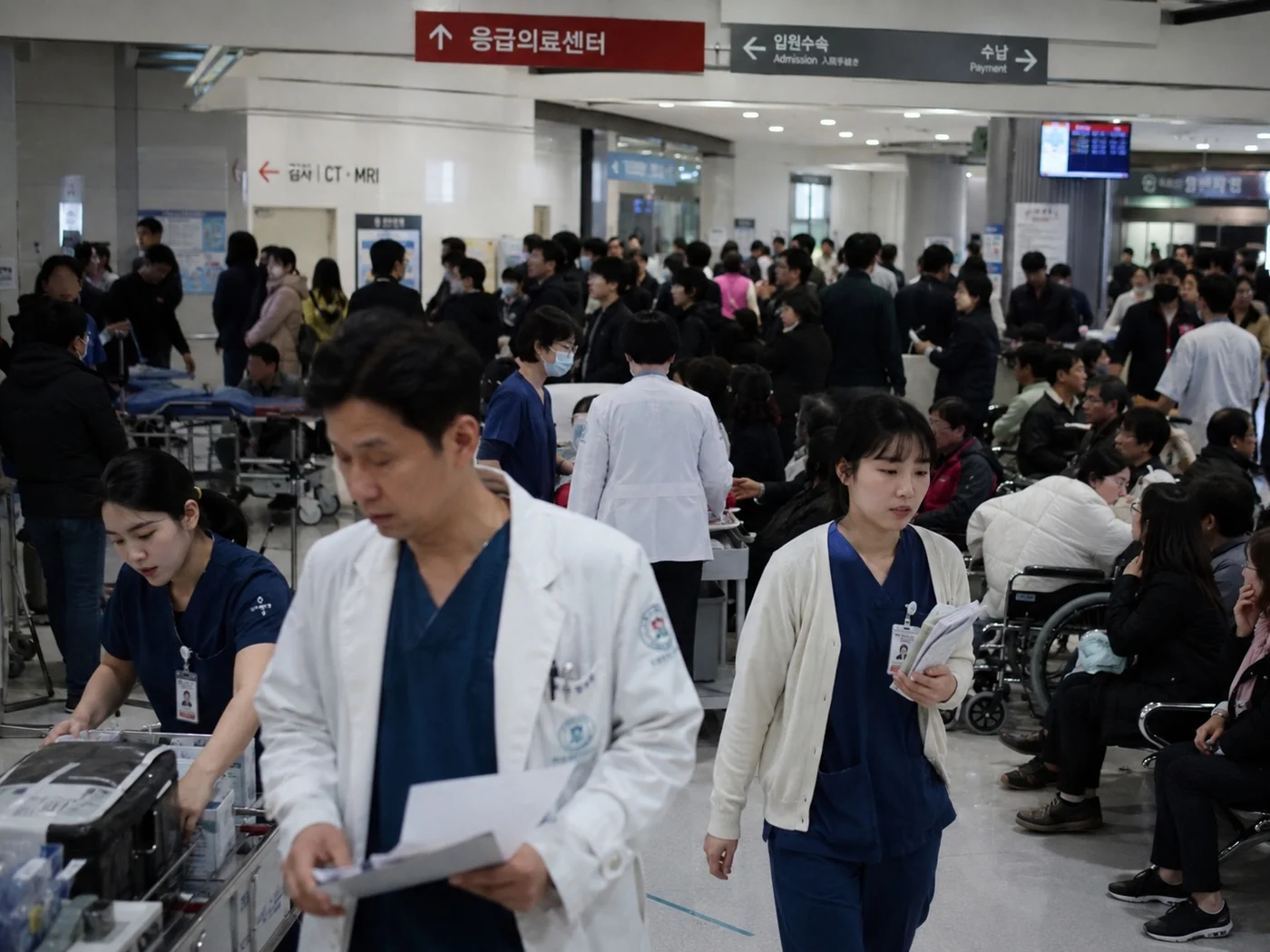
In Hospital Playlist (슬기로운 의사생활), the five lead characters are the kind of friends who formed a band in medical school and still meet every Thursday night to play together. The drama is warm, funny, and deliberately unheroic in its rhythms. But its setting — a top-tier Seoul teaching hospital where patients arrive from all over the country and the emergency room is full at 3 a.m. — is not background detail. It is an argument about what Korea built, and what that building cost.
The premise the drama captures, almost as a given: in Korea, you can access a world-class hospital quickly, and what you pay for covered care is manageable. Viewers from the United Kingdom — where non-emergency surgery waiting lists can stretch to a year or more — react to same-day MRI scenes with something between wonder and genuine envy. American viewers notice what a Korean hospital visit doesn’t include: a two-week wait for a specialist, a surprise bill arriving six weeks later, a phone call with an insurance company’s pre-authorization desk.
How did a country that was, in 1960, among the world’s poorest nations build a system that earns those reactions? The answer begins in 1977 — not with a single dramatic reform, but with a politically calculated twelve-year accumulation.
Quick answer: Korea built universal health insurance in twelve years — 1977 to 1989 — then merged hundreds of separate insurers into a single national payer in 2000 (with finances fully unified by 2003). That single-payer structure keeps covered costs low. The paradox is real: affordable and fast for covered procedures, and genuinely strained at the top of the pyramid. By reported figures, roughly 94% of Korea’s hospital-level institutions are private (public share ~5% by institution count, ~9.5% by beds as of end-2023) — among the lowest public shares in the OECD — and patient demand has concentrated at five elite Seoul hospitals. The insurance is public; the supply behind it is not.
Let’s trace the twelve years.
How did Korea build universal health insurance in just twelve years?
Most high-income countries spent decades assembling their health-coverage systems — Germany took roughly a century from Bismarck’s 1883 accident-insurance law to full population coverage; the UK built the NHS from scratch in 1948 on the foundation of wartime consensus; even Japan, Korea’s nearest structural cousin, reached universal coverage (kokumin kai hoken) in 1961. Korea compressed the equivalent journey into twelve years: 1977 to 1989 — later than Japan, but unusually fast, as the Oxford Health Policy and Planning study of Korea’s experience documents.
The starting point was 1977, when the government introduced mandatory health insurance for workers at firms with 500 or more employees. The logic was administrative efficiency as much as social welfare: large firms had payroll records, organized workforces, and the infrastructure to collect contributions. The state could build a system on the existing corporate structure of industrializing Korea. (The same year, Korea also launched Medical Aid (의료보호), a separate public-assistance program covering the poor — not insurance, and the ancestor of today’s Medical Benefit scheme. The two should not be conflated.)
Coverage then expanded in deliberate steps. By January 1988, rural and fishing communities had been incorporated. In July 1989, urban self-employed workers — the last major uncovered group — were added, and Korea declared universal coverage complete. 1977 was the starting point; 1989 was the finish line. The claim sometimes seen in English coverage — that Korea “achieved universal healthcare in 1977” — is simply wrong; 1977 is when the build-out began.
Two forces explain the speed. First, Korea’s developmental-state administrative apparatus was designed for top-down implementation at scale; the same infrastructure that had driven industrial policy could route social-insurance enrollment. Second, rapid industrialization had already created millions of formal-sector wage workers organized at firm level — the natural administrative unit for insurance. You did not have to build a new system from scratch; you could expand an existing employment-based one.
But a crucial distinction is often lost: universal coverage (1989) is not the same as a single insurer. When everyone became covered in 1989, the system was still fragmented — by one count, more than 350 separate insurance societies (workplace, regional, government-employee) operated in parallel, each with its own administration. Consolidation came in stages: the regional and government-employee funds merged into the National Health Insurance Corporation in 1998, and in 2000 that body absorbed the workplace funds to create a single National Health Insurance Service (NHIS / 국민건강보험공단). Workplace and regional finances were fully integrated only in 2003. The result is the mechanism that holds prices down to this day: one payer negotiating reimbursement rates with every medical provider in the country. The NHIS’s unified leverage is why a Korean MRI costs a fraction of its American counterpart for covered procedures.
Is Korean healthcare really cheap and fast?
The global perception of Korean healthcare as inexpensive needs a careful qualifier. Korea’s out-of-pocket payment rate — the share of total health spending that patients pay directly — is actually above the OECD average. This seems to contradict the “cheap” reputation, but the structure is more nuanced than the headline figure suggests.
For covered procedures, the experience matches the reputation. A simple visit to a neighborhood clinic, without tests, typically carries a co-payment of a few thousand to around ten thousand Korean won (at the standard 30% outpatient co-insurance rate, as of 2025) — low by any international comparison. Even significant diagnostic procedures like CT scans and MRIs, when they fall under insurance coverage, cost in the range of hundreds of thousands of won: a fraction of comparable costs in the United States without insurance. Visits that involve tests, injections, or procedures run higher — easily into the tens of thousands of won — and co-payment rules differ for the elderly, infants, pregnant women, and patients with designated serious conditions.
The gap opens with non-covered (비급여) items. Elective services, premium hospital rooms, some newer surgical techniques, and certain specialist fees fall outside the insurance schedule, and patients bear those costs in full. Korea’s affordability is therefore item-specific: genuinely low for routine and covered care, and potentially high for elective or premium services.
The “fast” dimension is similarly two-sided. For routine visits and covered diagnostics, wait times in Korea are measured in days, not weeks or months — fast by international standards. (The caveat: specific departments and sought-after specialists at the Big 5 can still involve meaningful waits; “fast” describes the typical visit, not every appointment.) That accessibility, however, is precisely what creates the system’s most documented structural problem: concentration at the Big 5. When a patient can walk into one of Korea’s top five hospitals for a general consultation almost as easily as visiting a neighborhood clinic — and many do, associating large institutions with better equipment and more experienced staff — the demand load on those hospitals becomes unsustainable.
The result is that Korea’s physicians at top institutions see far more patients per day than their peers in most comparable systems — a strain made worse by the fact that Korea has, by OECD Health at a Glance 2023 figures, one of the lowest doctor-to-population ratios in the developed world (about 2.6 doctors per 1,000 people including traditional-medicine practitioners, or roughly 2.1 counting only Western-medicine physicians, against an OECD average near 3.7). The exhausted doctors of Hospital Playlist are not a dramatization of an edge case. They are a portrait of a structural condition: a system built for universal access that, for lack of a strong gatekeeping function between primary and tertiary care, routes too much of that access toward the same narrow tier — staffed by relatively few doctors.
2026 update: The 2024 plan to add 2,000 medical-school seats triggered a prolonged trainee-doctor walkout and was ultimately rolled back. The 2026 admissions quota returned to 3,058 — the pre-increase level — before the government settled on a slower path: 3,548 seats for 2027 and a phased rise of roughly 668 per year toward about 3,871 by the early 2030s. The doctor-supply debate is not over; it has shifted from a sudden 2,000-seat shock to a gradual, regionally targeted expansion.
A correction that matters: A common misreading in English-language coverage is that Korea’s healthcare system is a “public healthcare system” in the sense of government-owned and government-staffed hospitals. It is not. By reported figures, roughly 94% of Korea’s hospital-level institutions are privately owned and operated (public institutions about 5%, and public beds about 9.5%, as of end-2023) — a public-supply share that is among the lowest in the OECD. The insurance is public — mandatory, single-payer; the supply is almost entirely private. The correct framing is: private medical supply under public insurance — a hybrid model with its own specific strengths and vulnerabilities.
How realistic is Hospital Playlist’s hospital setting?
| In Hospital Playlist | In real Korea |
|---|---|
| Top Seoul teaching hospital overwhelmed with patients from across the country | Korea’s Big 5 hospitals draw national patient volumes; concentration is a documented policy problem |
| Doctors visibly exhausted, working around the clock | Korea’s doctor-to-population ratio (~2.6/1,000, ~2.1 excluding traditional medicine) is among the OECD’s lowest, and major-hospital patient loads run far above OECD norms |
| Same-day diagnostics that astonish viewers from the UK and US | Korea’s outpatient wait times are among the shortest in the OECD |
| Universal access is simply assumed by every character | Korea has had mandatory universal enrollment since 1989 — it genuinely is universal |
| The system simultaneously performs miracles and strains the people inside it | Korea’s system delivers on access and cost for covered care; sustainability and distribution remain open problems |
The drama’s most accurate detail may be its least dramatic one: every character simply has insurance, and no one ever discusses it — that quiet background assumption is the twelve-year achievement, and what makes the show feel quietly foreign to viewers from systems where it cannot be taken for granted.
Key terms. NHIS (National Health Insurance Service / 국민건강보험공단) — the single public insurer created in 2000 by consolidating hundreds of workplace and regional insurance societies; its unified bargaining power is the mechanism that holds covered prices low. Universal coverage (1989) vs. single payer (2000) — 1989 is when every Korean became covered; 2000 is when the many insurers became one. Big 5 (빅5) — Seoul National University Hospital, Severance, Samsung Seoul Medical Center, Asan Medical Center, and Seoul St. Mary’s — the five institutions that function as de facto national referral centers. Out-of-pocket rate — the share of total health spending paid directly by patients; Korea’s rate exceeds the OECD average because the non-covered (비급여) sector is substantial. Single-payer model — one institution pays all providers on behalf of all enrollees; Korea pairs this public payer with almost entirely private medical supply, distinguishing it from government-run systems like the UK’s NHS.
How do Korea, the US, the UK, and Japan compare on healthcare?
The four-way comparison reveals that universal coverage is not a single design choice — it is a family of structural decisions that produce very different tradeoffs.
Korea — the fast, affordable paradox. Single public insurer (NHIS) combined with near-exclusively private medical providers. Mandatory universal enrollment, income-based premiums. Covered procedures are priced below most comparable systems; non-covered items are unregulated and can be expensive. The very low barrier between primary and tertiary care produces dramatic concentration of demand at the top of the system, strained further by one of the OECD’s lowest physician densities. The rapid build-out — twelve years — was enabled by a specific political-economic moment that would be difficult to replicate elsewhere.
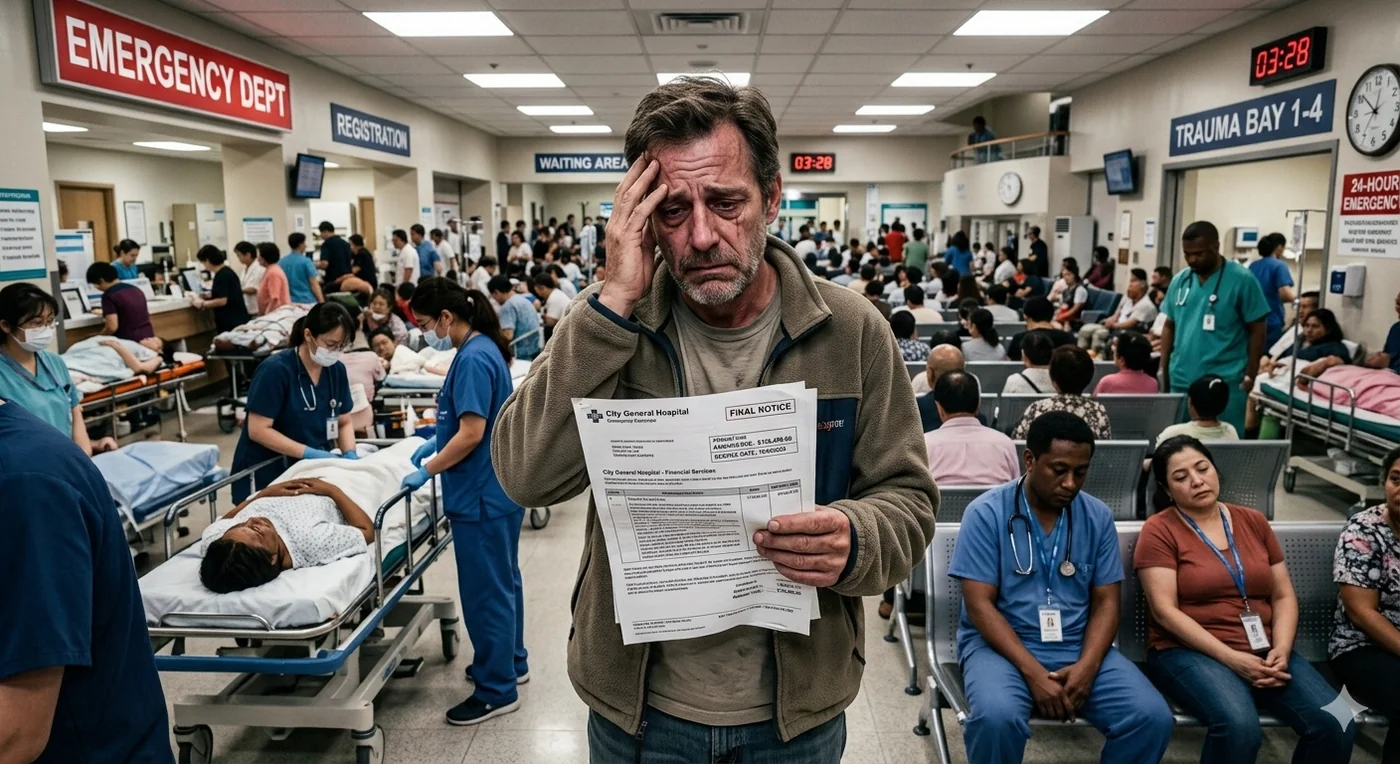
United States — private insurance with public supplements. Medicare covers Americans 65 and older; Medicaid covers low-income populations; a significant share of working-age Americans under 65 remain uninsured or underinsured depending on employment and income. The NHIS equivalent does not exist: coverage is a patchwork of hundreds of private insurers, each negotiating rates separately, producing wide variation in what the same procedure costs. Medical costs are a documented driver of household financial distress, though the precise share of bankruptcies attributable to healthcare is contested — survey-based research (Himmelstein et al., 2009) put medically related bankruptcies near 60%, while causal analysis (Dobkin et al., NEJM 2018) found the direct effect of medical events much smaller, with much of the burden flowing from lost income rather than bills themselves. What is not contested: medical debt is widespread in the US in a way it is not in Korea for covered care.
United Kingdom — free at point of use, at the cost of waits. The NHS, funded by general taxation, provides care without co-payment at the point of service (with exceptions for some prescriptions). The structural tradeoff is time: chronic funding pressure relative to population health needs has produced waiting lists for non-emergency procedures that stretch from months to over a year in some specialties. The British reaction to Hospital Playlist’s same-day CT scans — genuine surprise — is an accurate signal of the gap. The NHS model eliminates financial barriers absolutely; it substitutes time barriers instead.
Japan — Korea’s nearest structural cousin, aging faster. Japan operates a social insurance model most similar to Korea’s: mandatory universal enrollment (reached in 1961), multiple insurers organized by employer type and region, and co-payments fixed at 30% for most working-age adults, reduced for children and the elderly. Access is generally good and medical costs are regulated. Where Japan strains is on demographic sustainability — its aging curve is among the world’s steepest, and the fiscal math of an expanding elderly population drawing on a system funded by a shrinking working-age base is a challenge Japan and Korea face in parallel, with Japan somewhat further along the curve.
Coming up next
From 1977 workplace insurance to a single national payer in 2000 — and the five friends in a hospital band who play Thursday-night sets while fielding a national patient load. The drama’s warmth is genuine; the structural paradox behind it is equally real.
In the next essay, we look at another K-drama that puts Korean society in historical focus — and ask how the weight of social hierarchy shapes the choices available to ordinary people across very different centuries.
Thanks for reading — see you in the next one.
Frequently asked questions
What is Hospital Playlist about? Hospital Playlist (슬기로운 의사생활, 2020–2021, tvN) follows five doctors who became close friends in medical school and now work together at a major Seoul teaching hospital. Two seasons trace their professional and personal lives with an unusually warm, ensemble-driven tone. The show’s setting — a top-tier Seoul hospital permanently under demand pressure — is as much a subject as the characters, and accurately reflects how Korea’s healthcare system concentrates national demand at a small number of elite institutions.
When did Korea achieve universal health insurance? Korea completed universal health-insurance coverage in 1989, twelve years after the 1977 introduction of mandatory coverage for large-firm workers. The build-out expanded to rural and fishing communities in January 1988 and to urban self-employed workers in July 1989. Universal coverage (1989) is distinct from the single-payer merger: hundreds of separate insurers were consolidated into the National Health Insurance Service (NHIS) in 2000, with finances fully integrated by 2003.
Is Korean healthcare actually free? No. Korea has mandatory co-payments, not a free-at-point-of-use model. For covered procedures, co-pays are low by international standards — a simple clinic visit without tests is typically a few thousand to around ten thousand Korean won (30% co-insurance, as of 2025). Tests and procedures cost more, and a substantial non-covered (비급여) category — elective services, premium rooms, some newer treatments — carries full patient cost. The system is genuinely affordable for covered items; for non-covered items, costs can be significant.
Is Korea’s healthcare system like the UK NHS? No — and this is the most common misunderstanding. Both deliver universal coverage, but the structure is opposite at the supply level. The UK NHS is publicly funded and largely publicly operated: government-owned hospitals, salaried staff, free at the point of use. Korea pairs a single mandatory public insurer (NHIS) with almost entirely private hospitals and clinics, paid under regulated prices. The slogan version: Korea’s insurance is public, but its hospitals are not. It is a public-insurance, private-provider model — not an NHS-style public-hospital system.
Can foreigners use Korea’s national health insurance? Foreign nationals residing in Korea for six months or more are required to enroll in the national system and receive the same benefits as Korean citizens. This is distinct from medical tourism, which involves self-pay visitors without insurance coverage. The inclusion of foreign residents in mandatory enrollment has become part of ongoing fiscal sustainability discussions as Korea’s foreign-born workforce grows.
What are Korea’s Big 5 hospitals? The Big 5 (빅5) are Korea’s five largest and most prestigious teaching hospitals: Seoul National University Hospital, Severance Hospital (Yonsei University), Samsung Seoul Medical Center, Asan Medical Center, and Seoul St. Mary’s Hospital. These institutions draw patients from across the country, creating a concentration of demand that is one of the system’s most discussed structural problems.
Why are Korean hospitals always so crowded? Because the system lacks strong primary-care gatekeeping. Patients can access a major hospital’s outpatient departments almost as easily as a neighborhood clinic, and many do — associating large institutions with better equipment and more experienced specialists. The low barrier between primary and tertiary care routes excessive demand to the top of the system, where relatively few doctors carry very high patient loads.
How many doctors does Korea have compared to other countries? Fewer than most wealthy nations. By OECD Health at a Glance 2023 figures, Korea had about 2.6 doctors per 1,000 people — including traditional-medicine practitioners; counting only Western-medicine physicians, roughly 2.1, among the OECD’s lowest, against an average near 3.7. This shortage, concentrated further by specialty and region, was central to the 2024 medical school quota dispute, when a planned 2,000-seat admissions increase triggered mass trainee-doctor resignations.
How does Korea’s healthcare system compare to the US? Korea has a mandatory single public insurer (NHIS) covering all residents and negotiating covered prices; the US relies on a patchwork of private insurers, Medicare, and Medicaid, leaving some working-age adults uninsured. Korean covered-care costs are a fraction of comparable US costs. Medical costs drive documented financial distress in the US, though the exact share of bankruptcies attributable to healthcare is contested — survey work (Himmelstein et al., 2009) put it near 60%, causal analysis (Dobkin et al., NEJM 2018) found the direct effect much smaller. Either way it is not a structural risk in Korea for covered procedures.
What is the biggest challenge facing Korea’s healthcare system? Two interconnected challenges: the concentration of demand at a few elite hospitals without adequate primary-care gatekeeping, and long-term fiscal and workforce sustainability as Korea’s population ages rapidly. The 2024 medical school enrollment expansion — a 2,000-seat increase that triggered mass trainee-doctor resignations — was tied directly to projected physician shortages in regional and non-specialty areas. Both challenges trace back to the system’s original design: universal access built quickly, without strong structural guidance about where that access should flow.
Sources & further reading
This piece was written from the historical script and fact-check of 사뚱샘의 역사방 (SaDDungSam), with primary and official sources linked inline beside the claims they support:
- Korea’s 1977–1989 health-insurance build-out, the 350+ insurer fragmentation, and the 2000 single-payer merger — Thirty Years of National Health Insurance in South Korea, Health Policy and Planning (Oxford Academic); National Health Insurance Service (국민건강보험공단) institutional history; National Archives of Korea records on the health-insurance system.
- Doctor density (~2.6 / ~2.1 per 1,000) and public-hospital share — OECD Health at a Glance 2023, Korea country note; World Health Systems Facts, Korea physical resources; Korean national-approved statistics on public medical institutions (end-2023).
- Co-payment structure and the non-covered (비급여) sector — Health Insurance Review and Assessment Service (HIRA / 건강보험심사평가원) benefit schedules and current co-payment standards (2025).
- US medical debt and the bankruptcy debate — KFF Health Care Debt Survey (2022) and the Consumer Financial Protection Bureau’s Medical Debt Burden in the United States (2022); Himmelstein et al., Medical Bankruptcy in the United States, 2007 (American Journal of Medicine, 2009) and Dobkin et al., Myth and Measurement — The Case of Medical Bankruptcies (NEJM, 2018).
- 2024 medical school quota dispute — Wilson Center analysis of the doctors’ strike; Reuters reporting on the trainee-doctor walkout (February 2024).
- UK NHS and Japan comparisons — NHS England elective-care performance data; OECD Health Statistics chapters for the UK and Japan; Japan’s Ministry of Health, Labour and Welfare on universal coverage (1961).
Thanks for reading — see you in the next one.
This article was researched and written by K-Drama History. Source: How Korea Built Universal Health Insurance in 12 Years: Hospital Playlist and the Medical Paradox — K-Drama History