Doctor X: Where Did the Professor's Grip on Korean Hospitals Come From?
From the research behind Pause the Drama.
The new SBS series Doctor X (닥터X: 하얀 마피아의 시대) premiered on October 9, 2026, as a 12-episode drama. It is a Korean remake of TV Asahi’s Doctor-X: Surgeon Michiko Daimon (2012–2021). On Netflix the official title page lists it as Doctor X: Mafia in White, while the English edition of TenAsia has used Doctor X: Era of the White Mafia. A Netflix title page existing does not tell us which countries can stream it. We have not checked that, and the show may not be available where you live.
The heroine is a brilliant surgeon. But what may strike overseas viewers as unusual is not her talent. It is the list of things she refuses to do.
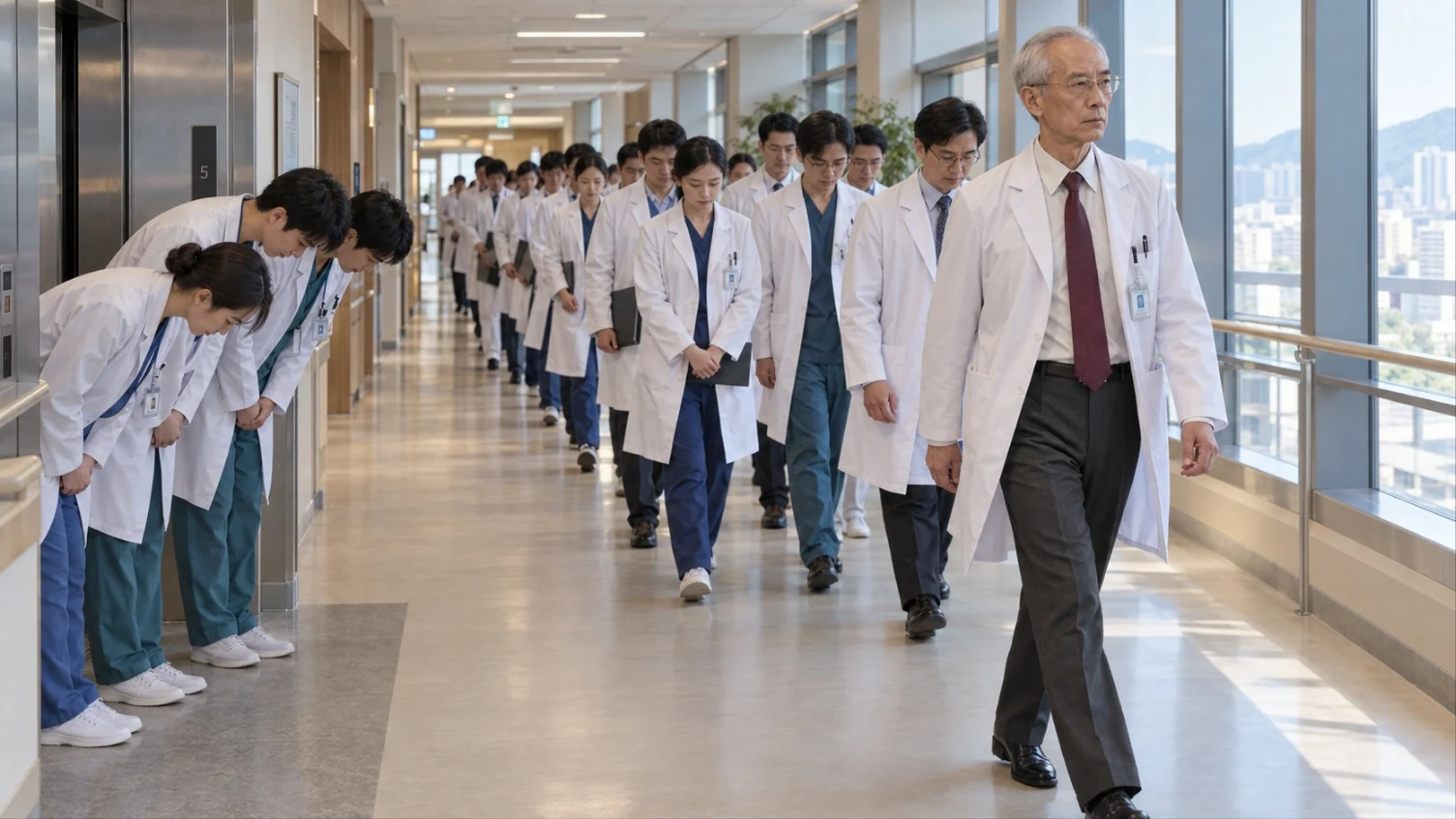 The director’s rounds as a procession: bowing juniors and a train of white coats. (AI illustration)
Quick answer: Korean university hospitals’ professor-centered organization and training system carry the influence of two systems imported in the 20th century, not just a straight line from Joseon tradition. The first is the Japanese ikyoku (医局, “medical office”) or “classroom” system. Japan built it in the Meiji era on a German model, and it entered Korea during the colonial period, with Keijo Imperial University’s medical school (opened 1926) as its leading base. The second is the American intern–residency system, which spread after liberation, especially from the late 1950s. The sources we checked do not show where specific rituals such as bowing, standing in unison or the procession of white coats came from. That origin is unconfirmed. Why a Japanese medical drama fits Korean hospitals so naturally is our interpretation: the two countries’ hospitals share roots.
| Question | What the sources support |
|---|---|
| Did Japan’s ikyoku have a German model? | Yes, according to Honda et al. (2022) |
| Was Keijo Imperial University’s medical school one of SNU’s predecessors? | Yes. SNU’s medical college was formed by merging it with Keijo Medical College |
| When did American-style residency take hold in Korea? | From the late 1950s. A 1958 draft-deferral agreement is cited as one important catalyst |
| Is the hierarchy simply inherited, unchanged? | No. The historian Jeong Jong-hyeon (2024) stresses both continuity and rupture |
| Where did the bowing and standing rituals come from? | Not established. No direct source found |
The scenes: why does Gye Su-jeong refuse the professor’s rounds?
Scene 1: the director’s rounds and “All rise.” Park Tae-kyung, a surgical intern, walks into the department office on his first day, and a senior sends him straight back out. The hospital director is suddenly doing rounds. An announcement sounds in the corridor: “Hospital Director Kim Myeong-seop’s rounds will now begin.” When the elevator doors open, the waiting doctors bow in unison. Dozens of white coats then follow the white-haired director (played by Kim Jong-gu, per SBS’s official clip description) down the hall in two lines.
At the “7th Medical Staff Conference” that follows, the emcee calls out “All rise” as the director enters, and hundreds of doctors stand up at once in the auditorium. The slide on screen reads “Open Cholecystectomy MS technique,” an open gallbladder removal. The “MS” appears to stand for the director’s initials, since the slide shows his name beside the title, but that is our inference. The director is about to retire. He says he will perform this operation himself, as a last chance to remind everyone what a “surgeon” is. That is when Gye Su-jeong speaks up. Removing the gallbladder, she says, “has been done laparoscopically for a long time now.” Does this operation really have to be done by opening the abdomen? In an auditorium where the director’s word is the prescription, her question becomes a challenge to the hierarchy, not just to a surgical technique.
Scene 2: the director collapses, the patient remains. The director performs the open operation himself on a patient suspected of gallbladder cancer (described in our sources as 80 years old, which we have not checked against the broadcast). During the surgery the patient goes into shock, and the director collapses too. The cause, according to TenAsia’s episode-1 recap, was latex surgical gloves. The professors carry the director out of the operating room. The staff left behind, whom a TVDaily report says included intern Park Tae-kyung, the anesthesiologist and the nurses, are left facing a crisis with the patient’s abdomen still open. Gye Su-jeong, already out of favor because of her one question, has everyone change their gloves and gowns and saves the patient. The rounds and the standing in unison come across as rituals of one hierarchy.
Scene 3: Gye Su-jeong’s list. Gye Su-jeong (Kim Ji-won) is the star of a doctor-dispatch agency. She has been sent to Guseo University Hospital, which is short of surgeons because of a strike. Although she handled the operating-room crisis, the director fires her once he regains consciousness. Bu Seung-gwon (Son Hyun-joo), who holds evidence of the former director’s corruption, becomes the new director and calls her back. The agency head, Jang Hee-sook (Lee Jung-eun), then tears up the standard contract and hands over a special one. Helping with research, gathering material for papers, rounds, staff dinners and social events: she will do “absolutely none of them.” Bu Seung-gwon accepts. In iMBC’s episode-1 report, this list is a condition of the special contract presented at her rehiring. It is not a speech Gye Su-jeong makes on her first day.
A note on the scenes: we confirmed these three scenes through user-supplied screen captures, a transcript of a recap video and news reports of episode 1, not by watching the broadcast ourselves. The only dialogue quoted directly is taken from the drama’s on-screen subtitles in those captures, and the iMBC report for “absolutely none of them.” We have not added any other scenes.
The question. Hospitals in the United States and Europe have rounds too: an attending physician leads residents through the wards. What is different here is not the rounds themselves but the ritual around them. Juniors bow from the waist, hundreds stand at once, and even interns are called out to line up. When the director passes, interns are summoned to bow. And the contract Gye Su-jeong signs has to rule out, in writing, helping with research, gathering material for papers and attending staff dinners, as if those were assumed to come with the job. (That list is the drama’s; it should not be read as evidence of ghostwriting or of compulsory dinners in real Korean hospitals.) Is this hierarchy uniquely Korean?
The short answer
Korean university hospitals’ professor-centered organization and training system carry the influence of two layers: Japanese-style medical education from the colonial period, and the American specialist-training system adopted after liberation.
The first layer is the Japanese “classroom” or ikyoku system. It entered Korea during the colonial period, and Keijo Imperial University’s medical school, opened in 1926, became its main base. Japan had built that system in the Meiji era on a German model. The second layer is the American intern–residency system, which spread after liberation and especially from the late 1950s.
That is why the Japanese drama Doctor X can be transplanted into a Korean hospital without feeling foreign: the two countries’ hospitals share roots. This is our interpretation. It reads the ease of the remake through institutional history, and we found no source that argues this directly.
There is one more twist. William Halsted of Johns Hopkins, who built the American surgical residency, also drew on what he had seen in German-speaking university clinics (Androutsos 2005). So both layers in Korean university hospitals touch German-speaking university medicine at their starting points. That link is also our interpretation, not an established line of descent.
How the hierarchy arrived
Starting point: the ikyoku of Meiji Japan
The structure in which “the professor holds everything,” the structure Gye Su-jeong refuses, has a Japanese name: the ikyoku (医局). After the Meiji Restoration of 1868, Japan chose German medicine from among the Western traditions. The University of Tokyo’s medical school, established in 1877, hired German physicians as professors. Medical training at these schools ran through a strong hierarchy called the ikyoku. In this German-based system, the department head professor decided research and teaching, and even which hospital each graduate would be sent to (Honda et al. 2022).
The ikyoku professor did not just teach. He decided where his students got their first jobs. Control over career placement could create dependence on the professor, but the sources cited here do not trace specific practices such as compulsory staff dinners or research errands back to it.
Transplanted to colonial Korea: Keijo Imperial University (1926)
The system arrived in earnest at colonial Korea’s top institution of higher education. Imperial Ordinance No. 104, dated May 1, 1924, set up Keijo Imperial University with a Faculty of Law and Literature and a Faculty of Medicine, starting on April 1, 1926. The medical program took four years. Its first 55 graduates finished in 1930, and 12 of them were Korean. At the founding, the university’s president was the Government-General’s Administrative Superintendent. Throughout the colonial period, Koreans made up about a third of those admitted to the preparatory course (Encyclopedia of Korean Culture — Keijo Imperial University).
After liberation in 1945, Keijo Imperial University became Gyeongseong University and then, in August 1946, Seoul National University (same entry). SNU’s College of Medicine was formed by merging Keijo Imperial University’s medical faculty with Keijo Medical College (Encyclopedia of Korean Culture — Seoul National University). In institutional terms, then, the two government medical schools of the colonial era led to post-liberation Korea’s top medical college.
An overview written from the Korean Academy of Medical Sciences’ side traces Korea’s postgraduate medical training to an internship begun informally in 1914, or to “the Japanese-style classroom-member or ikyoku-member system” (Kim & Kim 2004). The habit Korean medical schools still have of calling departments ”○○ gyosil” (“classroom of ○○”) is connected to this lineage. We did not, however, find any study devoted to where the term comes from.
Second layer: American residency and the “draft-deferral” agreement (1958)
After liberation, Korean medicine turned from the Japanese system toward the American one. The National Medical Service Act, enacted on September 25, 1951 (Law No. 221), provided in Article 41 that practitioners could not advertise a specialty without the minister’s permission. Conditions were not yet ready, so for the first eight years licenses were issued on documents alone, and examinations began in 1960. Designation of training hospitals began in 1957 with eight university hospitals and 60 general hospitals (Kim & Kim 2004).
The trigger for the full-scale intern–residency system may surprise overseas readers. According to one account, a 1958 joint meeting of the Ministry of National Defense and medical school deans agreed to defer military service by five years for some doctors training in university hospitals. This became known as “Kim’s Plan” (Kim & Kim 2004). The name is said to come from the surname of then-Defense Minister Kim Chung-yul (Korean Society of Radiology history page; Kim Taek-jung 2024). That account treats the agreement as the starting point of the full system. A 2024 study by Kim Taek-jung, however, separates several factors. It distinguishes the medical profession’s preparations for adopting American-style training, how Seoul National University Hospital ran the system, and the solution to the military-service problem. In that study, SNU Hospital’s first internship course began on April 19, 1958. Kim’s Plan took effect from 1959 and at SNU Hospital first applied to the second intern cohort, which began on April 11, 1959. So the 1958 agreement is best read as one important catalyst among several for the spread of American-style training in Korea. We have not seen the agreement document itself, and we do not state its exact date, the institutions involved or its selection criteria as checked facts.
In the same years, an American educational aid program, the Minnesota Project, reshaped Seoul National University. The U.S. Foreign Operations Administration (FOA) and the University of Minnesota signed the agreement on September 28, 1954, and the project ran from January 1, 1955, to June 30, 1962. According to Kim Seong-eun’s research, a total of 226 people were sent to the United States: 218 SNU faculty members and 8 officials from the Central Officials Training Institute. 77 of the trainees were in medicine. Jeong Jong-hyeon (2024) and some SNU materials describe all 226 as “SNU faculty.” As a result, SNU’s medical education is assessed as having shifted from a Japanese, theory-centered model to an American, clinic-centered one (Jeong 2024, whose project overview draws on Kim Seong-eun 2019).
The terminology followed. A 1976 presidential decree on specialist training called interns and residents suryeon-ui (“trainee doctors”). The term in that regulation was changed to jeongong-ui (“specialty doctors”) by an amendment on October 27, 1978. That is when the regulation’s wording changed. It does not mean the word first appeared anywhere else at that time.
One man who lived both layers: Yun Il-seon
How the two layers actually overlapped can be seen in one career, that of the pathologist Yun Il-seon (尹日善, 1896–1987). The account below follows Jeong Jong-hyeon (2024) unless noted.
- The end of a line from Germany to Japan. Yun graduated from Kyoto Imperial University’s medical school in 1923 and joined the pathology classroom of Professor Fujinami Akira (藤浪鑑). Fujinami had studied under Rudolf Virchow, the German known as the “father of modern pathology.” Through these people, the classroom system that had come from Germany to Japan passed on to a Korean student. We confirmed the Fujinami–Virchow link in Jeong’s paper only.
- What an ikyoku relationship looked like. Yun’s first position was as an unpaid assistant. Fujinami paid his tuition and arranged scholarships and research funds for him. Years later, Yun recalled that interns are paid nowadays, but back then the job was unpaid from the start (a 1979 interview, quoted in Jeong 2024; we have not checked the original). This was a structure in which the teacher held both a student’s living and his career.
- The wall of the colonial ikyoku. In March 1928 Yun became an assistant professor in the pathology classroom of Keijo Imperial University’s medical faculty. He was the first Korean appointed to that faculty. He was not, however, a professor holding a chair. Jeong notes that the first Korean promoted to a chair professorship was the geologist Kim Jong-won. In the imperial universities of the time, chair-holding professors and assistant professors were far apart in status. Yun was never allowed to give the main lectures, and in April 1929 he was effectively pushed out and moved to Severance Union Medical College. Jeong attributes this to ethnic discrimination, not just a matter of rank. At Severance he was promoted to professor in May 1930 and became head of the pathology classroom, and with that the Japanese-style classroom system came to Severance as well (Hong Jong-wook 2018).
- After liberation, he opposed merging the schools. In 1945 Yun became dean of medicine at Gyeongseong University. In 1946 he opposed merging the faculty with Keijo Medical College, reasoning that a university medical faculty training the top elite could not be combined with a professional school (Oh Cheon-seok 1975, quoted in Jeong 2024). Jeong reads in this stance an imperial-university elitism and a sense of rank between educational institutions. This was a ranking between schools. It is not evidence that Yun endorsed bowing or standing rituals inside hospitals. One core issue in the “National University Plan controversy” over founding Seoul National University was likewise whether to keep imperial-university-style “faculty self-governance” or accept an American-style board of trustees.
- And then he brought in the American way. Yun served as SNU’s vice president and then president in the mid-1950s. Jeong dates these to 1955 and 1956, while SNU’s official record gives his vice presidency as 1954–1956. His tenure overlapped almost entirely with the Minnesota Project. He sent students from his pathology classroom to the United States for training. He also argued that Japanese and German medical education stressed “theory” and American and British education stressed “practice,” and that the two should be combined (Yun 1951, quoted in Jeong 2024).
One man learned the ikyoku from a student of Virchow, ran into its wall in a colonial university, defended the rank of the university medical faculty after liberation, and as president brought in the American model. The two layers of Korea’s university hospitals overlapped within a single life. Jeong does not, however, describe this as a simple “continuation.” He sees continuity and rupture together, because the National University Plan itself was an attempt to break with the legacy of the imperial university.
Drama versus history
The “doctor-dispatch agency” is a drama setting. The setting is not new to the remake. TV Asahi’s official synopsis for the Japanese original’s first episode (October 18, 2012) describes Michiko Daimon as a freelance surgeon sent by a doctors’ referral agency. It also includes her objection to the director’s surgery and the operating-room crisis that follows. Whether such agencies actually operate in Korea, or whether Korean university hospitals use dispatched outside surgeons, we have not checked. We treat it only as a drama setting.
“White mafia” is not a historical term. The subtitle is the drama’s rhetoric. What history shows is a structure in which research, teaching and personnel decisions were concentrated in one professor. That does not by itself mean corruption. Japanese researchers also note that graduates welcomed the ikyoku system and that it was a route to highly specialized skills (Honda et al. 2022).
We could not confirm where the ritual of professorial rounds came from. We found no source for the idea that the procession of rounds led by a professor comes from the German-speaking tradition of the Visite, so we do not make that claim. What can be traced is the lineage of the hierarchical structure that supports such rituals, not the rituals themselves. The institutional link alone cannot settle where the lining up, the standing in unison, the pressure to join staff dinners or the expectation of doing a professor’s research legwork each came from.
Twists for overseas readers
- Much of the professor-centered structure behind “K-hospital culture” was imported. The professorial authority that overseas viewers see as Korean bears traces of systems that came through Germany and Japan, and then from the United States.
- Shared roots may make the remake easy (our reading). That Japanese medical dramas keep being remade in Korea can be read as an outcome of institutional history rather than coincidence. This is our interpretation. Yamasaki Toyoko’s novel The White Tower (白い巨塔), about the fight for a professorship in a Japanese university hospital, was also made into a 20-episode MBC drama in 2007 (per press reports).
- One account traces residency to a draft deferral. The account that the 1958 draft-deferral agreement launched the full intern–residency system is a story few overseas readers know. A more recent study treats it as one important catalyst among several.
- The two layers in tension. The Japanese ikyoku stressed a lasting relationship between professor and student, including career placement. Halsted-style American residency systematized step-by-step clinical training. Even in early American residency, though, the training director personally held strong power (American College of Surgeons Bulletin, 2026). Korean university hospitals carry ikyoku-style relationships under American-style titles, and that, we suggest, is what Gye Su-jeong’s list is made of. This is our interpretation.
Unofficial histories and legends: this is 20th-century institutional history, and we know of no folk tradition or unofficial history with a traceable source. We have not added any.
Same roots, different branches: an international comparison
① German-speaking university clinics: the prototype
This was the model for the Japanese ikyoku (Honda et al. 2022). From 1878 to 1880, Halsted visited German-speaking university clinics, including Billroth’s clinic in Vienna and clinics in Würzburg, Leipzig, Halle and Berlin. He was deeply struck by how far surgical training there was from what he knew in America (Androutsos 2005). The connection to Korea can also be traced through people: Yun Il-seon’s teacher Fujinami Akira was a student of Rudolf Virchow (Jeong 2024). This piece does not go into the details of the German full-professor system. It treats the German-speaking world only as the prototype that Japan and America each drew on in different ways.
② The United States: step-by-step residency
At Johns Hopkins, whose hospital opened in 1889, Halsted set up a formal surgical residency (Johns Hopkins Medical Archives). Over 33 years he appointed 17 people to its final stage, “resident surgeon.” This is the number who reached that last rung, not the number of people he trained. The aim was to produce professors of surgery, not just skilled operators (Androutsos 2005). Both the Japanese and American systems were hierarchies. The ikyoku stressed the professor–student relationship and placement, while the American residency systematized staged clinical training under a training director who still held strong personal authority.
The founder’s own life was dramatic too. In the 1880s, after experiments with cocaine as an anesthetic, Halsted became addicted. His dependence on morphine stayed with him for the rest of his life. Halsted’s surgical rubber gloves began as gloves he ordered for Caroline Hampton, an operating-room nurse whose hands had been damaged by disinfectant. The two married in 1890 (Johns Hopkins Medical Archives; Androutsos 2005). By coincidence, the operating-room crisis in Doctor X’s first episode was caused by latex surgical gloves, a descendant of that invention. We are the ones drawing that link; there is no evidence the drama intended it.
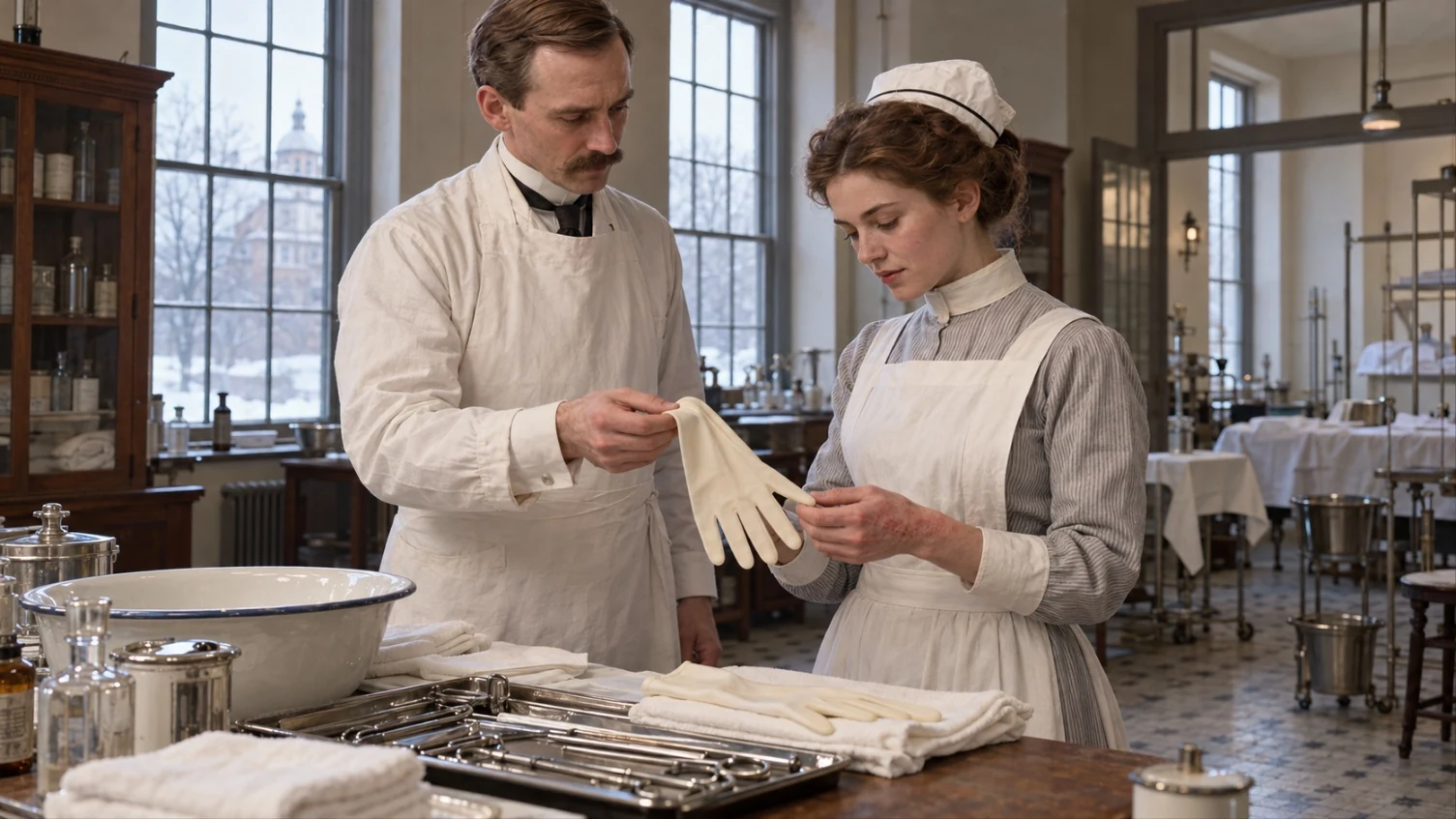 Halsted had rubber gloves made for nurse Caroline Hampton; they married in 1890. (AI illustration)
③ Japan: dropped the American internship, kept the ikyoku
Japan created a mandatory internship in 1946, during the U.S.-led Allied occupation (Imperial Ordinance No. 402 required at least a year of practical training after graduation before the national medical exam). It was then written into the Medical Practitioners Act enacted in 1948. Amid complaints about a poor curriculum and financial insecurity during training (Honda et al. 2022), Japan abolished that system in 1968. It was replaced with post-licensure clinical training that was only an “effort obligation” (Japan Ministry of Health, Labour and Welfare). Honda et al. date the internship from 1948 to 1969. The ikyoku system, by contrast, was welcomed by graduates and survived throughout the 20th century. Only after a mandatory two-year clinical training program was introduced in 2004 did the ikyoku’s influence gradually weaken (Honda et al. 2022).
④ Korea: a country with both layers
Korea inherited the Japanese ikyoku through colonial medical education. Then American-style internship and residency spread, with the 1958 draft-deferral agreement cited as one important catalyst. That ran in the opposite direction from Japan, which dropped its mandatory American-style internship in 1968. Japan replaced its pre-licensure internship with post-licensure clinical training; Korea built its intern–residency system on the American model. As a result, Korean university hospitals kept both American titles and ikyoku-style relationships, and Gye Su-jeong’s list describes the everyday life this double structure produced. These last two sentences are our interpretation.
Back to Gye Su-jeong’s list
Read again, Gye Su-jeong’s “won’t do” list looks less like one woman’s stubbornness than like a century of institutional history. The procession of rounds and the cry of “All rise” call up the ikyoku’s hierarchy. The research-related clauses call up a structure in which professors held their students’ careers, though they do not establish misconduct on their own. Staff dinners call up the rituals that kept those relationships going. These are associations; we have no direct record tracing each ritual to its source.
In 1928, Yun Il-seon stood somewhere nearby. He became an assistant professor at Keijo Imperial University but was never allowed to give the main lectures, and he left about a year later, in April 1929. Behind that lay not only hierarchy but colonial ethnic discrimination (Jeong 2024). After liberation he defended the rank of the university medical faculty over professional schools. Perhaps Gye Su-jeong’s refusal feels so satisfying on screen because, in real life, outsiders were more likely to be blocked by the hierarchy or end up part of it. That is our interpretation. There is no basis for seeing Yun as a model for Gye Su-jeong, the two did not face the same kind of hierarchy, and we use him only as a contrast.
Korean university hospitals’ professor-centered organization and training system carry the influence of both colonial-era Japanese medical education and post-liberation American specialist training. Why a Japanese drama transplants so easily into a Korean hospital, we suggest, is that the two countries’ hospitals share roots. That is an interpretation, not a proven cause.
This article was researched and written by K-Drama History. Source: Doctor X: Where Did the Professor's Grip on Korean Hospitals Come From? — K-Drama History