Did Silla Fall in 927? What Taejo Wang Geon Leaves Out
From the research behind Pause the Drama.
On September 29, 2001, in episode 157 of the KBS1 epic Taejo Wang Geon, Gyeon Hwon’s army storms Silla’s capital, Seorabeol. King Gyeongae is captured at Poseokjeong in the middle of a banquet. Press reports from the time say that in this episode Gyeon Hwon spits on King Gyeongae and orders him to lick liquor spilled on the floor, and the king begs for his life. In episode 158 the next day, Gyeon Hwon installs Kim Bu as the new king of Silla.
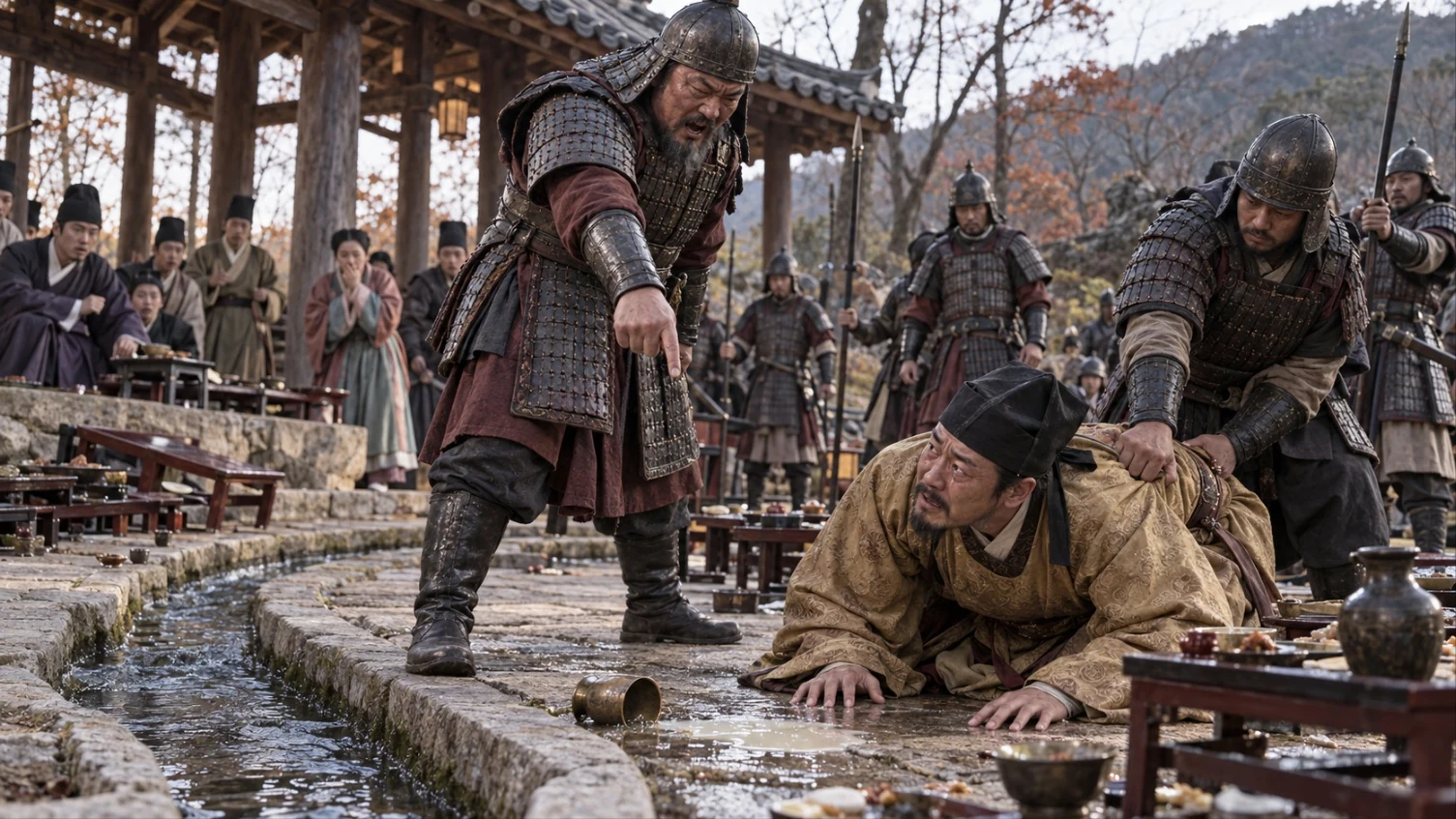 Poseokjeong as the drama staged it. The spitting and the licking of spilled liquor are not in the historical record. (AI illustration)
The scene caused trouble off screen too. The Miryang Park clan association demanded to know what the scene was based on (Media Today, Oct 18, 2001). The Hankook Ilbo reported the descendants’ complaint that it was “a distortion of fact for entertainment, created by the writer’s imagination” (Oct 12, 2001). Filming at the real Poseokjeong, with soldiers walking over the historic site, also started a heritage-protection dispute. The production team said a responsible official was present during filming and that the stone structure could not have been damaged. No physical damage has been proven.
Many viewers remember this scene as “the day Silla fell.” That memory raises the question for this article: did Silla really end at Poseokjeong in 927?
Quick answer: No. The one who died in 927 was King Gyeongae. The Silla dynasty lasted eight more years. Silla did not end at Poseokjeong in 927. Its control over the provinces weakened first. After the attack on its capital it held on for eight more years, and it ended in 935, when King Gyeongsun chose to submit to Goryeo. The fall came in three stages, not in one day: the 889 halt in provincial tax deliveries recorded in the Samguk sagi, which exposed how little the center still controlled the provinces; the 927 raid on the capital, a military blow; and the final political decision in 935. Even that last decision was not a free choice. The king made it when the kingdom had almost nothing left.
| Year | What the Samguk sagi records | What the drama shows |
|---|---|---|
| 889 | Provinces and counties stop sending tribute and taxes; Wonjong and Aeno revolt (vol. 11) | Not found in the official episode summaries |
| 927 | Gyeon Hwon enters the capital; King Gyeongae is forced to take his own life; Kim Bu (Gyeongsun) is enthroned (vol. 12) | Episodes 157-158: the banquet scene, spitting and licking spilled liquor added |
| 935 | King Gyeongsun submits to Goryeo; the prince goes into Gaegolsan (vol. 12) | Original episode not identified |
| 936 | Later Baekje falls; the Later Three Kingdoms are unified (not covered by the 935 entry) | Not checked |
889: The year the provinces stopped sending taxes
The names Wonjong, Aeno, and Uryeon do not appear anywhere in the 200 official episode summaries of Taejo Wang Geon. The episodes themselves have not been checked, so we cannot say for certain that no such scene exists. For this part of the story, though, the evidence comes from the sources rather than the drama.
The Samguk sagi entry for the third year of Queen Jinseong (889) gives a clear sequence of events. The provinces and counties stopped sending tribute and taxes to the capital, and the state storehouses ran empty (國內諸州郡不輸貢賦 府庫虛竭). When the queen sent envoys to demand payment, bandits rose up everywhere. Wonjong and Aeno rebelled from a base at Sabeolju (modern Sangju, North Gyeongsang). This was a sign that the center’s system for collecting revenue from the provinces had broken down. The entry says nothing about the social status of Wonjong and Aeno.
The next scene in the entry reverses expectations. The central official sent to crush the revolt, Yeonggi, who held the rank of nama, was frightened when he saw the rebels’ fortifications and would not advance. The man who fought instead was Uryeon, the local chonju (村主, a local notable responsible for village-level administration). Uryeon fought as hard as he could and died. The queen had Yeonggi beheaded and allowed Uryeon’s son, a boy of about ten, to inherit his father’s post as chonju (祐連子年十餘歳 嗣爲村主).
The provinces helped bring Silla down, but people in the provinces were also among those who defended it to the last.
Local society in late Silla did not divide neatly into “rebels versus the dynasty.” The National Institute of Korean History’s annotation explains that the post of chonju could be hereditary, and that some chonju grew into hojok, regional strongmen, during the transition from late Silla to early Goryeo.
Who were the hojok? Were they all rebels?
Taejo Wang Geon is full of local strongmen who call themselves castle lords (seongju) and generals (janggun). Historians call them hojok (豪族). The word was not an official title or a social rank at the time, though. It is an analytical term used by modern historians. The records use titles such as seongju and janggun, and the people who held them included local aristocrats, village headmen, soldiers, maritime powers, and rebel leaders (Sinpyeon Hanguksa vol. 12, cited secondhand).
Ha Il-sik argues that many of these local powers were not a new class that suddenly appeared. In his view, they were families who had long led their rural communities and who organized self-defense forces during the crisis. (This article relies on his abstract only.) Some local powers fought Silla. Local notables like Uryeon fought rebels on Silla’s behalf. Others helped broker talks between Silla and Goryeo. That variety is the key to the whole three-part series.
Gyeon Hwon: The man who struck Silla was a Silla soldier
In Taejo Wang Geon, Gyeon Hwon starts as an officer in the Silla army and is sent to clear pirates from the southwestern coast (episode 8). He later seizes Mujinju and proclaims himself great king (episodes 14–15, according to the official summaries). The drama did not invent this background.
The Samguk sagi biography of Gyeon Hwon says he came from Gaeun County in Sangju and was the son of Ajagae, a farmer who became a general. Gyeon Hwon entered the royal capital with the army and was then sent to defend the southwest coast. He reportedly slept with his spear for a pillow while waiting for the enemy, and he was always braver than the ordinary soldiers, so he was made a bijang (裨將, deputy commander). This article relies on the Korean translation on Uri Yeoksa Net and has not checked the classical Chinese of this passage. Bae Jae-hun argues that this military career and support from local people were the foundation of Gyeon Hwon’s power (based on his abstract). (For an earlier chapter in late Silla’s story, see our piece on Jang Bogo and Cheonghaejin.)
Gyeon Hwon was not an outside enemy who brought Silla down. He was a soldier Silla itself had trained.
The dates come in two stages. Following the order of events in the Samguk sagi biography, Gyeon Hwon attacked Mujinju (modern Gwangju) in 892 and made himself king in practice. He did not yet dare to call himself king openly. Instead he used a long, self-assigned title that put Silla’s name at the front, such as “Commander-in-Chief of the Western Region of Silla.” Only in 900, when he reached Wansanju (modern Jeonju), did he declare that he would avenge the old grievance of King Uija (以雪義慈宿憤). He then called himself King of Later Baekje and set up government offices (遂自稱後百濟王 設官分職), building a state in earnest. In short, 892 marks his military independence and 900 marks the proclamation of a state.
Other records disagree. The Silla Annals in the same Samguk sagi, under the sixth year of Queen Jinseong (892), say Gyeon Hwon occupied Wansanju and called his state Later Baekje. That conflicts with the biography. Sin Ho-cheol argues that his first break with Silla came in 889. The 892 date in this article therefore follows the biography’s chronology only.
927 at Poseokjeong: What the sources say, and what the drama added
The Samguk sagi entry for the fourth year of King Gyeongae describes these events in order. Gyeon Hwon attacked Goulbu (modern Yeongcheon). King Gyeongae asked Wang Geon of Goryeo for help, and Wang Geon sent ten thousand elite troops. Before the relief army arrived, Gyeon Hwon swept into the royal capital in the winter, in the eleventh month (以冬十一月 掩入王京). The king was holding a banquet at Poseokjeong with his queen, consorts, and royal relatives, and did not even know the enemy had come.
This is where the record and the drama part ways. According to the record, the king fled with his queen to the inner palace (後宮). The king, the queen, and several concubines were found there, seized, and brought to the army’s camp. Gyeon Hwon then forced the king to take his own life (王與妃妾數人在後宮 拘致軍中 逼令王自盡). The record goes on to say that Gyeon Hwon also violated the queen (強淫王妃).
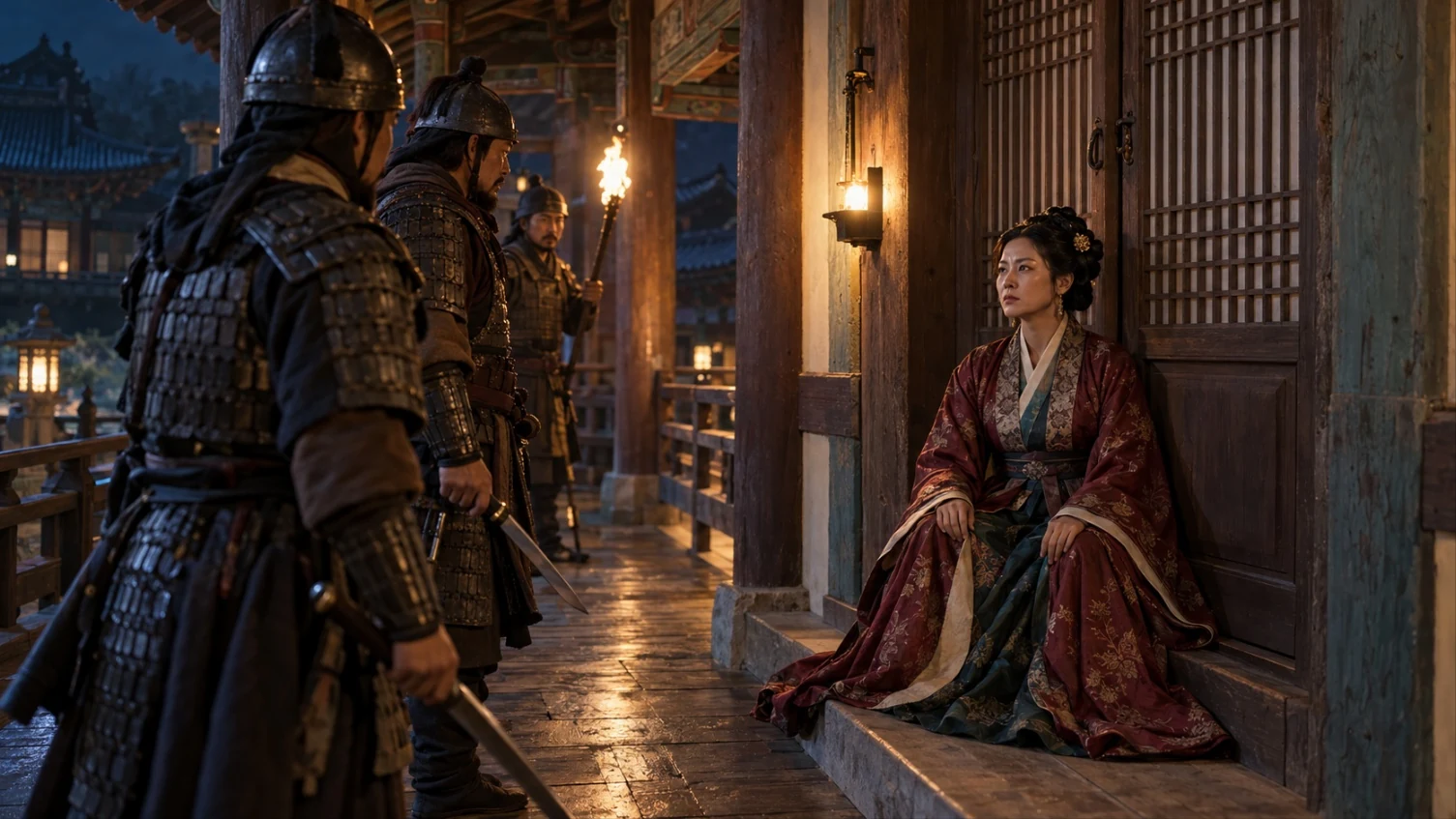 In the Samguk sagi account, the king and his queen fled to the inner palace before they were seized. (AI illustration)
The Samguk sagi Biography of Gyeon Hwon (vol. 50) tells the same raid differently: it dates the attack to the tenth month, says the king and queen withdrew to a detached palace south of the city, and says Gyeon Hwon had the king seized and killed in front of him (使人捉王 至前戕之) instead of forcing a suicide. The two accounts agree on Poseokjeong and on the installation of Kim Bu. The drama’s spitting and licking of liquor from the floor are not in either entry. It would still be an exaggeration to say “there is no humiliation in the sources.” The same entry says the captives, high-born and low-born alike, were drenched in sweat, crawled on the ground, and begged to be made slaves (無貴賤皆駭汗匍匐 乞爲奴僕). The drama took that collective terror and concentrated it into the humiliation of one man, King Gyeongae. Who kills King Gyeongae in the drama is unconfirmed, because the episodes have not been checked against the footage.
The banquet itself is also debated. It was the eleventh lunar month. The enemy had already reached Yeongcheon, and the king had already asked Goryeo for help. Some researchers doubt that a king in that position would have held a feast outdoors. There are three explanations:
- The banquet, as the Samguk sagi itself records it.
- A state-protection rite: the king went there to perform a ritual for the kingdom’s protection (Kwon Yeong-o, 2013).
- A search for refuge: in the middle of the crisis, he went there looking for safety (Park Sun-gyo, 2016, based on the Samguk yusa).
These three explanations do not carry equal weight. The first comes from a historical chronicle, while the second and third are modern scholarly reinterpretations. Whichever one you accept, the conclusion is the same: the one who died that day was a king, not the kingdom.
Gyeon Hwon’s motive is also recorded. According to the National Institute of Korean History’s annotation, the Samguk sagi biography explains that Gyeon Hwon attacked the capital because Silla was growing close to Goryeo, and he wanted to stop Goryeo from taking Silla first. On that account, the attack on Gyeongju was not madness but part of a three-way struggle for supremacy. This explanation comes from the chronicle’s compiler, though, not from Gyeon Hwon himself.
The eight years after 927: Why did Gyeon Hwon’s own king hand the kingdom to Goryeo?
Gyeon Hwon did not take Silla for himself. He put Kim Bu on the throne, and Kim Bu became King Gyeongsun, Silla’s last king. Gyeon Hwon’s power was at its height that year. Wang Geon met the returning Later Baekje army at Gongsan (around today’s Palgongsan, Daegu) with five thousand elite cavalry and was badly defeated. Sin Sung-gyeom and Kim Rak were killed, and Wang Geon barely escaped with his life (Samguk sagi, Biography of Gyeon Hwon). Taejo Wang Geon shows this defeat and Wang Geon’s return over episodes 159–162 (according to the official summaries). There is a well-known story that Sin Sung-gyeom swapped armor with Wang Geon. The Samguk sagi Biography of Gyeon Hwon records only that he died in the battle and does not mention a swap.
The twist is that the king Gyeon Hwon installed did not take Gyeon Hwon’s side. Uri Yeoksa Net sums up King Gyeongsun this way: although he came to the throne at Gyeon Hwon’s hands, he consistently opposed Later Baekje and favored Goryeo. After Goryeo won the battle of Gochang (modern Andong) in 930, King Gyeongsun asked to meet Wang Geon. In the second month of 931, Wang Geon entered Seorabeol with only about fifty horsemen and was received with great hospitality. The official summary of episode 171 (Nov 17, 2001) has Wang Geon entering Seorabeol at King Gyeongsun’s invitation, so that episode may correspond to the 931 visit. The original broadcast episode of the 935 submission scene has not been identified.
In the tenth month of 935 (original text), King Gyeongsun discussed submission with his officials. He said the lands on all four sides now belonged to others, and the kingdom was weak and isolated. The court was divided. The prince said a thousand-year state could not be handed over in a single morning. The king chose to submit, saying he could not let more innocent people die (Samguk sagi, King Gyeongsun, year 9). The prince went into Gaegolsan (the Diamond Mountains), wore hemp clothing, lived on plants, and died there. Later generations called him Crown Prince Maui (麻衣太子, “the hemp-robed prince”). The Samguk sagi calls him only “the prince,” and the Samguk yusa only “the royal crown prince.” Neither gives his name.
What happened after the submission is another surprise. According to the Samguk yusa, Wang Geon appointed King Gyeongsun to the office of jeongseung (正承), placed him above the Goryeo crown prince in rank (位在太子之上), and gave him a stipend of a thousand seok of grain. He also renamed Silla Gyeongju and made it King Gyeongsun’s fief (改新羅爲慶州 以爲公之食邑). The state was gone, but the Silla royal family and the Gyeongju elite were absorbed into the new dynasty.
Silla ended its dynasty through the king’s submission, and its royal house and the Gyeongju ruling class were absorbed into the Goryeo order.
Kim Busik, who compiled the Samguk sagi under Goryeo, judged King Gyeongsun’s decision this way: although it was made out of necessity, it is still worthy of praise (雖非獲已 亦可嘉矣). Lee Kang-rae argues that a Confucian worldview and the need to justify the submission shaped this account of Silla’s fall (based on his abstract). The contrast between “the king who died drinking” and “the last king who saved his people” is a record of events. It is also an interpretation written by Goryeo.
Legends and later traditions: A tiger’s milk and an earthworm father
[A birth legend in the official history] The Samguk sagi biography of Gyeon Hwon says that when he was a baby, his parents left him under a tree while they worked in the fields, and a tiger came and nursed him. (This article cites the story secondhand and has not checked the original text.)
[The Samguk yusa variant] Volume 2 of the Samguk yusa, under “Later Baekje: Gyeon Hwon,” tells a different story. Every night, a man dressed in purple visited the daughter of a wealthy family in a village north of Gwangju. She stuck a threaded needle into his clothes, and when she followed the thread, it led to a giant earthworm. She later gave birth to Gyeon Hwon. (This story is also cited secondhand and has not been checked against the original text.) Neither story is evidence of Gyeon Hwon’s birthplace or lineage. Both are traditions meant to explain a leader’s extraordinary nature.
[Later traditions] Crown Prince Maui did not even leave a name in the official histories. Later generations gave him a specific name and told stories about his descendants. Those names cannot be confirmed in the core sources.
Perhaps these traditions survived because, for people at the time, the closing of a thousand-year kingdom was an enormous shock.
Comparing other dynasties: How did they end?
1. Tang China: the closest parallel. Tang jiedushi (節度使, military governors) began as commanders responsible for frontier defense. After the An Lushan Rebellion (755–763), some of them became autonomous regional powers (Graff 2017, cited secondhand). The most extreme case was Zhu Quanzhong (Zhu Wen), a former military governor. He killed Emperor Zhaozong in 904, set up the young Emperor Ai, and in 907 received the throne by abdication and founded Later Liang. A strongman from the army seized the capital, brought about the ruler’s death, and installed a puppet ruler. That pattern is almost the same as Gyeon Hwon’s, and the two episodes are only about twenty years apart. The difference lies in the final move: Zhu Quanzhong made himself emperor, but Gyeon Hwon did not take Silla’s throne. (This comparison is for reference only. The dates for Zhu Quanzhong have not been checked against the original sources.)
2. West Francia: a clear contrast. In ninth- and tenth-century West Francia, royal power also weakened. Regional princes such as those of Flanders and Normandy, and the castellans below them, came to hold real power (Bates 2000, based on the publisher’s abstract). The kingdom itself survived as a framework, but the king’s actual authority shrank and powerful regional princes grew stronger. That path differs from the Korean peninsula’s. There, less than half a century after the crisis of 889, the Later Three Kingdoms were brought together militarily and politically under Goryeo in 936. The institutional incorporation of local powers continued afterward, into the reigns of Gwangjong and Seongjong. (This comparison is also for reference. It covers a long span of time and simplifies a great deal.)
3. Korea: Silla’s way. Silla did not end through usurpation or through endless fragmentation. Its last king brought his kingdom over to a rival state, and his royal house was treated with greater honor than the rival’s own crown prince. What made this possible was how Goryeo bound the hojok into its order, and that is the question for the next part of this series.
Back to Poseokjeong in episode 157
The Poseokjeong of Taejo Wang Geon episode 157 is one king’s most wretched moment. The drama exaggerated his humiliation, and that exaggeration drew real protests from his descendants. The bigger misunderstanding, though, is about the date rather than the size of the humiliation. King Gyeongae died in 927, but Silla lived until 935.
Silla did not end at Poseokjeong in 927. Its weakness was already visible in 889, when the taxes stopped and the village headman Uryeon fought at Sangju in place of the central official. After Gyeon Hwon’s raid, the end came with King Gyeongsun’s final decision. And the man who made that last decision was the very king Gyeon Hwon had put on the throne.
Key terms. Hojok (豪族): a modern historians’ term for the varied regional strongmen of late Silla and early Goryeo, not a title used at the time. Chonju (村主): a local notable responsible for village-level administration; the post could be hereditary. Gwibu (歸附): submission or allegiance to another state, here King Gyeongsun’s handing of Silla to Goryeo in 935. Poseokjeong (鮑石亭): a royal site in Gyeongju with a curving stone water channel, where the Samguk sagi places King Gyeongae’s banquet in 927.
This article was researched and written by K-Drama History. Source: Did Silla Fall in 927? What Taejo Wang Geon Leaves Out — K-Drama History