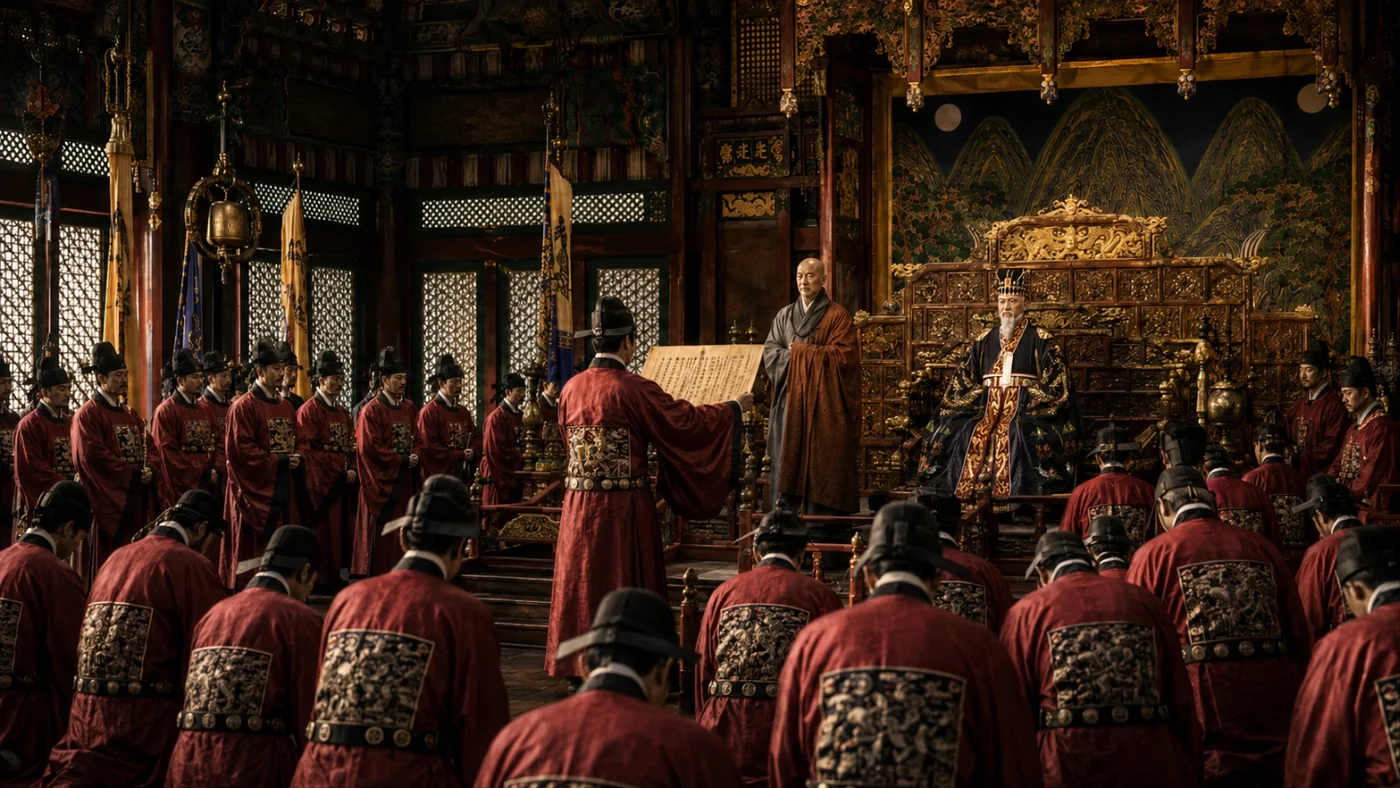
Faith (The Great Doctor): The Real Princess Noguk
From the research behind Pause the Drama.
In the 2012 SBS drama Faith (also known in English as The Great Doctor; 24 episodes, aired August 13 – October 30, 2012, starring Lee Min-ho and Kim Hee-sun, with Ryu Deok-hwan as King Gongmin and Park Se-young as Princess Noguk), the story opens in 1351. On the way back to Goryeo after her marriage in the Yuan empire, Princess Noguk is gravely wounded by an assassin’s blade. King Gongmin orders his guard Choe Yeong to bring back a “physician from the heavens” — and Choe Yeong passes through the gate of heaven and arrives in 2012 Seoul (SBS, episode 1 synopsis).
The assassination attempt and the time travel are invented. But hidden in this setup is an interesting reversal. In the drama, the king’s people save the queen. In the historical record, it was the other way around: the queen protected the king.
A princess from the Yuan imperial house protected the life of a Goryeo king who led an anti-Yuan reform. Why? And when she died, what was left for Gongmin?
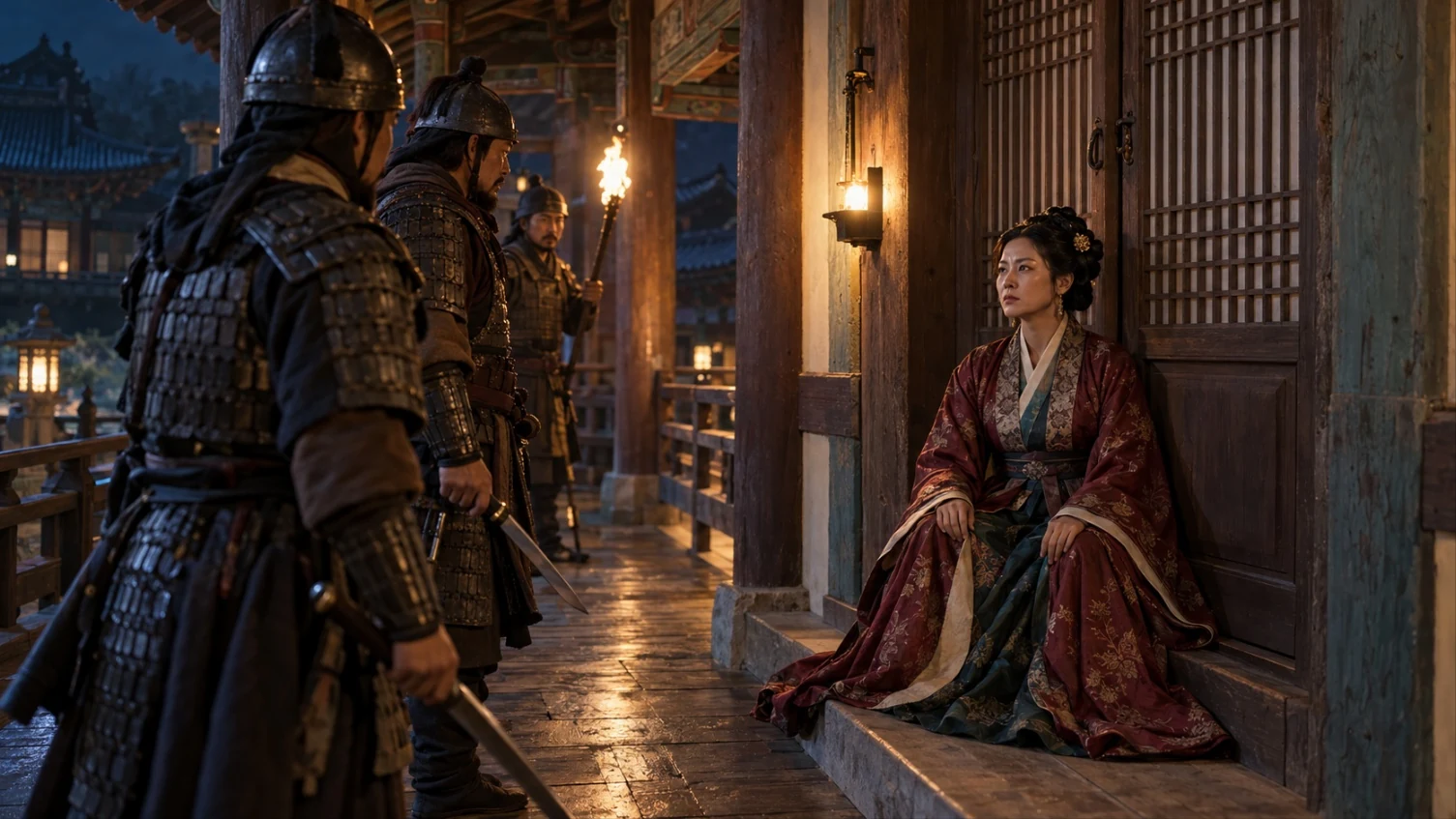 During the 1363 Heungwangsa revolt, Yi Saek says Princess Noguk sat in front of the door to guard the king. (AI illustration)
Quick answer: Princess Noguk came from a branch of the Yuan imperial clan, yet she supported her husband’s royal authority. The Encyclopedia of Korean Culture says she backed the politics of a king with a weak power base and protected his life during the Jo Il-sin rebellion and the Heungwangsa revolt (Encyclopedia of Korean Culture — Noguk Daejang Gongju). In the 1363 revolt, what the Encyclopedia of Korean Culture quotes from Yi Saek is that she sat in front of the door to guard the king while the attackers stood before her with drawn swords — not that she fought anyone. Why she stood with him rather than with the Yuan is a matter of researchers’ interpretation, not something she left in her own words. When she died after a difficult childbirth in 1365, Gongmin mourned her deeply, and that mourning became a vast memorial project that drew on the state’s labor and finances.
The short version:
- In the drama, the king’s guard saves the queen; in the records, the queen protected the king.
- Princess Noguk stood not on “the Yuan side” but beside her husband’s throne.
- The sources record a deep grief — and a real cost.
Let’s unpack it.
| In the drama (Faith) | In the historical record | |
|---|---|---|
| Who is saved | Princess Noguk, wounded by an assassin in 1351 | King Gongmin, in the 1363 Heungwangsa revolt (Encyclopedia of Korean Culture, quoting Yi Saek) |
| How | The king’s guard travels through time for a “heavenly physician” | The queen sat in front of the door to guard him; she did not fight |
| Her end | Not covered by the drama’s timeline | Died in 1365 after a difficult childbirth (Encyclopedia of Korean Culture) |
Was Princess Noguk the daughter of the Yuan emperor?
No — it’s a common misconception. Princess Noguk’s name was Botapsilli (寶塔失里), and she is recorded as the daughter of the Prince of Wei (魏王), a member of the Yuan imperial clan (Encyclopedia of Korean Culture — Noguk Daejang Gongju). She was not an emperor’s own daughter but a royal from a collateral branch of the Yuan imperial house.
Her name holds a trap too. She and Gongmin married in the Yuan empire in 1349, and she received the title Princess Seungui (承懿公主). The Encyclopedia of Korean Culture ties that title to the marriage; a contemporary stele, that of Gwangtongbojeseon Temple in Gaeseong, records the investiture separately, in 1351. The name widely used today, “Noguk Daejang Gongju,” is a shortened form of the posthumous title she received after her death (Encyclopedia of Korean Culture). According to the Goryeosa, the Yuan granted the posthumous title Noguk Hwiik Daejang Gongju in 1367, and Gongmin later ordered Hwiik changed to Hwiui.
In 1341, Gongmin — twelve years old by traditional Korean age reckoning — went to the Yuan court for a period of sukwi (宿衛): service at the imperial court that also functioned as a form of political hostage-taking. Raising Goryeo princes in the Yuan and marrying them to women of the Yuan imperial house was standard practice for Goryeo’s royal family during the period of Yuan domination. This marriage took place within that system.
The same system didn’t always produce a happy ending. Two generations earlier, Princess Gyeguk, wife of Gongmin’s grandfather King Chungseon, was at odds with her husband, and that discord gave the pretext for Chungseon’s deposition (Encyclopedia of Korean Culture — Gyeguk Daejang Gongju). A Yuan princess could be a shield protecting a Goryeo king — or a blade that brought him down.
Why did a Yuan princess take her husband’s side?
Gongmin’s 1356 purge of Gi Cheol and his faction — who had grown powerful by leaning on the Yuan — and his recovery of the Ssangseong Commandery are covered in our earlier piece, Shin Don, Explained. The question here is different: whose side was the Yuan-born queen on at that moment?
A 2009 study by Lee Hyung-woo assesses that Princess Noguk supported Gongmin’s political position, helping the 1356 reform and the maintenance of royal authority (based on the paper’s abstract). A 2011 study by Lee Myung-mi describes, in its abstract, how the rise of the Ki family — the natal family of the Yuan’s Empress Gi — put pressure on Goryeo’s royal authority. Whether either study goes further and argues that the Ki family’s rise also directly threatened the princess’s own position as queen has not been confirmed against the full text. These are researchers’ interpretations, and there is no record in which the princess herself states any opposition to the Yuan.
Nor did she simply follow her husband’s every wish. The Goryeosa’s Biographies of Royal Consorts records that in 1352, when Gongmin set out to perform rites at the Taemyo (太廟, the shrine of the royal ancestors), the princess had his attending officials stop him (cited via the research file; the original text was not checked at the drafting stage). She was her husband’s supporter, but not his shadow.
The night a queen sat at the door: the Heungwangsa revolt
In 1363, Gongmin returned from Bokju (present-day Andong), where he had fled the Red Turban invasion. Because the palace in Gaegyeong had been destroyed, he took up residence at Heungwangsa Temple, using it as a haenggung (行宮, temporary royal residence). There, Kim Yong, one of the king’s own close associates, sent a band of men to kill him (Encyclopedia of Korean Culture — Heungwangsa revolt; Uri Yeoksa Net — King Gongmin; Uri Yeoksa Net — Kim Yong).
The eunuch Yi Gang-dal carried the king on his back out through a window and hid him in the Queen Dowager’s private chamber (Yi Gang-dal’s quick thinking is in the Encyclopedia of Korean Culture; the detail of carrying him out through the window has not been checked against the original text). The Encyclopedia of Korean Culture quotes Yi Saek as saying that Princess Noguk sat in front of the door to guard the king (the Goryeosa text of this scene was not checked here). A 1370 pledge text in the Goryeosa also speaks of her shielding the king with her body from enemies who had come close — though that document was written to honor her merits, and should be read with that in mind. She did not take up a weapon and fight; she blocked the door with her body and screened the king.
That same night, someone else protected the king. The eunuch An Do-chi (安都赤, also read An Do-jeok) resembled the king in appearance. He lay down in the king’s bed himself, and the intruders, taking him for the king, killed him (Encyclopedia of Korean Culture; Goryeosa, vol. 122, Biography of An Do-chi).
The revolt was put down by Choe Yeong and others, who arrived with troops (Encyclopedia of Korean Culture). So Choe Yeong, the hero of Faith, really was among those who suppressed this revolt — but it happened more than a decade after the period the drama covers.
In the drama, the king’s guard saves the queen; in the records, the queen protected the king.
No other consorts at all?
The story that Gongmin loved only Princess Noguk and never took any other consort while she lived isn’t accurate either. In 1359, the high ministers urged the king to take a secondary consort because he had no heir; after the princess gave her permission, the daughter of Yi Je-hyeon became Consort Hye (Hye-bi) (Goryeosa, Biographies of Royal Consorts).
The same entry adds that the princess later regretted it and refused to eat. But that is the narration of the Goryeosa, compiled in a later era — not a record of her feelings that the princess left herself. What is certain is that the court strongly wanted an heir, and that this pressure entered the marriage.
1365: departing with the long-awaited child
In 1365, more than fifteen years after their marriage, the princess was about to give birth. As the due date approached, Gongmin pardoned prisoners; when a difficult labor left her gravely ill, he had prayers offered at temples and shrines and widened the scope of the pardon further. The king burned incense himself and did not leave her side even for a moment. But the princess died, together with the child (Encyclopedia of Korean Culture).
The royal pardons and prayers show that the king’s private grief was, at the same time, a state ritual. Her cause of death cannot be identified with a modern medical diagnosis.
The cost of grief: the portrait hall and the twin tombs
The Goryeosa relates that Gongmin painted the princess’s likeness himself, and wept as he ate his meals facing the portrait (Biographies of Royal Consorts, via the research file). For readers abroad, this may be the image that stays longest.
But the same records also note the cost. In 1366, Gongmin built a yeongjeon (影殿), a hall to house the princess’s portrait (Encyclopedia of Korean Culture); that year, construction of her portrait hall went ahead on a large scale southeast of Wangnyunsa Temple. Later, Gongmin also pushed a portrait-hall project at Maam. The sources record the burden placed on the many people mobilized to haul great timbers and stones. In 1368, the official Yu Tak opposed the Maam project, citing the burden on the people and the waste of state finances. When the king moved to have him executed, he ordered the scholar Yi Saek to draft a proclamation announcing Yu Tak’s crimes; Yi Saek refused, saying the charges laid out did not warrant death (Goryeosa, Biographies of Royal Consorts; Biography of Yu Tak; Biography of Yi Saek).
The king’s own tomb was built beside the princess’s. The Tomb of King Gongmin in Kaesong is a pair of tombs — the king’s and Princess Noguk’s — laid side by side, with figures of the twelve zodiac guardians painted on the walls of the king’s burial chamber. The Encyclopedia of Korean Culture says the princess was buried at Jeongneung (正陵) forty-nine days after her death; a Wikipedia summary of the Goryeosa says Gongmin oversaw the building of Jeongneung himself for about nine years and built his own tomb, Hyeonneung (玄陵), beside it in 1366. A 1372 completion date could not be confirmed from the sources opened for this article. Gongmin died in 1374 and was buried in the tomb he had prepared during his lifetime. The tomb was inscribed on the World Heritage List in 2013 as the “Mausoleum of King Kongmin”, one component of the “Historic Monuments and Sites in Kaesong” (UNESCO World Heritage Centre, No. 1278). The inscription covers the Kaesong site as a whole, not Goryeo royal tombs in general.
The sources record a deep grief — and a real cost.
Did he give up on governing after his wife died?
It’s a frequently heard explanation, but the chronology doesn’t fit. Shin Don stepped to the front of politics in 1365, the very year the princess died (as covered in Shin Don, Explained: royal tutor in the fifth month of 1365, high office in the twelfth). What came after that is told in that piece. The point to make here is that government continued after the princess’s death: in 1367 the National Academy (Gukhak) was rebuilt on a large scale, and in 1369–1370 Goryeo shifted its diplomatic course toward the newly risen Ming (Goryeosa, via the research file).
It is possible that grief affected the king’s judgment and the balance of the court. But the idea that “Goryeo would not have fallen if Princess Noguk had lived” is a hypothetical that cannot be proven.
What does the drama change from history?
Faith’s 1351 assassination attempt, the heavenly physician, and the time travel are fiction. Choe Yeong is a real historical figure, but most of what he does in the drama is dramatized.
The biggest difference is the time frame. The drama portrays the reforms of Gongmin’s early reign and the struggle with Gi Cheol’s faction, with Princess Noguk as a queen anxious to help her husband (SBS, episode 13 synopsis). The Heungwangsa revolt (1363), in which that queen shielded the king with her body, and her death (1365) both take place after the period the drama ends with.
A note on how far the drama has been checked here: the scenes referenced are drawn from SBS’s official episode synopses (episodes 1, 12, 13, and 22), SBS articles (episodes 16, 18, and 19), and a YTN-carried OSEN article from the time of broadcast (episode 6). The episodes themselves have not been compared directly. A pregnancy scene in episode 19 is confirmed in that coverage, but it should not be taken as a reenactment of the historical final pregnancy and difficult labor of 1365.
Later traditions: why is there a Goryeo king in Joseon’s Jongmyo?
The twist most likely to surprise readers abroad comes at the end. Inside Jongmyo in Seoul — the shrine that holds the spirit tablets of Joseon’s kings and queens — there is a shrine for King Gongmin of Goryeo. The Cultural Heritage Administration’s Jongmyo Management Office describes it as a detached building east of Mangmyoru Pavilion and says it is said to have been built when Jongmyo was first constructed. Its formal name is the “Shrine Enshrining the Portrait of King Gongmin of Goryeo” (高麗 恭愍王 影幀 奉安之堂) (Jongmyo Management Office — Gongmin-wang Shrine).
Why is it there? The widely known explanation is a folk tale: when Jongmyo was being built, a whirlwind blew in and dropped Gongmin’s portrait, and the shrine was built to house it (Encyclopedia of Korean Culture, Gongmin-wang-sin, via the research file). This story exists only at the level of “it is said,” and the shrine’s origin is unclear. A 2021 study by Yi Uk on the shrine and its keepers exists, but its full text has not been reviewed here, and its existence is no proof that the shrine was built when Jongmyo was founded.
The Gongmin-wang Shrine in Changjeon-dong, Seoul, has a similar tradition: King Gongmin is said to have appeared in the dream of a granary keeper and had him build the shrine. The National Heritage Service introduces this as something that “is said,” and lists the present building as dating from the 1950s (via the research file).
There are also written records that Gongmin painted (via the research file). The National Museum of Korea presents the painting Cheonsan Daeryeop-do (Great Hunt in the Heavenly Mountains) as “attributed to King Gongmin.” “Attributed” means it has been handed down that way — not that it has been confirmed as the king’s own work (via the research file).
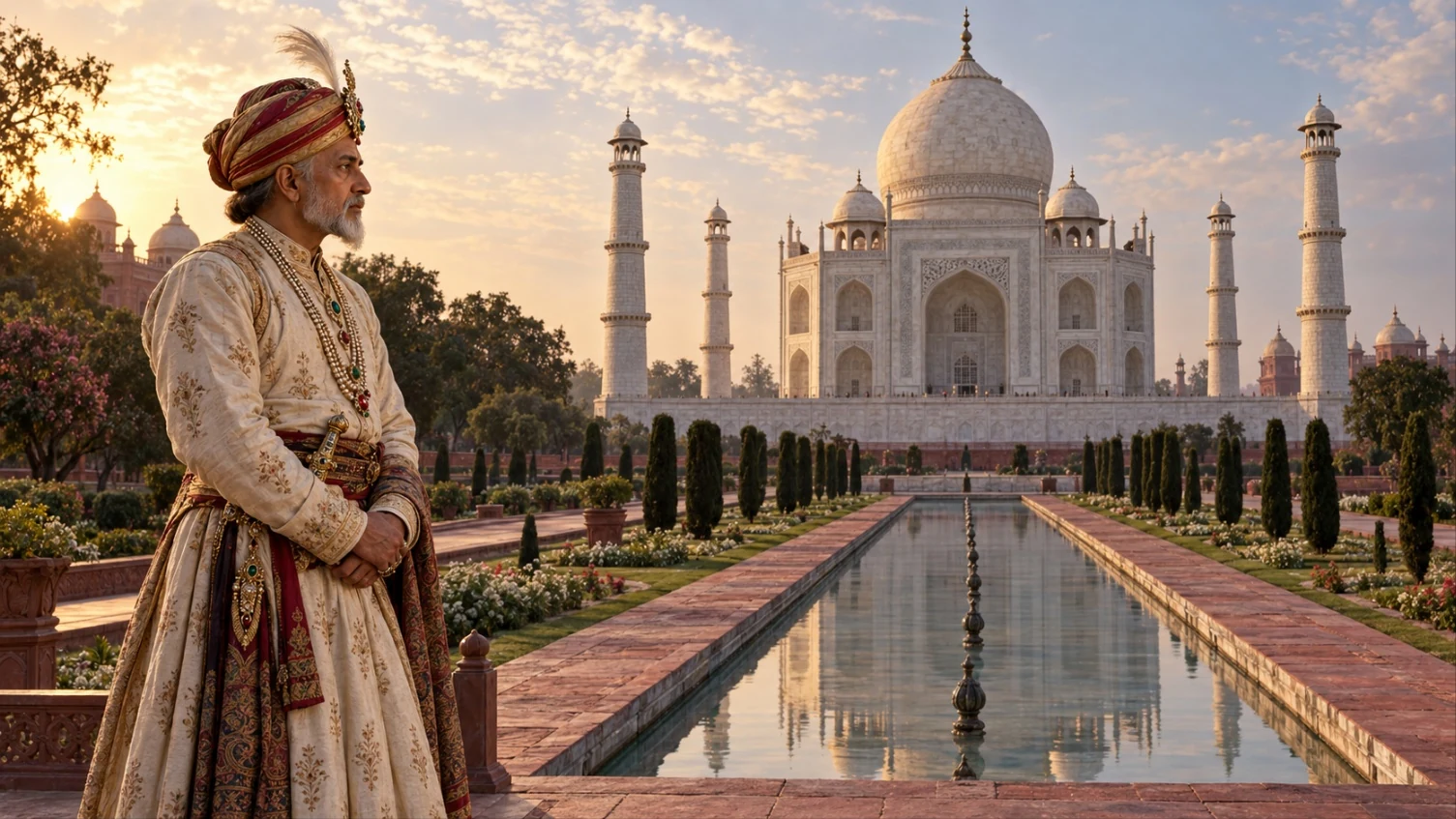 The Taj Mahal, built by Shah Jahan in memory of his favorite wife. (AI illustration)
A global comparison: architecture for a dead queen
Mughal India — the Taj Mahal (a case with much in common)
UNESCO describes the Taj Mahal as an immense white-marble mausoleum built in Agra between 1631 and 1648 by the Mughal emperor Shah Jahan in memory of his favorite wife (UNESCO World Heritage Centre — Taj Mahal). His wife, Mumtaz Mahal, is widely known to have died in childbirth (her cause of death has not been confirmed here from an official source). According to UNESCO, Shah Jahan’s cenotaph was placed beside hers some thirty years later.
A queen’s death, a king’s deep mourning, memorial architecture built with enormous labor, and finally a couple laid side by side. The story of Gongmin and Princess Noguk comes some 260 years before the Taj Mahal (counting from 1365 to 1631).
Korea — what outlasted the tomb
The difference lies in what came after. The Taj Mahal became the world’s most famous architecture of love. Gongmin’s portrait hall appears not to survive today, and the twin tombs stand in Kaesong, on the far side of the line that divides Korea. Instead, in one corner of the Jongmyo of Joseon — the dynasty that ended Goryeo — stands a shrine holding Gongmin’s portrait.
Watching Faith again
In Faith, Princess Noguk falls to an assassin’s blade, and the king’s people cross even the gate of heaven to save her. The drama portrays the early years of Gongmin’s reign, as the two begin to open their hearts to each other (SBS, episode 13 synopsis).
History remembers what came after. More than a decade later, on the night a revolt broke out, that queen sat in front of the door to guard her husband. And two years later, she left the world together with the child they had waited for.
In the drama, the king’s guard saves the queen; in the records, the queen protected the king.
The sources record a deep grief — and a real cost.
FAQ
Is Faith a true story? No. The time travel, the heavenly physician, and the 1351 assassination attack are invented. King Gongmin, Princess Noguk, Choe Yeong, and Gi Cheol were real people, but most of what they do in the drama is dramatized.
Was Princess Noguk the daughter of the Yuan emperor? No. She is recorded as the daughter of the Prince of Wei, a member of the Yuan imperial clan. She married Gongmin in 1349 and received the title Princess Seungui (a contemporary stele dates the investiture to 1351). “Noguk Daejang Gongju” is a shortened form of her posthumous title.
Did Princess Noguk really save King Gongmin’s life? The Encyclopedia of Korean Culture says she protected the king’s life during the Jo Il-sin rebellion and the Heungwangsa revolt. For the 1363 Heungwangsa revolt, the Encyclopedia of Korean Culture quotes Yi Saek as saying she sat in front of the door to guard the king. She did not take up arms and fight.
Did King Gongmin take any other consorts while Princess Noguk was alive? Yes. In 1359, over the question of an heir, the daughter of Yi Je-hyeon entered the palace as Consort Hye.
Did King Gongmin abandon government entirely after Princess Noguk died? That can’t be stated so flatly. After her death, state affairs continued — the National Academy was rebuilt in 1367, and diplomacy shifted toward the Ming in 1369–1370.
Were King Gongmin and Princess Noguk buried together? Yes. The Tomb of King Gongmin in Kaesong is a pair of tombs — his and hers — laid side by side. It is inscribed on the UNESCO World Heritage List as part of the “Historic Monuments and Sites in Kaesong.”
Is there really a shrine to King Gongmin in Joseon’s Jongmyo? Yes. Its formal name is the “Shrine Enshrining the Portrait of King Gongmin of Goryeo.” The story that his portrait blew in on the wind is folklore, and the shrine’s origin is unclear.
This article was researched and written by K-Drama History. Source: Faith (The Great Doctor): The Real Princess Noguk — K-Drama History