Why Does Woo Young-woo Trust Gimbap? The Changing History of Korea's Roll
From the research behind Pause the Drama.
In Extraordinary Attorney Woo (이상한 변호사 우영우, ENA, 2022), Woo Young-woo eats gimbap (김밥, also commonly spelled kimbap) in the morning. It comes from Woo Young-woo Gimbap, the restaurant her father runs. Before she eats, she stands the slices on end and lines them up so every filling shows. The drama gives her reason, as quoted in reporting on the show: gimbap is trustworthy, because you can see all the ingredients at a glance, so there’s no chance of being surprised by an unexpected taste or texture. (This article’s wording follows press accounts. It was not checked against the official subtitles.)
Gimbap is a marker of who she is. In Episode 15, as quoted in the press, her colleague Choi Su-yeon teases her with roughly “Today, Choi Su-yeon gimbap instead of Woo Young-woo gimbap?” Neither the exact wording nor the episode number has been checked against the broadcast.
To Woo Young-woo, gimbap is predictable because slicing it shows you everything inside. Historically, though, what appeared in that cross-section was anything but fixed. Danmuji (yellow pickled radish) and ham, which now seem basic, first show up as gimbap fillings in 1958 newspaper articles. Fish soboro and dried gourd strips (bakgoji), which earlier cookbooks list, have largely gone from today’s rolls.
The “predictable” line-up Woo Young-woo trusts in her gimbap was put together over time. The fillings and even the recommended laver shifted between the 1920s and the 1970s — and vinegar-seasoned rice was still in a 1976 cookbook.
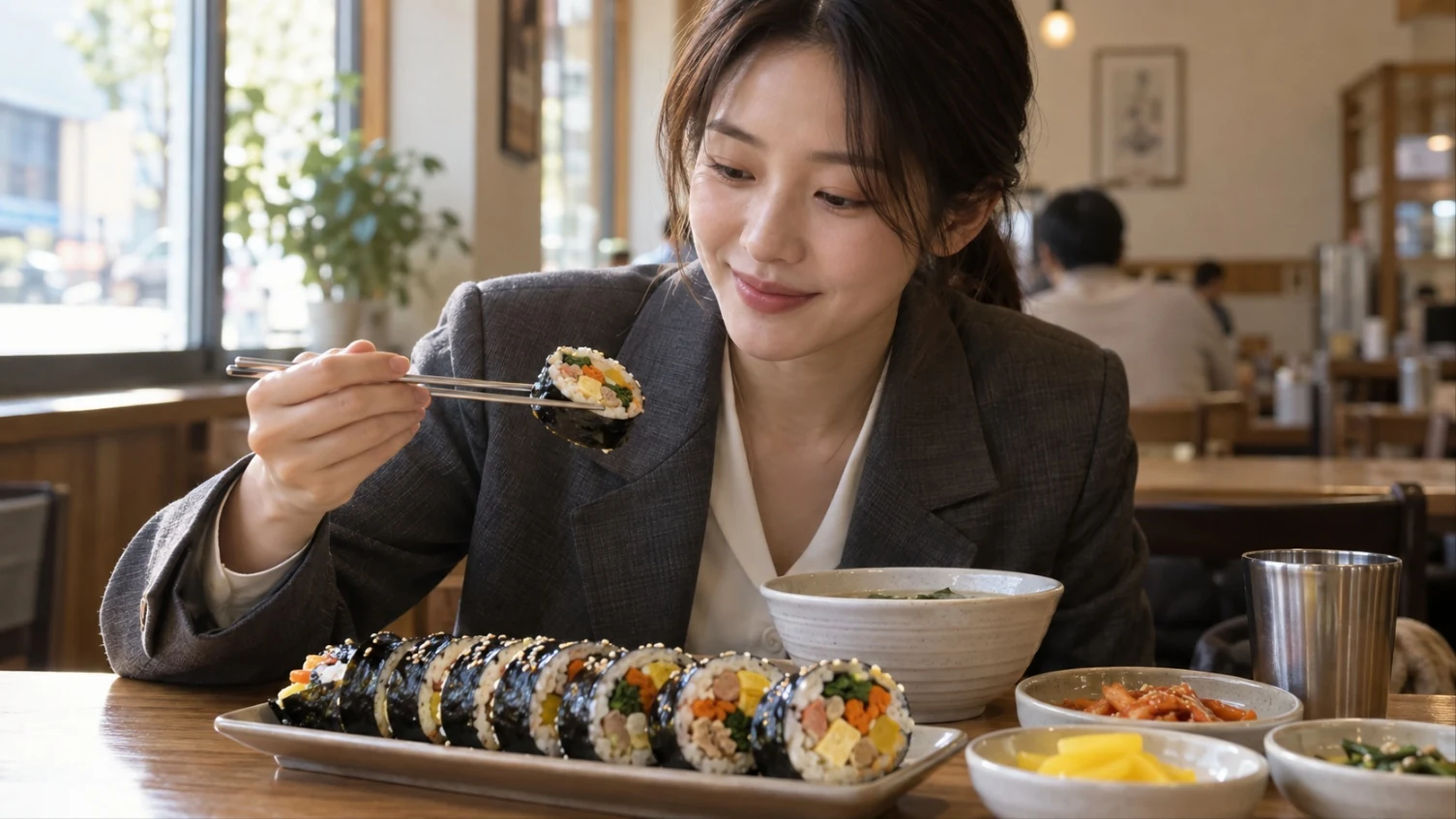 Gimbap cut so every filling shows. The cross-section Woo Young-woo trusts is the result of choices that changed over the decades. (AI illustration)
Why does Woo Young-woo eat gimbap?
In the drama, Woo Young-woo trusts gimbap because she can see every ingredient in each slice, so an unexpected taste or texture is unlikely to catch her off guard. It also comes from her father’s restaurant, Woo Young-woo Gimbap. That predictability is the point. The history of the roll tells a different story: the fillings visible in a Korean gimbap slice have kept changing.
Quick answer: Modern cylindrical gimbap took shape under the influence of Japanese norimaki during the colonial period, according to the Encyclopedia of Korean Culture. But Koreans were already eating rice wrapped in laver in the late Joseon period, as the first-full-moon food bokssam. From the 1920s on, newspapers and cookbooks show the roll being adapted in Korea: the recommended laver changed, new fillings such as danmuji and ham appeared and old ones dropped out.
A country that already ate laver: bokssam
Laver (gim) is seaweed that grows in the sea. It is shredded, spread thinly on a bamboo screen and dried, a lot like making paper by hand. So when overseas readers first describe gimbap as “rice wrapped in black paper,” they aren’t far off, at least about how the wrapper is made.
Old texts call laver by several names, including haeui (海衣), haetae (海苔), haechae (海菜) and jachae (紫菜). According to the Encyclopedia of Korean Culture, the Sejong Sillok Jiriji, Sinjeung Dongguk Yeoji Seungnam, Yeojidoseo and Daedong Jiji list it as a local product of the main coastal districts of Gyeongsang and Jeolla provinces and of parts of Gangwon and Chungcheong. (Those four geographies were not checked directly.)
The Veritable Records show that laver (海衣) was included among goods presented to Ming China and items given to Chinese envoys under Sejong (1429), Sejo (1468) and Seongjong (1480). The Encyclopedia reads this as laver good enough to be traded. The three entries themselves do not say it was chosen for its quality, and they do not describe commercial trade. They record it as tribute and diplomatic gifts.
Wrapping rice in laver shows up as a custom too. Yeoryang Sesigi (1819), Sesi Pungyo and Dongguk Sesigi (1849) describe a festival food for sangwon, the first full moon of the lunar year: rice wrapped in vegetable leaves or laver, called bokssam. The name is read as “wrapping up good fortune to eat it,” and the good fortune of the first full moon meant a good harvest.
The Chinese characters differ from source to source. The Encyclopedia of Korean Culture’s “Gimbap” entry writes 福裏. The Kyujanggak compiled edition of Dongguk Sesigi reads 福裹 (“以菜葉海衣裹飯啗之謂之福裹”, “wrapping rice in vegetable leaves and laver to eat is called bokgwa,” i.e. bokssam). Yeoryang Sesigi writes 縛苫. The characters used in Sesi Pungyo have not been confirmed. These spellings are listed here separately and not merged.
Bokssam and gimbap need to be kept apart. Bokssam is wrapped by hand and eaten right away. It is not rolled firmly on a mat into a cylinder and sliced. Saying that people wrapped rice in laver first is not the same as saying bokssam is the direct ancestor of today’s gimbap.
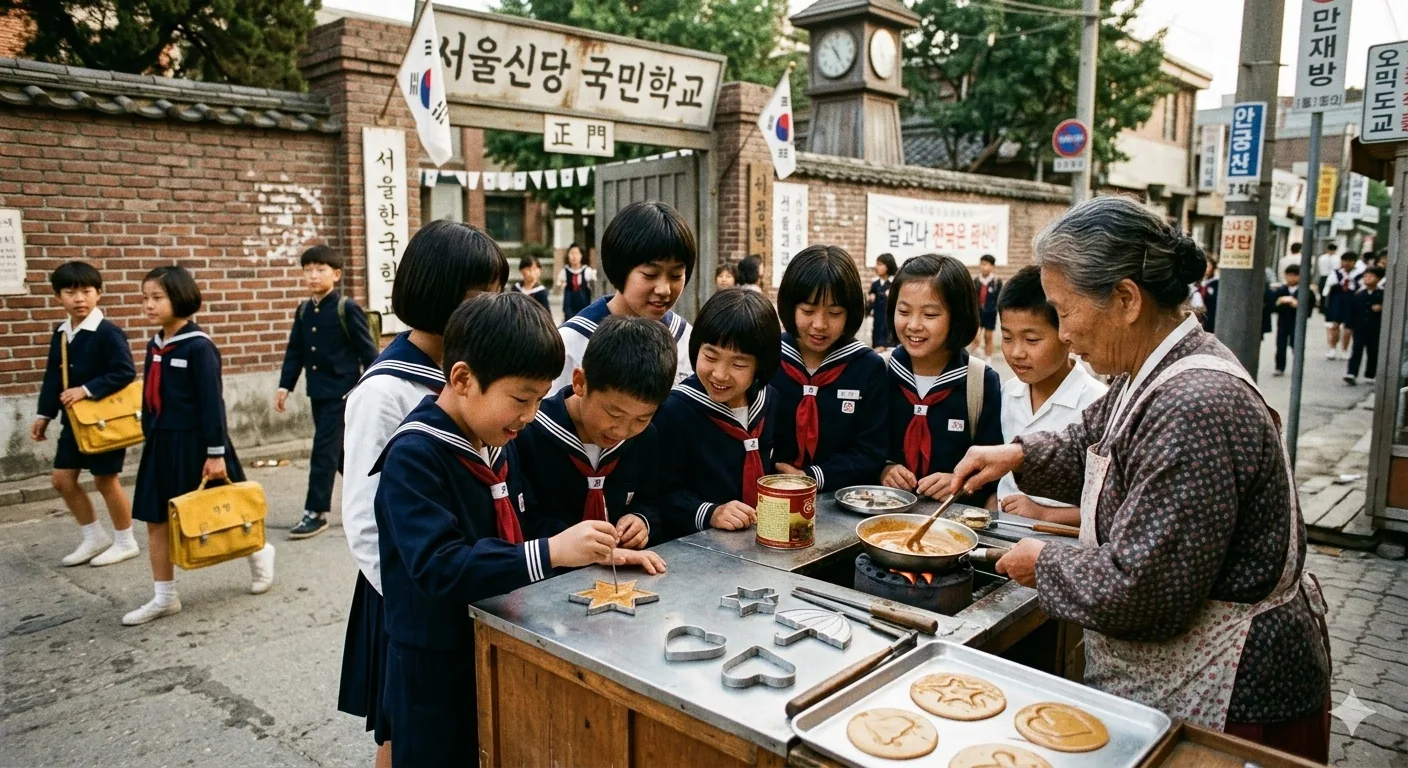
1930: a paper that asked for Japanese laver
The Encyclopedia of Korean Culture describes the modern cylindrical gimbap as Japanese rolled sushi (norimaki), introduced during the colonial period and adapted to Korean tastes. Modern newspapers record parts of that process. The Encyclopedia cites them, and this article did not check the original pages.
According to the Encyclopedia, a 1925 Chosun Ilbo article suggested riceballs, or gimbap made with crumbled laver mixed in, as a lunch for wonjok (遠足), a school outing. A 1930 Dong-A Ilbo recipe for “gimssambap” was much more specific. It stressed using Asakusa-nori (浅草海苔), a thick Japanese laver. Korean laver, it said, was thin and not well suited to rolling, so anyone who wanted to use it should layer two sheets. (The date of this article and its exact wording have not been checked against the newspaper itself.)
In 1930 a newspaper recipe preferred Japanese laver and said Korean laver needed doubling to roll. Ninety-odd years later, laver is Korea’s top seafood export.
1939 and 1946: two different choices
In 1939 the Chosun Ilbo ran a piece by Hong Seon-pyo (洪善杓), author of Joseon Yorihak (Korean Cooking). It said gimbap rolled with Korean laver, stored well in season, and filled with rice, jangjorim (soy-braised beef) and kimchi made an ideal packed lunch. Nine years apart, the recommended laver had changed. Two articles are not enough to say Japanese laver fell out of use. The sources confirm only that the 1930 and 1939 pieces recommended different laver.
The next clearer point is 1946, the year after liberation. The home economics department of Gyeongseong Women’s Normal College published a cookbook, Joseon Gajeong Yori (Korean Home Cooking). (What kind of book it was and who wrote which parts have not been confirmed.)
Under the heading “wonjok deungsan-yong jeomsim” (遠足登山用點心), lunches for outings and hiking, the book lists gimbap as “rolled rice.” According to the passage the Encyclopedia of Korean Culture quotes, the authors added a note beside the recipe. They explained that the Japanese “sushi” filling seasoning (sok gami) used a lot of mirin (味淋) or rice wine, and that they left these out because they could not use them and also did not need to. (This is a paraphrase. The quotation has been checked only in the Encyclopedia, not in the original book.)
“Could not” can be read as a reference to postwar shortages, and “did not need to” as a statement about taste. That reading is an interpretation of the sentence. The authors do not say it. The note is about the mirin and rice wine used to season the filling, not about the vinegar seasoning of the rice. Recipes usually list what to put in. They rarely say what was left out, or why. This one does, for one recipe in one book. It should not be read as the moment Korean gimbap as a whole split from the Japanese style.
The same book also gives a version that swaps laver for a square egg sheet, rolled with the same fillings in the same way. Egg-wrapped gimbap is often treated as a new trend. A version of it already appears in the 1946 cookbook.
A dated record of changing fillings
These documentary examples are dated, so they can be put in order. The dates below mostly come from the Encyclopedia of Korean Culture’s “Gimbap” entry, which cites each source. They are a list of documented examples, not a standard timeline agreed by scholars, and many of the original newspapers and cookbooks behind them were not checked directly.
Danmuji and ham both first appear in gimbap in 1958 newspaper articles, which is the earliest known record, not necessarily the year they were first used. Danmuji itself was made in Korea from the 1920s. In 1955 there was an official push to replace the Japanese-derived word takuan with “danmuji,” though the Encyclopedia notes it was not widely followed.
Some fillings were pushed out. According to the Encyclopedia, fish soboro, white fish steamed and tinted red, gave way to ham made for gimbap, and a gimbap ham product came out in 1996. Bakgoji braised in soy sauce was replaced by braised burdock root. The Encyclopedia describes both swaps. How complete or nationwide they were has not been shown separately.
How the rice was seasoned is another example. The 1976 cookbook Gyejeol-gwa Siktak (Seasons and the Table, spring volume) by Yu Gye-wan still describes gimbap seasoned with vinegar water, according to the Encyclopedia. (The Encyclopedia gives the author’s name as Ryu Gye-wan. The RISS library catalog records it as 유계완 / 柳桂完.) One cookbook shows the vinegar method was still around in 1976. It cannot tell us when sesame oil and salt became the national norm.
In the 1990s, gimbap specialty shops and franchises appeared, and variety took over from replacement. Tuna, cheese, pork cutlet, kimchi, and “nude gimbap” with the rice rolled on the outside all appeared.
So gimbap is better described as a format that kept being tested, not a food that guarded one fixed recipe. The fillings, the seasoning and the shape changed across these periods. The long-roll-and-slice form, with rice spread on laver, rolled and cut, is the familiar standard, though smaller rolls eaten whole also exist.
1958: gimbap for many people at once
In the 1950s and 1960s more restaurants sold gimbap, and it appeared often enough in newspaper serial novels such as Eonjenga Geunal (Someday) and Je2-ui Cheongchun (A Second Youth) to count as an everyday food.
According to the Encyclopedia, a 1958 Chosun Ilbo article reported that the student section of the World University Service donated 60 cans of powdered milk and 120 servings of gimbap to flood victims. It is a documented example from 1958 of gimbap feeding a group of people rather than one person’s lunch. It does not show this was the first time gimbap was used that way.
The 1966 Yori Baekgwa (Cooking Encyclopedia) set out gimbap-making in nine photographed steps and included advice on choosing good laver. It should be fragrant, smooth and glossy jet-black, and sheets with holes or uneven thickness should be rejected.
Gimbap that went the other way: Chungmu gimbap
Not every change added fillings. One gimbap went the other way.
In Chungmu, the name Tongyeong in South Gyeongsang Province went by from 1955 to 1995, Chungmu gimbap is laver rolled around plain rice, eaten with spicy squid and radish kimchi on the side. The Encyclopedia of Korean Culture’s “Chungmu Gimbap” entry says it was generally created after liberation (1945) and records two oral accounts of how it began. A 2018 Yonhap News feature places it around the 1930s instead. The original evidence that would settle the date has not been checked, and the two accounts are left as they are.
The Encyclopedia lists its sources (including the 2018 Tongyeong Sisi, the Tongyeong city history), but it does not link individual sentences to them. The details below are what the entry reports, and they are presented as oral tradition, not settled history.
The first account is about fishing. On boats, it was hard to eat at set mealtimes, so fishermen packed gimbap. In summer, rolls with rice and side dishes inside often spoiled before they could be eaten, so the rice alone went into the laver and the side dishes were packed separately. The second is about ferry routes. Chungmu was a hub for boats to nearby islands and to Busan, and this gimbap was sold to passengers at the ferry terminal. Because it could be eaten on a boat without refrigeration, it was also called baetmeori gimbap (ship’s-bow gimbap). The names halmae gimbap (grandma’s gimbap) and kkochi gimbap (skewer gimbap) are recorded as well.
The two accounts differ, but both say the filling was removed to stop it from spoiling in summer.
The entry also describes Chungmu gimbap in the past as “plentiful, cheap and rough.” Fishing was heavy labor, so there were more side dishes than gimbap. After it was presented at the 1981 festival Gukpung 81 and became known nationwide, the entry says, portions got smaller and prices went up as it moved upmarket.
After Gukpung 81 brought it nationwide attention, the entry says, Chungmu gimbap got smaller and more expensive. The Encyclopedia reports these changes in size and price but does not say what caused them.
The drama and the history
Extraordinary Attorney Woo is not a period drama, so there is nothing to fact-check. One point is worth making, though. In the scenes cited here, gimbap works as a fixed reference point for Woo Young-woo. The documented gimbap changed its laver, fillings and seasoning at several points. The drama’s gimbap feels reassuring not because gimbap is an old, unchanging food, but because one cut shows everything inside.
What it means economically
The Ministry of Oceans and Fisheries announced in December 2023 that laver exports had passed 1 trillion won for the first time, at about $770 million. That was the running total when the mark was reached, and it was the highest ever for a single seafood item. The ministry later gave the full-year 2023 figure as about $790 million.
Its December 2023 announcement said laver was exported to 124 countries, up from 64 in 2010. A November 2024 release gave 122 countries for 2023. The reason for the difference has not been confirmed.
In January 2026 the ministry announced that 2025 laver exports reached $1.13 billion, up 13.7% from the year before. That was another record, and laver stayed the top seafood export.
Frozen gimbap is reported separately from those laver figures. Agriculture ministry materials treat it as a processed-rice product within agri-food exports, so the two headline export numbers measure different categories and should not be added together. How the laver inside each roll is classified across every trade statistic was not confirmed.
Frozen gimbap is made in a factory, rolled and then frozen. Gimbap spoils easily at room temperature, and freezing has changed how it can be stored and shipped. It now crosses borders as a frozen product.
Chungmu gimbap dealt with summer spoilage by removing the filling. Frozen gimbap deals with it by freezing the filling in place. They are two different answers to the same problem.
A piece of folklore: eating rice sacks
Bokssam came with something close to a game. According to a gimbap feature in the monthly webzine of the Cultural Heritage Administration (now the Korea Heritage Service), people believed that eating a lot of laver-wrapped bokssam meant harvesting a lot of rice sacks. After breakfast on the first full moon, they would go out and boast, “I ate the most rice sacks, so my harvest will be the best this year.” In parts of Chungcheong Province, the article says, this was called “gim ssaseo meokgi” (eating it wrapped in laver) or “byeotseom kkeuraengi ssameokgi” (wrapping and eating the rice-sack ends).
This is a regional tradition taken from a government agency webzine. Neither the full article nor the original folklore sources were checked directly. One guess is that for people whose whole year depended on the harvest, that first mouthful of the year felt big enough for a story like this to last.
Around the world: what do you wrap it in?
Japan: norimaki. The closest comparison, and the starting point according to the Encyclopedia. Rice seasoned with vinegar, sugar and salt is rolled in laver. The 1946 Korean cookbook’s note was about leaving out the mirin and rice wine used for the filling seasoning, not about this rice seasoning.
The Middle East and the Mediterranean: dolma. Britannica describes dolma as a range of stuffed-vegetable dishes in Middle Eastern and Greek cooking, especially young grape leaves filled with rice, onion and often minced lamb, flavored with lemon. That grape-leaf type is another rolled rice dish, with one key difference: that dolma is rolled and then cooked, while gimbap is rolled and sliced as it is.
Mexico: the burrito. Britannica describes the burrito as a cylinder of tortilla wrapped around meat, cheese, beans and vegetables, and says it is thought to have come from Sonora in Mexico, where wheat and cattle ranching dominated the farm economy.
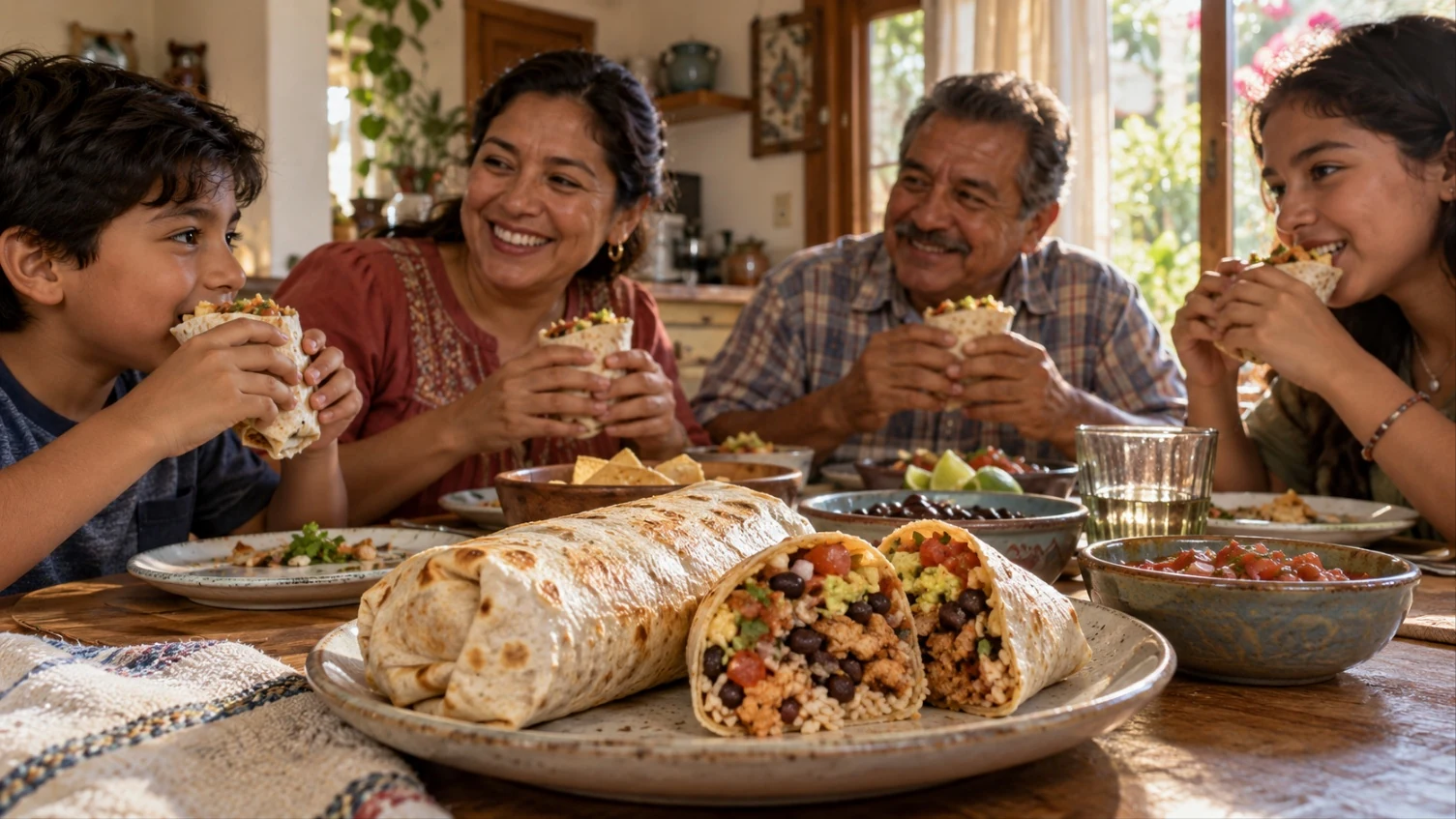 The burrito wraps its filling in a wheat tortilla; gimbap wraps it in laver. (AI illustration)
Korea: gimbap. Korea’s wrapper came from the sea. Laver was listed as a coastal product in Joseon geographies, and dried in thin sheets it becomes a kind of paper. Of the three, gimbap is the one usually sliced before serving, though small rolls eaten whole also exist. Slicing also makes a long roll easy to pack and share.
Back to Woo Young-woo
When Woo Young-woo stands her gimbap on end and lines it up, she is checking that everything is in order. The cross-section she checks is a list that was rewritten several times. The 1930 article asked for Japanese laver. The 1939 article recommended Korean laver. The 1946 cookbook left the mirin out. Danmuji and ham first appear in 1958 articles. The 1976 cookbook still used vinegar. A ham made for gimbap came out in 1996.
If that cross-section looks settled now, it isn’t because it never changed. It is today’s familiar combination, taking shape over that century and still changing, as the 1990s shop menus and today’s frozen exports show.
Gimbap became a Korean food less through a single origin than through the people who, decade after decade, decided what to put in and what to leave out.
This article was researched and written by K-Drama History. Source: Why Does Woo Young-woo Trust Gimbap? The Changing History of Korea's Roll — K-Drama History